
Are conservatives entitled to vigorous legal defense in America? Or should they be condemned to second-class status in civil society and court, rendered bereft of advice and counsel because capable lawyers abandon the field, fearing ruin should they represent the right?
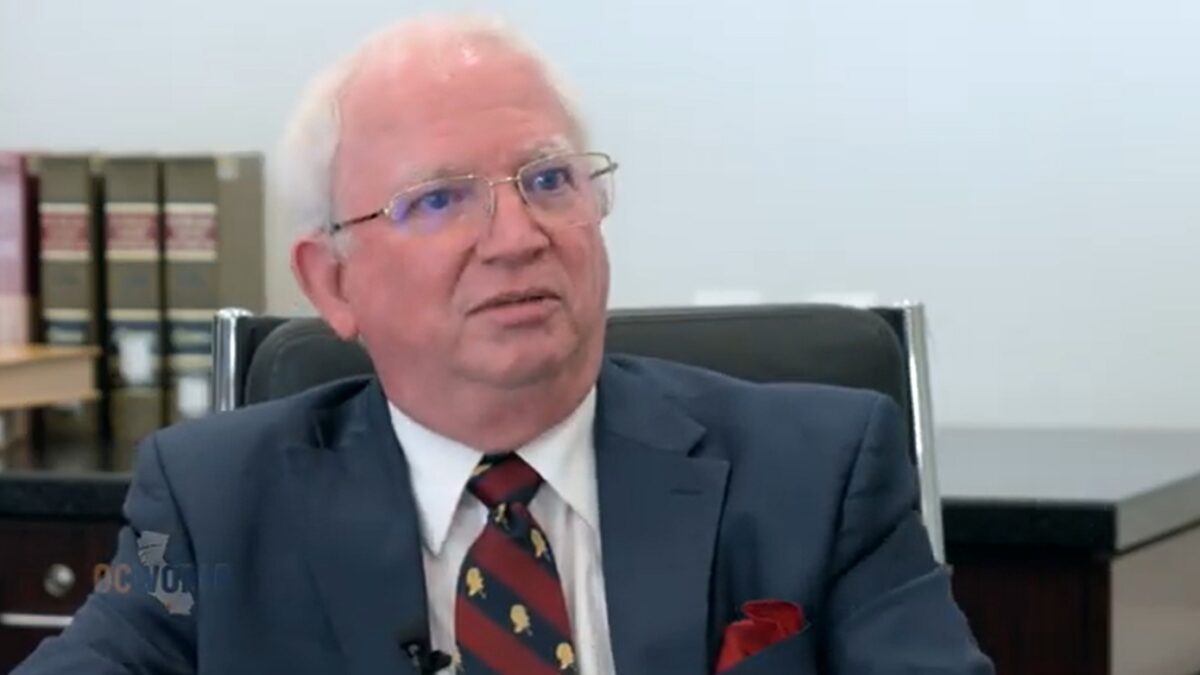
In a tyrannical travesty of “justice,” California appears to be trying to usher in the latter, dystopic world by disbarring constitutional scholar John Eastman. The Golden State’s Supreme Court blessed this position when, on April 15, it denied the conservative lawyer’s petition for review of the state bar’s yearslong disciplinary jihad against him and ordered him stripped of his license to practice law.
What was the nefarious behavior that this former Supreme Court clerk, university law school dean, and public interest litigator allegedly engaged in? Effectively, in the eyes of the bar and California’s highest court, his thoughtcrime, punishable with professional destruction, was “lawyering for MAGA.”
Eastman faithfully represented President Donald Trump and his campaign in connection with his 2020 election challenge and vigorously advocated for the president’s positions in the court of law and public opinion. The attorney compiled substantial evidence that the election was marked with fraud and irregularities, and that non-legislative officials had effectively made new election law, further delegitimizing the contest. He evaluated alternatives on behalf of the president for remedying those deficiencies through a careful study of legal history, theory, and precedent. And he presented them to the president’s team, drafted court filings in defense of the president’s positions, and argued for the president’s positions in media and before the president’s supporters.
California’s Claims
California, apparently working hand-in-glove with a prominent lawfare co-conspirator, transformed these actions into a sinister plot to steal the 2020 election. The caper appears to have been instigated by the States United Democracy Center, a key cog in Trump resistance efforts led by Norm Eisen. It filed a complaint with the state bar against Eastman in October 2021, alleging his work in connection with the president’s 2020 election challenge constituted professional misconduct.
Months later, in January 2023, the bar responded, issuing an 11-count set of disciplinary charges against Eastman for “engag[ing] in a course of conduct to plan, promote, and assist then-President Trump in executing a strategy, unsupported by facts or law, to overturn the legitimate results of the 2020 presidential election by obstructing the count of electoral votes of certain states.” Specifically, the bar hit Eastman with offenses including conspiracy to defraud the U.S., misleading the courts, and “moral turpitude” — offenses, incidentally, of which Eastman was never convicted, nor over which he ever faced legal sanctions in an actual court.
The bar sought to punish Eastman for everything from statements made about the alleged corruption of the election on a podcast, to court filings reprising arguments made by state attorneys general. But in an analogue to the Washington, D.C., bar disciplinary case brought against the first Trump administration’s Justice Department official Jeffrey Clark, previously detailed at The Federalist, the heart of the case centered on internal memos Eastman drafted laying out how best to resolve outstanding election issues in contested states, and Eastman’s conversations with Trump confidantes and administration officials about those approaches.
Eastman’s Solid Scholarship
Perhaps most grievously in the Golden State’s eyes, Eastman indicated in one memo solicited by the Trump campaign that there was “very solid legal authority and historical precedent” suggesting that the 12th Amendment trumped the potentially unconstitutional Electoral Count Act of 1887, rendering the vice president solely responsible for counting the votes “including the resolution of disputed electoral votes” during the January 6 congressional session.
The memo detailing that theory laid out a “most aggressive” scenario, in which, with dueling slates of electors in seven states, then-Vice President Mike Pence could either count electors solely in non-disputed states or punt the contest to the House — likely leading to President Trump prevailing. A second internal memo illustrated a series of other scenarios, “War Gaming the Alternatives” the vice president could pursue. Eastman would recommend, directly and through his subordinates, that Pence take the option of delaying the counting of electoral votes and permitting contested states to call emergency sessions to resolve disputes over the election and its outcome.
Eastman addressed these open and hugely consequential questions in the heat of an unprecedented election with appropriate caveats, citing substantial evidence and scholarship, and on a good faith, reasonable, and reasoned basis in dutiful support of his client. He believed he had an obligation to produce such work. And he believed that the First Amendment protected it. That Congress would later see fit to modify the Electoral Count Act in 2022 because of its ambiguity, including regarding the vice president’s role in counting the electoral votes, would only vindicate Eastman’s analysis. And how could America have a justice system if lawyers could not hypothesize about and take positions on unresolved legal questions?
That Eastman’s analysis was tenable was the only thing necessary to drive a stake through the heart of the bar’s case. Yet the disciplinary authorities were unswayed, ignoring facts, evidence, logic, and precedent in a case seemingly rigged against Eastman from complaint to conviction.
Kangaroo Court
The kangaroo state bar court would subject the attorney to a grueling, 34-day, 10-week trial at massive expense, perhaps the longest and most expensive such proceeding in U.S. history.
Eastman’s legal team indicated in filings that the trial occurred before a judge drawn from a five-judge panel consisting of all registered Democrats, three of whom, including the presiding judge, had either made campaign contributions to the Democratic Congressional Campaign Committee or to Joe Biden in the 2020 election. Likewise, the bar’s prosecutors were all registered Democrats. Eastman’s team would argue his case came before adjudicators who were not impartial, to no avail.
During the case, Eastman alleged that he faced other potential due process violations. He was, for example, prevented from compelling numerous key out-of-state witnesses to testify, despite all the alleged misconduct occurring in other states. He also argued that his team faced a double standard with respect to evidence, with the prosecution favored on what could be submitted or excluded and the unjustified exclusion of nearly all of his expert witnesses. Those witnesses also faced harassment, according to Eastman.
What’s more, Eastman claimed he was held to an unsupported legal standard, with case law indicating that in bar disciplinary proceedings, the prosecution must show “clear and convincing evidence” of culpability. Despite reasonable doubts in Eastman’s case, he argued, the bar disciplinary authorities repeatedly found him culpable.
Eastman would be charged on 10 of the 11 counts facing him and recommended for disbarment. The recommendation would survive appeal all the way up to the California Supreme Court, which has just refused to even entertain Eastman’s challenge.
The ruling concluded an apparent yearslong conspiracy to crush Eastman. Despite the evil efforts of the January 6 Committee, Biden Justice Department, and corrupt state and local prosecutors, they had heretofore failed to draw blood. Well, save for the massive legal bills, threats to his life and home, de-banking, trashing of his reputation, diversion from his life’s work, and the associated stress and humiliation that he had suffered.
Eastman, an eminent attorney, and to anyone who has ever met him, a self-evidently decent person and patriot, has vowed to take this fight to the Supreme Court. While he will do so in defense of the First Amendment and due process rights, he will also be defending an even more fundamental ideal. As I have detailed in reporting at RealClearInvestigations, the tactic of Barfare that he has faced is in practice more than just a nefarious effort to destroy conservative lawyers and chill would-be defenders of conservative causes and figures. It is at core a tyrannical assault on America’s adversarial system of justice.
He is, in short, fighting for the rule of law itself.
The Supreme Court must overturn the Golden State’s abominable decision. Otherwise, it will turn one man’s travesty into a tragedy for all of America.