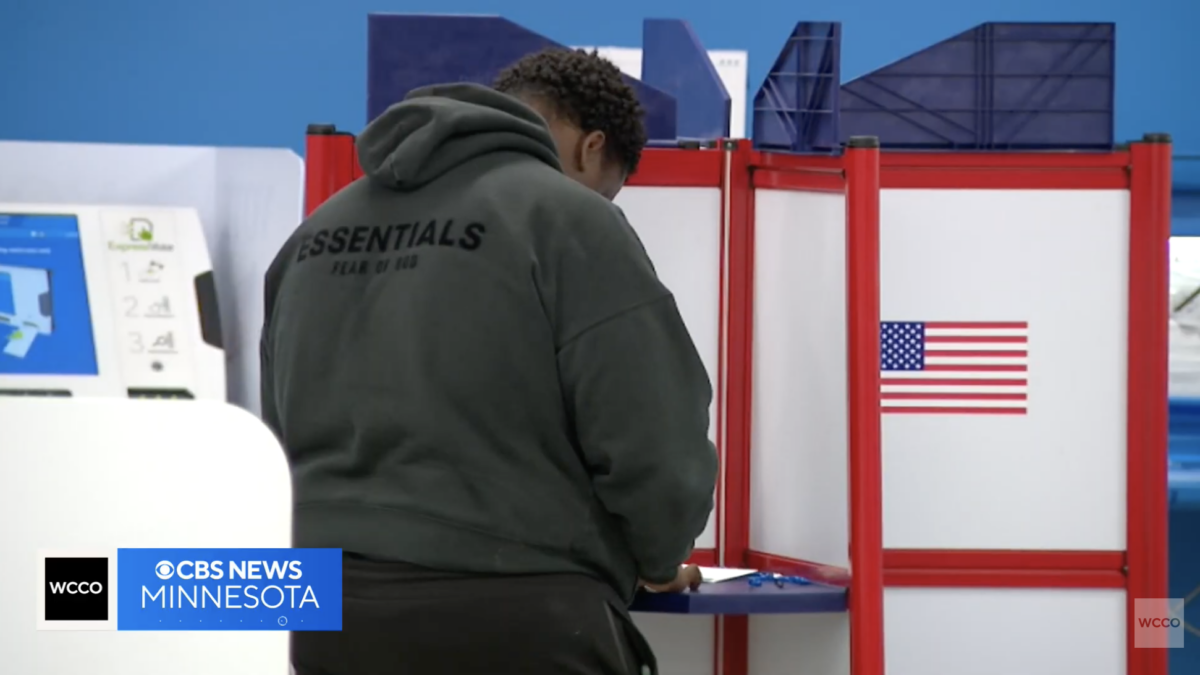

Minnesota’s leftist Secretary of State wants Congress to know that his Midwest state has “one of the most secure and accurate voter registration systems in the state.”
That boast likely will be put to the test when Steve Simon appears before the House Administration Committee Thursday morning. Surely Simon will be asked to explain how a 39-year-old noncitizen in Minnesota registered and voted in the 2024 election. But wait, there’s more … a lot more.
In a blue state led by ICE-hating radicals, Simon has placed politics over integrity, a common theme among Democrats fighting tooth and nail against the SAVE America Act and other measures to block foreign nationals from voting in U.S. elections.
The Administration Committee Hearing, set to begin at 10:15 a.m. Swamp Time, is titled “Oversight with Secretaries of State: List Maintenance and Eligibility Verification.” Congressional sources say the committee will hear a tale of two secretaries of state — from Minnesota and Kansas. One who has eschewed common-sense election integrity reforms, another who has warmly embraced them. And, yes, blue vs. red has much to do with the starkly different approaches.
Committee Chairman Bryan Steil, R-Wis., in January sent letters to the elections officials asking them how the they conducted voter-roll cleanup in compliance with federal voting and elections law. States are required to maintain current voter registration lists, remove ineligible registrants, and provide the lists to the public.
Kansas Secretary of State Scott Schwab, a Republican who is running for governor, and Minnesota’s SOS, will testify at the hearing.
‘Every Method and Data Source’
In his response to Steil’s January letter, Schwab thanked the chairman for the opportunity to provide information on his state’s voter-roll maintenance procedures. He said his office “relentlessly employs every method and data source authorized by the state legislature to maintain accurate voter rolls,” and included a long list.
The Kansas Secretary of State’s office also uses the registration vetting tools provided by the Trump administration, including the Systematic Alien Verification Entitlements (SAVE) program. Administered by U.S. Citizenship and Immigration Services, the online system, allows governmental agencies to verify U.S citizenship.
Kansas was among the first states to employ the SAVE database. Schwab said his office, for the first time in nearly a decade, was able to cross-index Kansas voter rolls with the Social Security death index
“As a result, more than 5,500 deceased voters have already been canceled, after verifying through other means that they were deceased,” Schwab wrote. The same matching system helps identify potential noncitizens on voter rolls.
The small southern Kansas town of Coldwater made national headlines in December when its mayor was charged with election fraud. Jose Ceballos, was arrested one day after winning a second term. According to the Department of Homeland Security, the alien from Mexico voted in “numerous” U.S. elections — a felony. He was charged with three counts of voting without being qualified and three counts of election perjury.
Schwab explained that the election integrity breach was an example of “an individual who had registered to vote before the advent of a centralized voter database with standardized procedures and verification screening.”
“His name was flagged by both the SAVE program and the state’s temporary driver’s license report, both tools became available only in late 2025. Criminal charges were promptly brought for registering and voting as a noncitizen,” the secretary wrote.
‘Only Limited Value’
Minnesota election officials, on the other hand, have thumbed their noses at the SAVE system — and Trump’s Department of Justice. Simon, in his response to Steil, claimed that the citizenship-vetting program “provides only limited value” to the Minnesota Office of Secretary of State. He said the majority of people who register to vote in the state use their driver’s licenses or state identification numbers, not their Social Security Number.
Those lacking such ID, however, must provide the last four digits of their Social Security number, Simon explained. If they don’t have a Social Security number, they “must submit a certification to that effect.” It sounds like a faulty election integrity lullaby. Ultimately, the state’s “failsafe” is the dubious honor system in which all applicants must check a box attesting that they meet all requirements for voter eligibility — including U.S. citizenship.
Moreover, Simon noted, he and his leftist band of Trump Derangement Syndrome sufferers don’t trust the “reliability and security” of the SAVE program.
Minnesota relies on a lot of monthly reports to monitor its voter rolls, Simon wrote. Among them the controversial Electronic Registration Information Center (ERIC) system launched and run by liberal activists and abandoned by several states. For reasons that long ago stopped making sense, the Gopher State need not comply with the National Voter Registration Act. It’s exempt.
In 2023, the Democrat-controlled Minnesota State Legislature passed a bill that mandates automatic voter registration for individuals applying for and updating drivers’ licenses.
A month before the 2024 presidential election in which Minnesota’s fraud scandal-immersed governor ran as vice president on the doomed Harris/Walz ticket, Steil and Rep. Tom Emmer, R-Minn., demanded answers from Simon following a report of some 1,000 voter registration applicants flagged for failing to provide proper documentation.
The Secretary of State called it a “glitch.” Simon told Republicans at the time that state officials “made changes to the system” following the “potentially problematic registrations,” the Associated Press reported.
Steil told Alpha News at the time that the “troubling circumstance does not inspire that confidence.”
“As we rapidly approach Election Day, Americans deserve confidence that Minnesota has the right procedures in place to prevent noncitizen voting,” the Administration Committee chairman said.
Now, the thing that many a liberal Minnesota politician says never happens, appears to have happened in Minnesota. As Fox 9 Minneapolis reported, Mukeshkumar Somabhai Chaudhari, 39, was charged with a voting violation and lying about it after he allegedly cast a ballot in the 2024 election.
Interestingly, investigators assert the noncitizen was sent a voter registration notice apparently after getting his driver’s license in Minnesota. Simon’s office told Fox News all about the honor system, the attesting of eligibility on the voter registration form, and the attesting before voting.
“If a noncitizen attempts to vote in an election, they will be caught and held to account,” the Secretary of State’s office declared. “Penalties for voting while ineligible may include deportation, a permanent bar on future citizenship, a fine of up to $10,000, and up to five years in prison.”
‘For American Citizens Only
There is no certainty that noncitizens “will be caught and held to account.” Even if they are, their vote still counts — a vote that disenfranchises eligible voters.
Last month, CBS News reported that Simon’s office received a “grand jury subpoena ordering it to turn over certain individual voter records, as part of a federal investigation into whether non-citizens are registered or have unlawfully cast ballots.” Sources told the corporate news outlet that investigators were looking into records involving north of 125 individuals.
Unlike Kansas, Minnesota has no interest in showing its work.
Minnesota is one of several blue states that has refused to turn over voter rolls to the Department of Homeland Security as the agency investigates whether elections officials are complying with federal election laws, particularly provisions on accurate voter rolls. Democrats say they object in part on privacy grounds, but many of the states sell the records to the general public, including campaigns.
It begs an understandable question: Do these states have something to hide? The House Administration Committee seeks to find out.
“I will continue to seek answers on how frequently this happens and what states are doing to address the issue. American elections are for American citizens only,” Steil told Fox News Digital earlier this year.