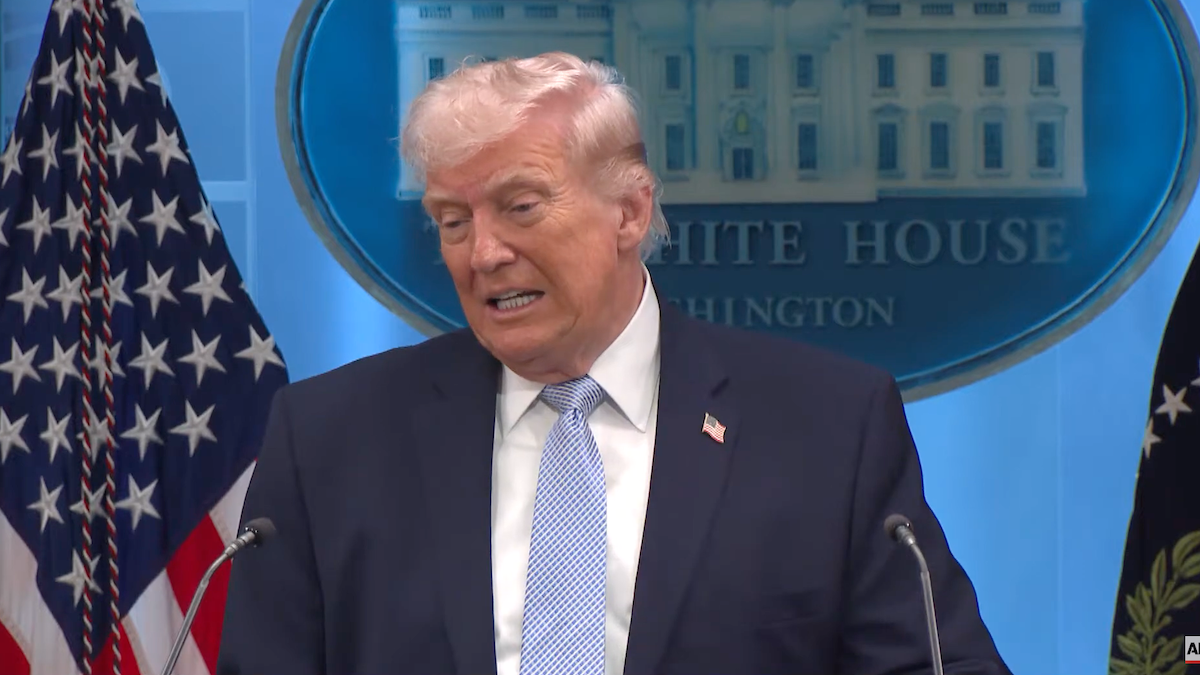

After threatening the death of “a whole civilization” on Tuesday morning, President Donald Trump announced a two-week, “double-sided” ceasefire with Iran Tuesday evening, pending the immediate opening of the Strait of Hormuz.
The annihilation of Iran, it seems, was averted by a last-minute deal brokered by Pakistan. In his announcement of the ceasefire, Trump said Pakistan “requested that I hold off the destructive force being sent tonight to Iran.”
What’s going on? Did Trump really call off some devastating (possibly nuclear) strike because of a deal that only came through 90 minutes before the White House deadline? Maybe. Was the deal already in the bag before Trump made his hyperbolic threat that “a whole civilization will die tonight?” Possibly. And what about the 10-point proposal Trump said he received from Iran, which he called “a workable basis on which to negotiate?” The details of an Iranian proposal, which include things like reparations for Iran, Iranian control of the strait, and the lifting of all sanctions, have been public for days. Is that the proposal Trump was referring to on Tuesday evening, or is it something else? Who knows.
What does seem clear amid the fog of war, however, is that Trump’s maximalist, annihilationist rhetoric — talk of destroying Iranian “civilization,” “never to be brought back again,” taking out “the entire country,” bombing it “into the stone age,” targeting critical civilian infrastructure like power plants — has already gravely damaged the United States.
Why? Because America should only wage just wars, and waging a just war means being subject to certain restraints. Just war precludes immoral means — like the mass killing of civilians — to achieve victory. Even threatening such means, as Trump has done, damages the moral conscience of a people as much as it degrades the moral standing of a nation. Simply put, threatening to do something intrinsically immoral, even if you don’t actually do it, is wrong.
This is especially true in times of war, when a certain level of deception is licit and sometimes necessary. Trump’s defenders will retreat to this point, saying he is simply employing maximalist rhetoric as a negotiating tactic, acting crazy to intimidate the Iranians, tossing out empty threats. But if these are such transparently empty threats, the Iranians probably know that too. As Oren Cass noted on X, “We are not living in some quantum thought experiment where he simultaneously is and is not serious. We cannot expect the Iranians, but only the Iranians, will believe him.”
The utility of Trump’s rhetoric, however, is beside the point. Making war directly on the Iranian people could never be morally justified. Whatever our reasons for going to war against Iran (and those reasons seem to change by the week) the intentional targeting of civilians would render our cause manifestly unjust.
To be clear, these are not arbitrary assertions. They follow from just war theory or doctrine, which was developed primarily by the Catholic Church over many centuries, a long tradition of moral reflection on war and lethal force meant to guide the conduct of states and empires in times of martial conflict.
Catholic just war doctrine is generally divided into two categories, jus ad bellum (the right to war) and jus in bello (right conduct in war). The first category stipulates that the first condition for a just war is that you must have a just cause, such as defense of the national homeland or the protection of innocent life. It also stipulates that a nation must have the right intention, meaning the object of the war must be peace and justice, not vengeance or domination.
The second category, right conduct in war, requires distinguishing between combatants and non-combatants, prohibiting direct targeting of the latter, proportionality, and so on. Obviously, Iran has failed to meet these requirements by launching missile attacks on civilian areas in Israel and the Persian Gulf, to say nothing of the regime’s targeting of their own civilians in the run-up to the war.
That said, what should most concern Americans in this war is not the conduct of Iran’s leaders but the conduct of our own. Pope Leo, who has been a vocal critic of the war, spoke with moral clarity and authority on Tuesday when he said, “This is truly not acceptable. Here there are certainly questions of international law, but even more than this a question of morality for the good of people … attacks on civilian infrastructure are against international law, but it is also a sign of the hatred and division and destruction that human beings are capable of.”
Amid the tumult of world events in recent days, the pope’s words stand out in part because they offer such a contrast to the naked bloodlust and rumblings of annihilation coming from the Trump administration. Whatever happens, we cannot lose sight of the moral dimension here. In both word and deed, if we do not hold ourselves to a high moral standard then we risk, in a very real sense, becoming the villains in an unjust war.