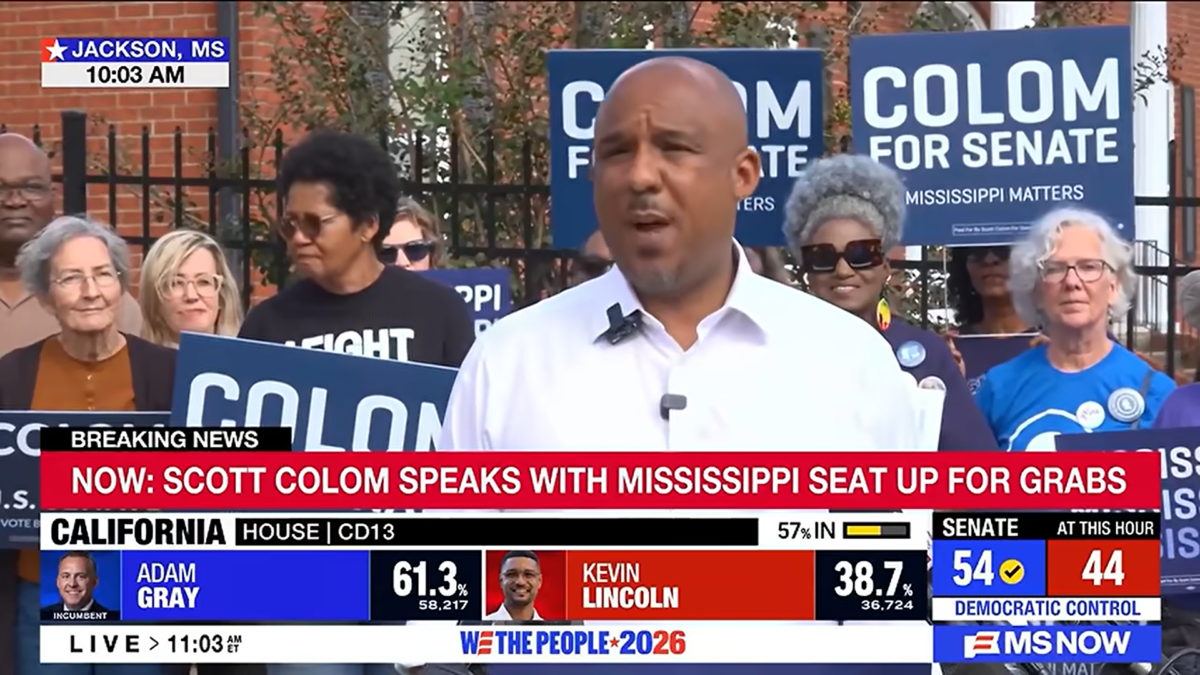

Tuesday night saw a lot of upsets for Republicans. Usual Republican stalwarts like South Carolina and Texas went blue. Democrats strengthened their grip on North Carolina, and they dragged Iowa and Ohio back into purple state territory. But while those races garnered national attention before Election Day, the most surprising upset of the night flew completely under just about everyone’s radar.
The Mississippi Senate race still hasn’t been called, but it’s not looking good for Republican incumbent Cindy Hyde-Smith. Scott Colom, a district attorney who was nominated by President Joe Biden for a position as a district judge in northern Mississippi in 2022, leads by roughly 1,800 votes with 96 percent of votes counted at the time of this writing. The remaining votes to come are heavily concentrated in either heavily Democrat areas around Jackson or in counties that have swung considerably toward Democrats this election.
Even if by some Mississippi miracle Hyde-Smith pulls out a win at the 11th hour, the usually solid red state was far too close for comfort, and the fact that a usual Republican stronghold was this close (with an incumbent running, no less) does not bode well for 2028.
Losing Mississippi was the most unthinkable of the unthinkable outcomes that unfolded Tuesday night. So how did this happen? The reasons for Hyde-Smith’s probable defeat are almost certainly the same reasons that toppled many other Republican candidates on Tuesday night: the Iran War, high gas prices, and dissatisfaction that the Republican-controlled Congress seems allergic to doing anything productive. Colom also benefited from a series of well-produced ads that hammered all of these points.
While the aforementioned reasons probably explain Mississippi’s general swing to the left, the closeness of the race means that another factor was vitally important to the Magnolia State’s flip: demographic change. In fact, the dramatic demographic change in a single county can explain Mississippi’s flip.
DeSoto County, my home county located in northern Mississippi, voted Democrat in a Senate race for the first time since 1982, when it voted for segregationist John C. Stennis. Since then, it has been one of many conservative strongholds in the state, reliably voting for the Republican by comfortable margins. It helps that DeSoto County is the third most populous county in the state, providing a nice little reservoir of votes for the GOP.
But that changed on Election Day. DeSoto voted for Colom 52-46 with 96 percent of votes counted. In raw votes, Colom leads Hyde-Smith by about 3,300 in the county. With only a 1,800-vote gap between Hyde-Smith and Colom, DeSoto County can be accurately described as the tipping point county in this election.
Something curious has been happening to DeSoto County over the last 26 years. Curious, but not uncommon on the national stage. In the year 2000, DeSoto County’s demographics looked like this: 84.7 percent white, 11.3 percent African American, 0.6 percent Asian, 0.6 percent mixed, and 2.35 percent Hispanic.
Fast forward 20 years, and the demographics have undergone a radical change: 52.2 percent white, 36.5 percent African American, 2 percent Asian, 3.4 percent mixed, and 6.5 percent Hispanic.
The explosion in the African American population can be explained by flight from the absolutely disastrous policies by neighboring Memphis Democrats that have rendered that city, up until recently thanks to President Trump’s intervention, a lawless hellhole. The tripling of the Hispanic population can almost certainly be attributed to the country’s generally open borders policy over the last couple of decades. Note also that the most recent Hispanic percentage is from 2020 — before President Joe Biden’s unprecedented mass invasion of illegal aliens.
African Americans and Hispanics overwhelmingly vote Democrat in most elections. In raw numbers, Hispanics increased from a little over 2,500 in 2000 to more than 10,000 in 2020 (and likely many more by 2026). It’s safe to estimate that there were enough Hispanics alone in DeSoto County who voted Democrat on Tuesday to create the 1,800-vote lead for Colom.
The overall demographics of the state remain relatively stable. The percentage of white population has only decreased about eight points since 1980, while the black percentage has largely remained stable. Mississippi overall counts more than 100,000 Hispanics in its population — more than enough to tip the balance given Hispanics’ usual tendency to vote Democrat.
In the grand scheme of things, Mississippi has not experienced a demographic change as dramatic as, say, Texas has, but Tuesday night shows that even a small demographic change can have major consequences for elections and the policies that result from them. As we at The Federalist have pointed out time after time in our election fraud coverage, it does not take much to decisively change a state’s, or a country’s, demographics to affect an important election.
Importing thousands of foreigners very likely flipped the Mississippi Senate race from a slim Republican victory to a razor-thin Democrat gain. Likewise, allowing Democrats to run major cities into the ground and turn them into crime-infested cesspits has caused major migrations that have helped tip typically red states blue.
I never thought that I would see my home state, much less my home county, go blue. It’s hard to overstate how much of a Republican stronghold Mississippi was and how monumental a defeat this is. The reason you didn’t hear about the Mississippi race until election night was that everyone took for granted that Mississippi is a red state. Republicans can’t do that anymore. We’ll have to claw back that seat in six years, meaning we have to divert energy and resources to what should have been a safe seat rather than to a truly competitive one elsewhere.
The defeat in Mississippi is largely a tale of changing demographics — demographics that don’t favor the Republican Party. Decades of ignoring the immigration and crime crises have led to this, and now we’re paying for it at the ballot box. The more than 65,000 Hispanics who have been added to Mississippi’s population since 2000 were more than enough to swing the race in Democrats’ favor. Now think of states where the demographic change has been even more dramatic, like Texas or North Carolina, and you begin to understand the true threat that Republicans face in future elections.
The demographic shift in Mississippi may have been relatively small compared to other states and the overall national trend, but it nevertheless proved decisive in this election. If decisive action is not taken by the present administration, then it will continue to prove decisive in future elections, invariably to the detriment of the Republican Party and to America as a whole.