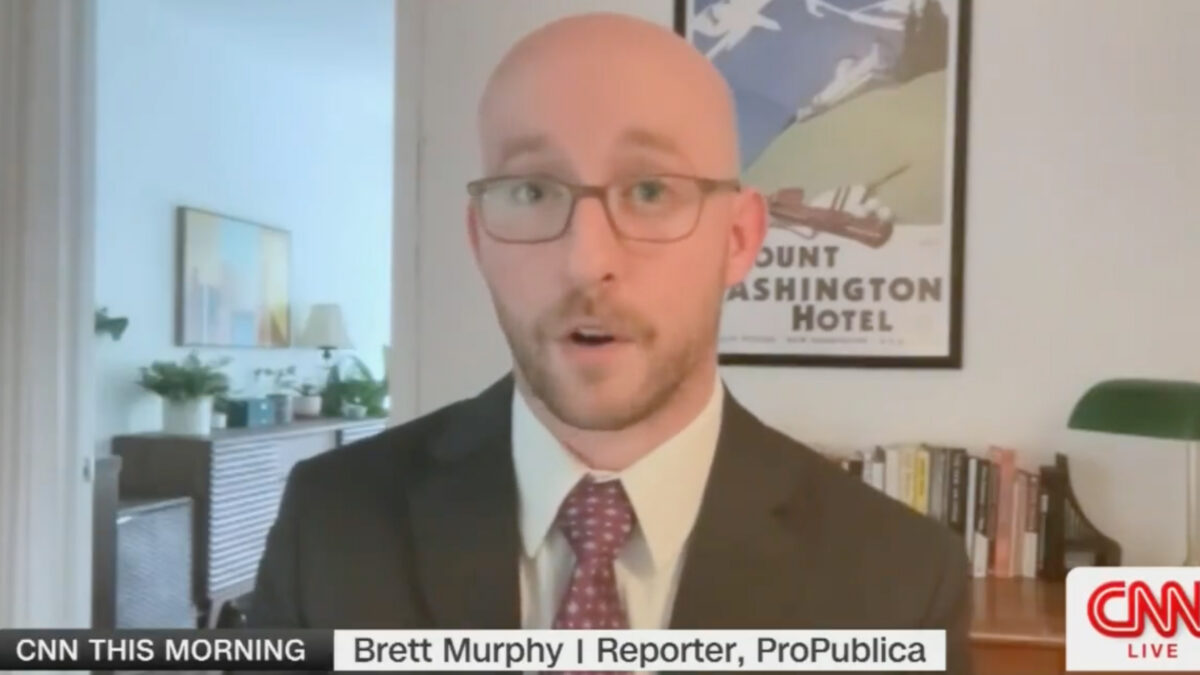

In 2022, a ProPublica reporter named Brett Murphy reported that he had penetrated deep into a secret world, uncovering a covert police tactic that a retired police officer named Tracy Harpster was fighting to hide. That ex-cop, he wrote, “has traveled the country quietly sowing his methods into the justice system case by case, city by city,” and a bunch of police agencies “have bought into the obscure program.”
Over and over again, in paragraph after paragraph, Murphy described just how deeply hidden the target of his investigation had been:
“The program has little online presence.”
“I followed the paper trail Harpster left as he traveled the country, working law enforcement’s back channels.”
“Outside of law enforcement circles, Harpster is elusive. He tries to keep his methods secret and doesn’t let outsiders sit in on his classes or look at his data.”
The first of many problems with ProPublica’s dramatic description of this covert law enforcement program is that Tracy Harpster is the co-author of a 340-page criminal justice textbook, published in 2017, that describes his supposedly secret, hidden, elusive, deliberately obscure methods in depth, with page after page of practical examples. You can buy that book on Amazon. The hardcover edition comes with two-day shipping, and the Kindle edition is available for immediate download.
So the secret program that ProPublica penetrated with a long and aggressive piece of investigative journalism is available to you online for the price of a book, instantly.
Last week, I asked Murphy and ProPublica a long series of questions about their investigation of Harpster, and this was the last question I asked them: “How is it possible to say that a man who published a publicly available, openly sold book about his methods is trying to ‘keep his methods secret?’ Can you explain that description?”
ProPublica’s response arrived by email this week, in the form of an email message from Associate Director of Communications Alissandra Calderon. Her answer about the book is a long one, and I’ll quote it in full to show how little it even tries to address the question:
That is addressed in the story. Here is what we reported: “Outside of law enforcement circles, Harpster is elusive. He tries to keep his methods secret and doesn’t let outsiders sit in on his classes or look at his data. ‘The more civilians who know about it,’ he told me once, ‘the more who will try to get away with murder.’”
And again: “I asked to sit in on one of his classes. No, he said, that’s out of the question. They’re only for law enforcement. During the height of the pandemic, Harpster told police he didn’t want to host virtual classes because he feared his course materials would leak out.
There’s also the book he and Adams co-wrote, currently listed on Amazon. ‘It’s really a textbook for law enforcement,’ he said. ‘But it doesn’t help law enforcement if everybody out there uses it to defeat law enforcement.’”
To begin with, this is an example of answering a different question than the one that was asked. Question: How can it be a secret if everybody can buy the book? Answer: Yes, he doesn’t allow people who don’t work in law enforcement to attend the seminars he conducts for law enforcement personnel.
But then, turning to the book, ProPublica acknowledges that the book is sold on Amazon, after describing it as a secret they uncovered through deep investigation, while quoting Harpster as saying it won’t help if a bunch of criminals learn about it. This, you will notice, is not a claim that the book which describes supposedly secret methods isn’t available to the public.
This is still just the start of the fake secrecy problem, by the way, because Harpster has also extensively published on the same techniques in criminology journals, and his publicly available 2006 master’s thesis discusses the same methods.
So ProPublica’s investigation broke into the dark, covert, secret, carefully hidden world of a widely published set of methods promoted in print for twenty years and available for instant download by anyone with a web browser and a credit card.
This is what ProPublica does: dramatic language, breathless framing, banner headlines, and absolute nonsense to anyone who knows how to read the actual fact claims that a story makes.
One Investigative Tool
The non-profit news organization ProPublica says its mission is to “expose abuses of power and betrayals of the public trust by government, business, and other institutions, using the moral force of investigative journalism to spur reform through the sustained spotlighting of wrongdoing.”
In practice, ProPublica produces an endless parade of tedious hit pieces on conservative targets like Supreme Court Justice Samuel Alito, drawing conclusions that are often contested. After The Federalist described the organization’s recent story on conservative election integrity activist Cleta Mitchell as lazy and dumb, we heard from Harpster as the target of a previous and absolutely ludicrous ProPublica investigation.
Harpster is a now-retired cop from a small town in Ohio. Attending the FBI National Academy in 2004, he had an epiphany during a presentation on the analysis of evidence: Sometimes the person who calls 911 to report a crime is the person who committed the crime, like a frustrated parent who slams a baby into a wall and then calls for help in a panic.
That means a 911 call can be the earliest and most spontaneous statement from the suspect, a panicked and unrehearsed description made before the caller has had time to call a lawyer and think about what to say. But Harpster argues that police have had a tendency to leave those calls under-examined.
His effort to think about the problem of using 911 calls as evidence led to that 2017 textbook that he wrote with a co-author, a retired FBI agent named Susan Adams.
In the book, Harpster and Adams explicitly say that close attention to the content of 911 calls “can identify investigative leads and relevant topics for productive interviews.” That is, they describe 911 call analysis as a starting point, a comparative and contextual tool that can help homicide investigators begin to understand the evidence that they find at a murder scene.
As Harpster told The Federalist this week, describing a hypothetical 911 call about a murder supposedly committed during another crime, “if the caller describes a burglary but the scene reveals obvious staging, further investigation is warranted.” His point throughout the book is about following up on the description from the 911 call: “further investigation.”
In an example from pages 190 and 191 of the book, if you’d like to see it for yourself, a woman told a 911 operator that she had done CPR on her husband after a stranger broke into their house and shot him. But officers responding to the 911 call found the husband in an undisturbed pool of blood, and the wife in white pants with no blood on them.
The comparison of the claims made on the 911 call and the physical evidence at the crime scene gave detectives a possible lie to pursue in discussions with the wife, who shared her later conviction with the people she had hired to kill her husband.
“I repeatedly stress that 911 call analysis is but one investigative tool for law enforcement,” Harpster told The Federalist, “and it should not be used to pronounce guilt or innocence solely from the 911 call.”
Listening to a thousand 911 calls in which the outcome had been adjudicated – a murder conviction or a cleared 911 caller – Harpster and Adams developed a list of behavioral tendencies. That last word is important: The book does not divide behaviors into things that guilty people say on 911 calls and things that innocent people say on 911 calls. Rather, the book does this, over and over again, and this example is a slightly crooked screenshot from page 24 of the book that I took on my dining room table:
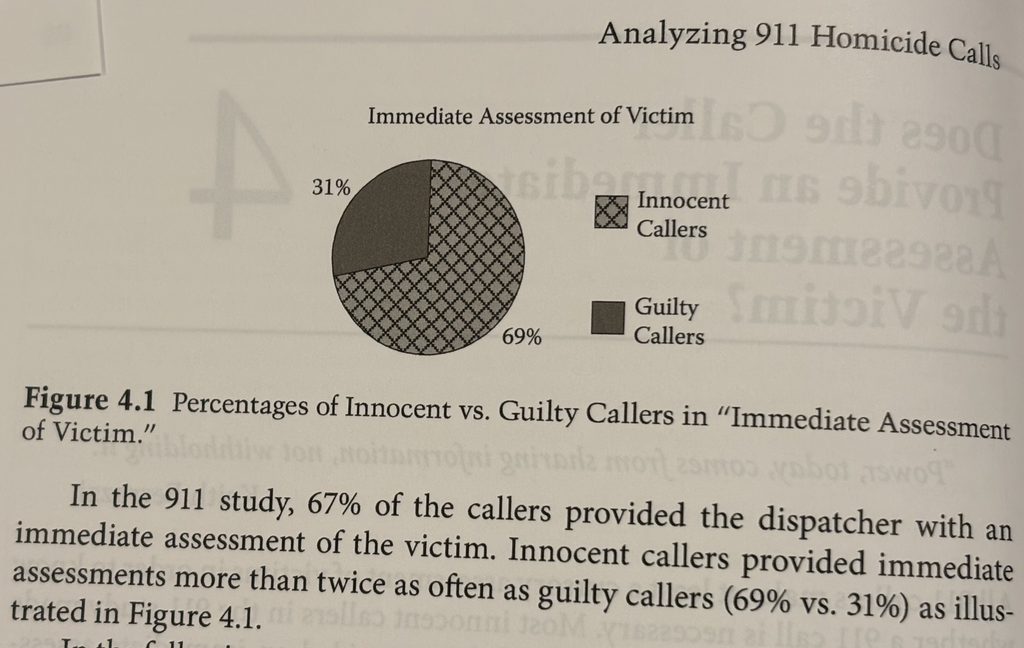
Remember this: Harpster and Adams do not say that a person who drops a certain behavioral indicator on a 911 call is the murderer and should be arrested. They describe tendencies, saying explicitly that innocent people also sometimes do the same things. The point is for detectives to follow up with further investigation.
Miracle Method
Now, watch what ProPublica does with this method, in the first two paragraphs of their story, and here’s the link to their story again if you want to go see it for yourself. Murphy writes that Harpster promotes “a miracle method to determine when 911 callers are actually guilty of the crimes they are reporting,” and then he adds that the author describes a “linguistic detection” technique that tells you if they killed someone.
That is, flatly, not what the textbook Harpster and Adams have written claims to do. They do not say that analysis of a 911 call can “determine” through a “miracle method” who is a murderer.
As Harpster told The Federalist this week, “we advise our students in every class that the 911 call is but one piece of the puzzle in an equivocal death investigation, but it’s the first piece.”
Murphy also makes a remarkable choice for a reporter who is describing a textbook that anyone can read, misrepresenting Harpster’s argument about the use of words in a 911 call.
“Stripped of its context,” Murphy writes, describing the methods outlined in the textbook, “a misplaced word as innocuous as ‘hi’ or ‘please’ or ‘somebody’ can reveal a murderer on the phone.”
But Harpster is speaking, precisely, about the context of those words. If a person calls 911 and says that he just saw someone shoot his wife, but then answers with “huh?” when the 911 operator asks what the shooter looked like, be may not be describing something he actually saw. Instead, he may be making up a story, and may have been caught flat-footed by the follow-up question in the first panicked seconds of a phone call. Harpster doesn’t argue for stripping words of their context; he does precisely the opposite.
Harpster has critics, including academic psychologists and criminologists who argue that his findings can’t be consistently replicated and should be treated with caution. A 2025 paper argued that listeners couldn’t distinguish guilty and innocent callers on recordings of 911 calls. Harpster argues that critics refute something he hasn’t argued, showing that it isn’t possible to clearly determine guilt from the content of 911 calls. But however right or wrong the critics might be, disagreement over evidence should be settled by discussion and debate, not by overhyped hit pieces.
We Never Said That
Finally, go look at the way the ProPublica story appeared on the screen, starting with the headline and a photo composite of three haunted faces staring out from the shadows.
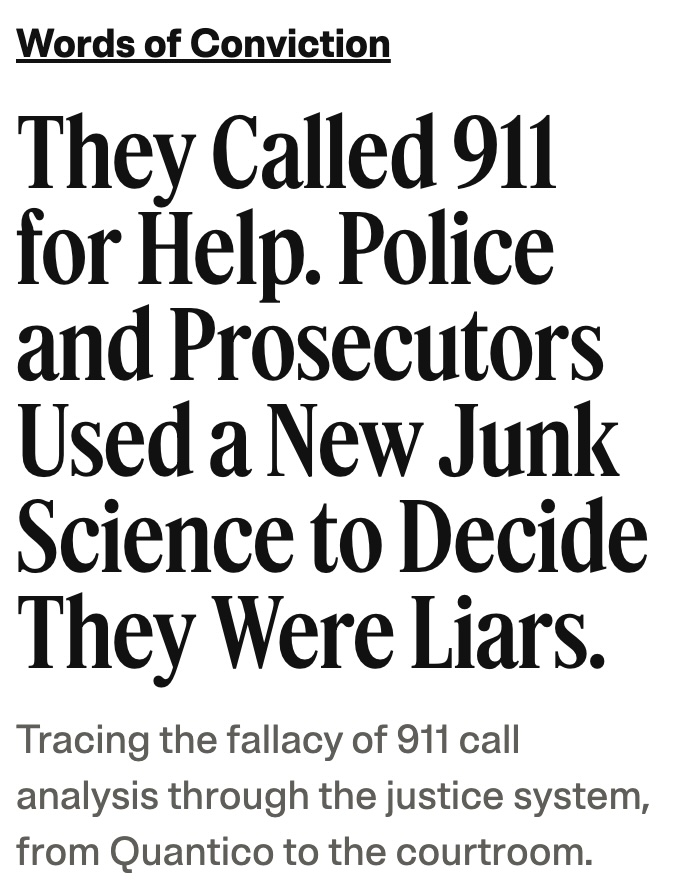
Haunted faces / “words of conviction.” The story is illustrated with three faces of people who called 911 for help, but then found that the police called them liars. The implied message here, and not a subtle one, are that these are the innocent people convicted by Harpster’s dishonest method, using only their words on a 911 call.
But the slippery headline doesn’t say that, and neither does the story. It describes cases in which Harpster’s methods were used at some point, and it describes cases in which convictions were called into question, but it doesn’t connect 911 call analysis to later exoneration. The story hints, suggests, and implies.
In one place, Murphy goes so far as to say this: “In reality, people have been wrongfully accused and convicted of murder after someone misinterpreted their call for help, while those who used 911 call analysis against them face little or no consequences.” But he doesn’t name people who were convicted because of 911 analysis, then later exonerated.
Here’s Murphy’s description of the arrest of Kathy Carpenter for a 2014 murder in Colorado, describing an investigator’s analysis of her 911 call: “Lewis found 39 guilty indicators and zero indicators of innocence. Carpenter was arrested eight days later.” Look closely at the explanatory chasm between those two quoted sentences, a model of the post hoc fallacy: after this, therefore because of this.
Another person later confessed to the killing, and Carpenter was exonerated. But you notice what Murphy didn’t say in between those two quoted sentences: He did not say that Carpenter was arrested because of the 911 analysis, omitting entirely a discussion of what other evidence investigators considered. He implies without saying.
And here, at last, is the big finish.
When ProPublica published its story about Tracy Harpster, Harpster objected. He wrote an angry letter to the editors demanding a retraction. ProPublica refused his demand, and posted online their entire response to Harpster from editor-in-chief Stephen Engelberg. You can still read that letter here. The most interesting response appears on the first page of the six-page letter:
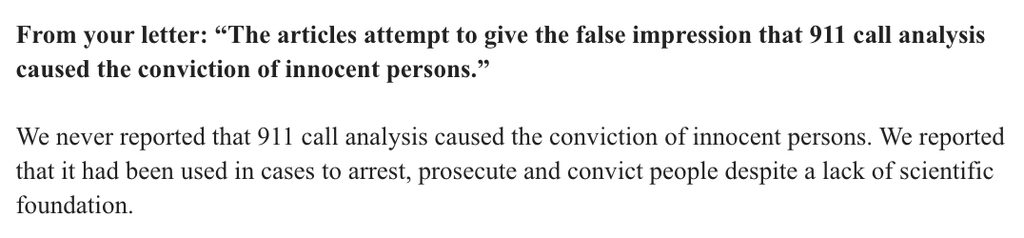
“We never reported that 911 call analysis caused the conviction of innocent persons.” And that’s correct: They didn’t. ProPublica’s best defense of its reporting is the clearest indictment of its reporting. Like the discussion of the Kathy Carpenter arrest, they put a description of the 911 call analysis next to a description of an outcome, but didn’t argue for the connection, excluding a discussion of other evidence used in the cases. Result: innuendo through proximity, but a slippery absence of a real causal argument.
Scroll back up and look at the headline, and the way they illustrated the story, and then think about the words, “We never reported that 911 call analysis caused the conviction of innocent persons.”
Now you understand what ProPublica does.