
Since 2004, the political precedents Barack Obama sought to establish have already been in motion, and now, in 2026, newcomers Abdul El-Sayed and Zohran Mamdani appear to be advancing his unfinished mission in exactly that direction. That may be why Obama seems to be playing the role of a proud father, secretly smiling in approval as his well-schooled children venture out to harvest the seeds he’s spent more than 20 years sowing.
As these wet-behind-the-ears political successors seek to establish themselves as the new face of what Obama has long hoped would take shape, Obama appears to be tacitly passing the torch to trophy-kids El-Sayed and Mamdani and seems to have no problem publicly supporting their efforts. By standing side by side with El-Sayed and Mamdani, the former president reinforces policies associated with democratic socialism and positions and agendas that extend beyond what he publicly championed during his two terms as a supposed capitalist Democrat. The association further undermines Obama’s moderate persona and highlights his role in propelling the Democrat Party down the path of left-wing extremism.
Recently, in an article titled “Barack Obama Looks Left,” The Atlantic examined the former president’s shift toward and support for younger leftist politicians, including Mamdani and El-Sayed. A week later, in a political ad, a gray-haired Obama, speaking on behalf of El-Sayed’s hopes to represent Michigan in the Senate, used inclusive language, emphasized shared purpose, and employed pugnacious innuendo, saying, “Michigan is where we fight back.”
Remember, tough-guy Obama is the one who said, “If they bring a knife to the fight, we bring a gun.”
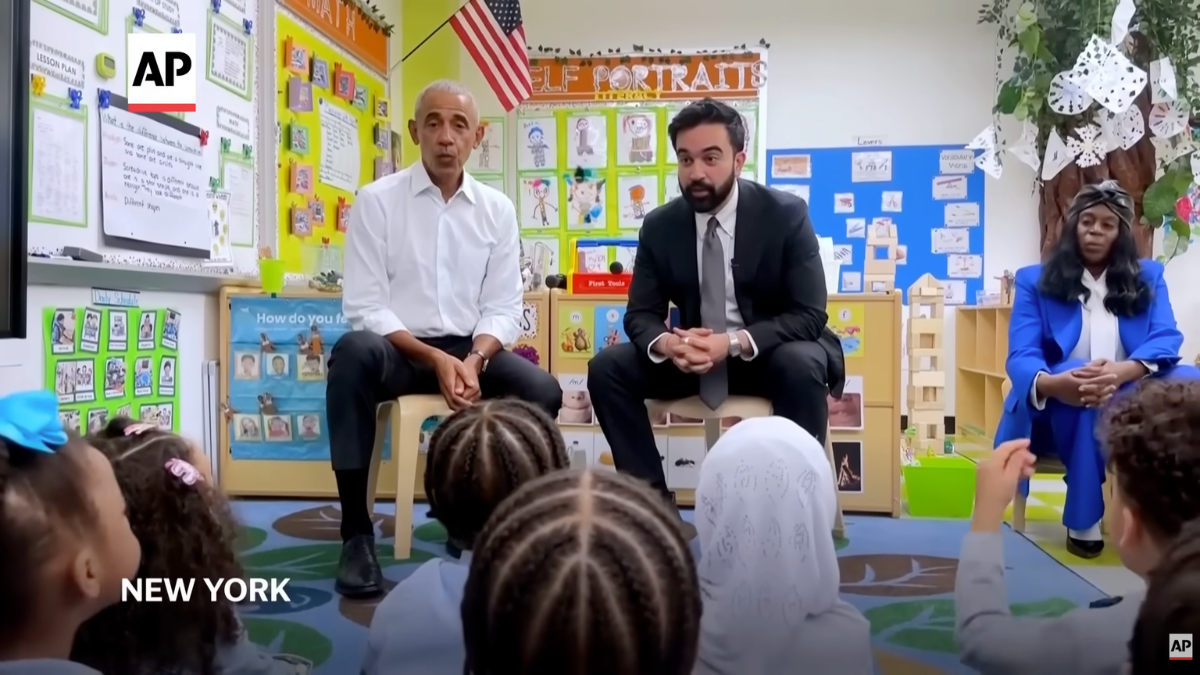
By volunteering as the smiling face on El-Sayed’s Oct. 24 campaign poster, the implication is that Obama believes far-left policies reflect the direction America should take. If that weren’t true, the former president would never stump for El-Sayed or delight preschoolers (including a girl draped in toddler hijab) at a Bronx day care center by singing the Wheels on the Free Bus with smiley Mamdani.
When Barack Obama officially sashayed onto the political stage in July 2004, he was roughly the same age as El-Sayed is now. At the time, El-Sayed was just shy of 20, and Mamdani was turning 13. Amazingly, both young men had ties to Egypt, and all three would eventually connect, in different ways, with Muslim Brotherhood President Mohamed Morsi.
Here we have three politicians with Muslim family origins, overlapping progressive political bents, and an ever-increasing public relationship with one another. In fact, when Obama delivered his “fundamental transformation speech,” he did so in Columbia, Missouri, the Midwestern town where El-Sayed’s mother, nurse practitioner Fatten Fathy Elkomy, had worked for the Islamic American Relief Agency (IARA). In 2004, the U.S. Treasury Department designated IARA a specially designated global terrorist organization for allegedly supporting terrorism.
Obama’s decision to publicly support these two political neophytes may stem from shared religious upbringing and political and parental influences that helped cultivate what now appears to be a shared vision for America.
Obama’s Kenyan father and his stepfather, Lolo Soetoro, were both Muslims. Obama spent much of his childhood in Indonesia, attended a mosque, and, at an impressionable age, was reportedly educated in a school that exposed him to Islamic teachings and traditions.
Abdul El-Sayed was raised as a Muslim with Egyptian roots. Zohran Mamdani grew up in an interfaith household. His father, Mahmood Mamdani, was a Muslim. Mamdani has said that his Muslim identity was “politicized” after 9/11.
Barack Obama’s mother, Ann Dunham, was an anthropologist and a civil rights and social-reform activist. Mamdani, an Africana Studies graduate, also grew up with politically active parents. From age 3, El-Sayed was raised by his father, a student activist in Egypt, and his stepmother, Jacqueline. El-Sayed’s 2016 Columbia alumni profile notes that his nurse practitioner mother and engineer father instilled in him “a commitment to social change.”
During his senior year, 2006–2007, El-Sayed served as vice president of the Muslim Student Association at the University of Michigan and participated in a walkout at a Young Americans for Freedom event titled “Terrorism: The World’s Greatest Threat.”
In 2012, then-President Obama held diplomatic talks with Mohamed Morsi, Egypt’s president and leader of the Muslim Brotherhood. That same year, El-Sayed was in New York, signing a petition supporting Morsi’s controversial November 2012 decisions. Meanwhile, Mamdani was at Bowdoin College, in Maine, advocating for Palestinian rights and criticizing Israeli policies. By 2014, Mamdani was openly supporting “an academic boycott of Israeli institutions.”
Obama, El-Sayed, and Mamdani share a similar speechmaking style: They warm to disarm critics with a smile, open with conciliatory language, then pivot sharply to an aggressive political attack. It happens almost every time. This may explain why, on the third anniversary of the Oct. 7 slaughter of 1,200 people, in true Obama fashion, Mamdani first condemned Hamas and then pivoted to eulogize Palestinians and villainize Israel.
If Obama’s presidency and subsequent comments on Israel were a lesson in school, El-Sayed and Mamdani appear to be star pupils.
Let’s not forget that in March 2010, Obama allegedly left Israeli Prime Minister Benjamin Netanyahu waiting in the White House after disagreeing over the parameters of the Palestinian settlements. Then, in December of 2016, Obama rebuked Netanyahu by allowing a U.N. Security Council resolution condemning Israeli settlements to pass.
Both the NYC mayor and the Michigan senatorial candidate aggressively confront Israeli military actions and U.S. support for the Jewish state. El-Sayed called Netanyahu’s government “bloodthirsty,” and before conceding in July 2026 that New York City lacked the legal authority to do so, hot-air enthusiast Mamdani threatened to arrest the Israeli prime minister, whom he called a “war criminal,” upon his arrival at the U.N.
Domestically, all three politicians advocate left-wing economic policies. Although Obama has never officially embraced democratic socialism, he pushed the country toward universal health care by passing Obamacare. Now, thanks to the former president’s mentorship, the two newcomers enthusiastically advocate universal health care and wealth redistribution through expanded public programs funded by progressive taxation.
To varying degrees, neither Obama, El-Sayed, nor Mamdani is hesitant to express disapproval of the call for voter identification. Obama, whose administration relied heavily on ICE to carry out deportations, now publicly stands alongside politicians who openly advocate abolishing the federal agency. Meanwhile, Obama and the boys are crystal clear about extending immigrant protections and sharply criticize Trump’s current immigration enforcement methods.
By mobilizing small donors, volunteers, and grassroots support, and using social media to campaign, it appears Obama may be hoping this next generation of outspoken Marxist-socialist-Islamist politicians will finally usher in the fundamental transformation he spoke about in Columbia, Missouri, on Oct. 30, 2008, one day before El-Sayed’s 24th birthday.
So why would Obama actively campaign for and appear with politicians whose platforms go far beyond what he publicly championed as president, unless he’s trying to reassure Democrat voters that voting for El-Sayed or Mamdani is just like voting for Barack Obama — even though their platforms supposedly differ?
Given whom he grants his political imprimatur to, it’s clear he doesn’t care what his support looks like publicly, confirming he’s always been far more left-wing than he’d like us to believe. As the tree he planted at the beginning of his political career finally bears fruit in politicians like El-Sayed and Mamdani, Obama’s stamp of approval is likely his way of saying, “finally.”