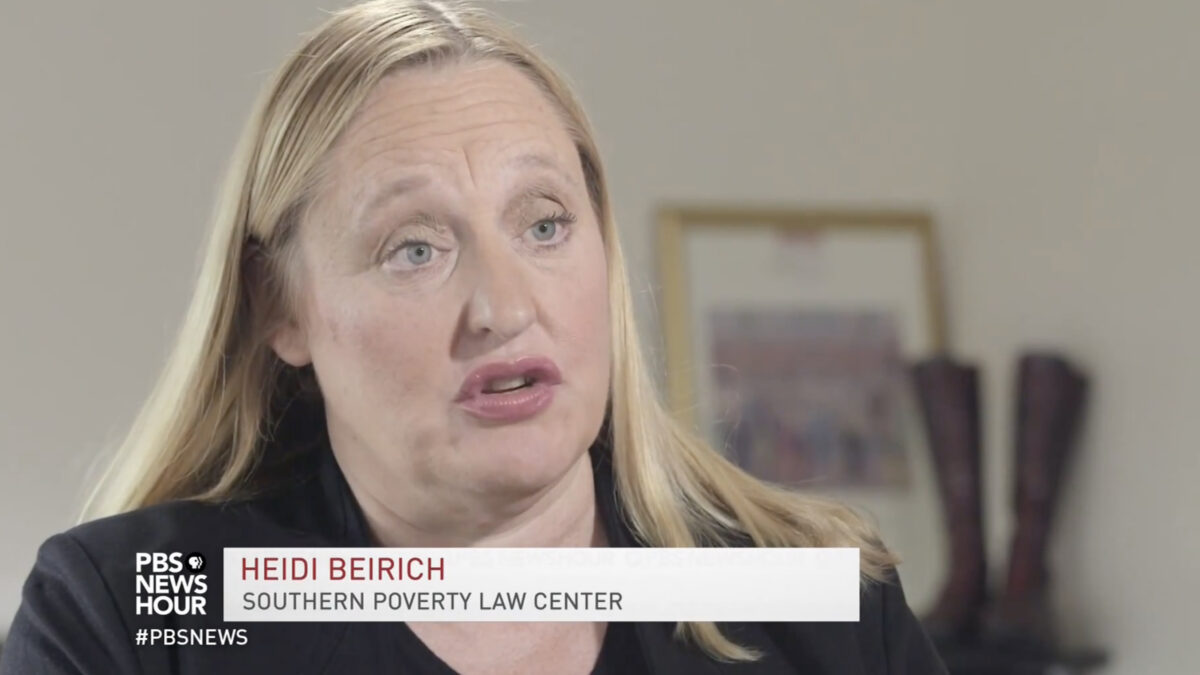

Delivering a new version of the Southern Poverty Law Center (SPLC) bank fraud indictment for the second time, federal prosecutors in Alabama added a new target this week: Heidi Beirich. The former SPLC executive is accused of living with a member of a neo-Nazi organization and sharing bank accounts with him while allegedly directing SPLC funds to him as payment for his work as an informant:
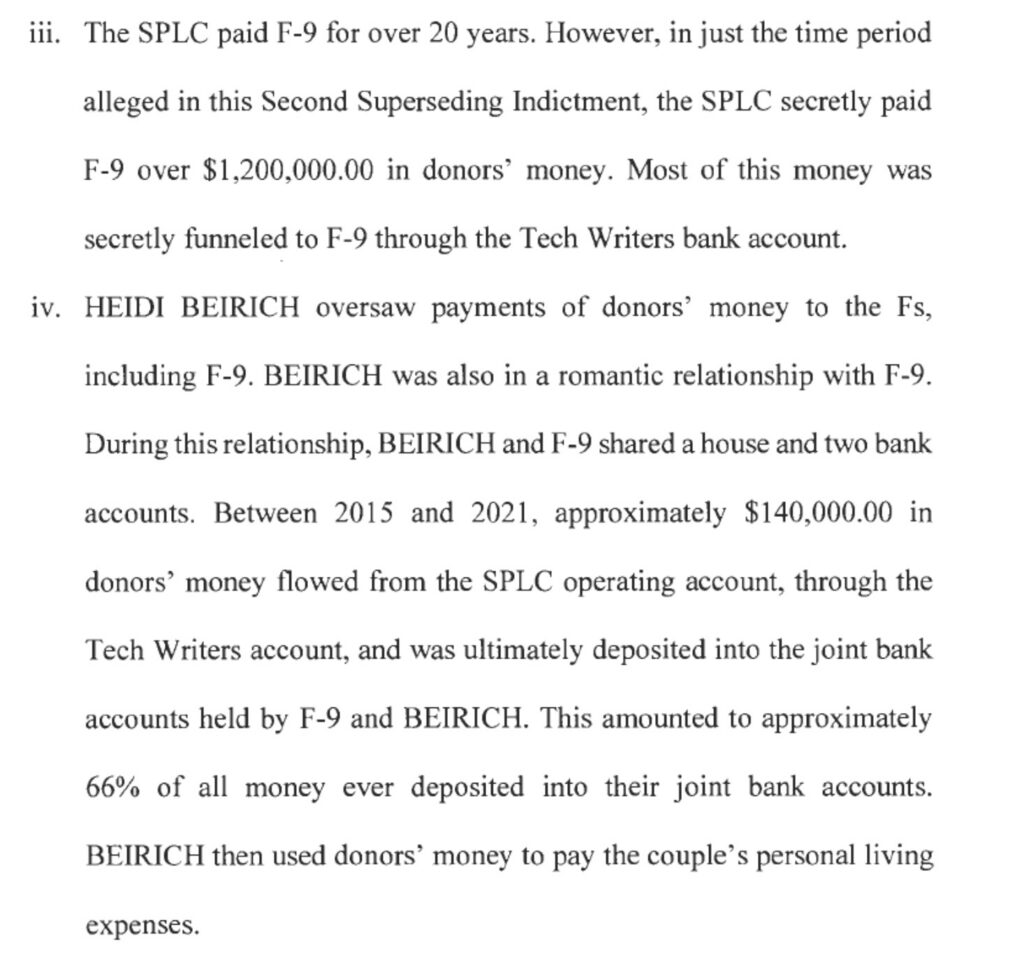
The addition of Beirich as a defendant makes the indictment stranger, rather than clearer, and suggests the presence of new and little-understood background themes in a continuing investigation.
Reflecting the language of the indictment, news stories had initially described Beirich as the SPLC’s former chief financial officer (CFO). That doesn’t appear to be true. Beirich is an academic, having written a dissertation on Spanish courts to earn her political science Ph.D. at Purdue University. She has no background in finance or accounting, and her own LinkedIn page lists a series of research and intelligence jobs at the SPLC rather than finance positions.
In an email message, The Federalist asked the SPLC what positions Beirich had held with the organization. The organization didn’t respond.
More importantly, Beirich appears to be an antagonist who broke with the SPLC during a period of internal crisis. Beirich left the organization in 2019, the same year that founder Morris Dees was forced out. In that year, a long series of news stories described chaos and anger inside the SPLC, routinely depicting it as a troubled institution. The Federalist sent an email message to Dees on Wednesday, asking him if he could discuss Beirich’s role at the organization and provide background that might help to explain the indictment. He didn’t respond.
A story published in the Daily Beast in October of 2019 framed Beirich’s departure as an element of a purge: “The leader of the Southern Poverty Law Center’s Intelligence Project is stepping down amid an ongoing leadership shakeup at the anti-hate organization.” Note that the 2019 story on Beirich’s departure didn’t describe her as the CFO, instead describing her as the head of the organization’s intelligence-gathering operation. That position would have put her squarely in the center of the SPLC’s use of informants.
A more recent story from CBS News, published this May, says that federal law enforcement was running a criminal investigation into the SPLC’s use of informants even as Beirich ran the organization’s intelligence operation and was apparently about to be forced out of that job: “Agents from IRS Criminal Investigation in 2019 and 2020 homed in on shell bank accounts that a former chief financial officer at the civil rights nonprofit opened to pay informants in exchange for intelligence about hate groups.”
So Beirich appears to have been forced to leave her intelligence job at the SPLC during the period when federal investigators were asking questions about the use of informants in the organization’s intelligence operations.
In statements to legacy media, Beirich’s lawyer has attacked the charges in the hyperbolic language that has already become familiar in the case: “A free and fair society does not use the justice system to silence its political opponents.” Seeking specifics by email, The Federalist asked Beirich’s lawyer if Beirich denied the factual allegations contained in the indictment, or if she conceded the fact claims but regarded prosecution over her behavior as improper and political. He didn’t respond.
Beirich has due process rights, and is entitled to a presumption of innocence.
Finally, cementing the appearance of antagonism toward her former employer, Beirich is a co-founder of a competing nonprofit organization that exists to do the same work the SPLC does. The Global Project Against Hate and Extremism (GPAHE), founded in 2019, says on its website that it counters racism and bigotry by performing “investigations and analysis” regarding extremist groups. It’s SPLC Jr., an SPLC spinoff, with former SPLC staff as founders. Corporate records on file with the Alabama secretary of state show that GPAHE was founded in October of 2019, right as Beirich left the SPLC. So Beirich is competing with the SPLC for donor funds and media attention, while being charged with crimes in her former capacity as an SPLC official.
The GPAHE website lists Beirich as that organization’s current chief strategy officer and cofounder. The Federalist asked GPAHE by email if Beirich remains an active executive at the organization, following her indictment. GPAHE didn’t respond.
It’s hard to say what all of this means, but it appears that the two defendants in the bank fraud indictment — the SPLC as an organization, and Beirich as the person who allegedly directed payments to informants while working there — are opponents who are likely to pursue antagonistic defense strategies. And it appears that the charges emerge from an old moment of institutional crisis, reflecting division with the SPLC that grew to a crescendo as the first federal investigation gained momentum.
The charges appear to address actions that were internally contested during a period of institutional crisis, complicating the legacy media’s framing of the story as a political prosecution of a leftist organization by a right-wing administration.
That background will become clearer as Beirich’s lawyer reveals his defense strategy in court. For now, no one is talking, no questions are being answered, and more indictments may be coming. We’ll be watching this story for a long time.