
A couple of years ago, I had the privilege of attending the Claremont Institute’s Lincoln Fellows program in Newport Beach, California. On the last evening of the program, students and instructors hopped on a bus to a waterfront restaurant, and I found myself seated in front of the prolific writer, former White House official, and Claremont senior fellow Michael Anton.
Anton, who recently completed his tour as the director of policy planning at the U.S. State Department under Trump — and was reportedly the brains behind the administration’s national security strategy — is a bit of an intimidating character. What one quickly realizes is not only that he is much smarter (and probably taller) than you, but that he suffers no fools, and tires quickly of small talk. Thus was I surprised to find him on this particular warm and sunny Southern California evening eager to discuss the Summer Olympics, as several of the female swimmers representing the USA were graduates of the University of Virginia, my alma mater.
Unfortunately for me, who was beyond thrilled to talk to one of my favorite conservative writers and thinkers, I know nothing about competitive swimming. Apart from the name “Michael Phelps,” I mean nothing. You might as well ask me about cricket or curling. Thus, I awkwardly smiled, nodded, and did my best to pretend like I had some idea of what Anton was describing, fearful that at some point he might, suspecting my embarrassing ignorance, query my thoughts on the 200m individual medley.
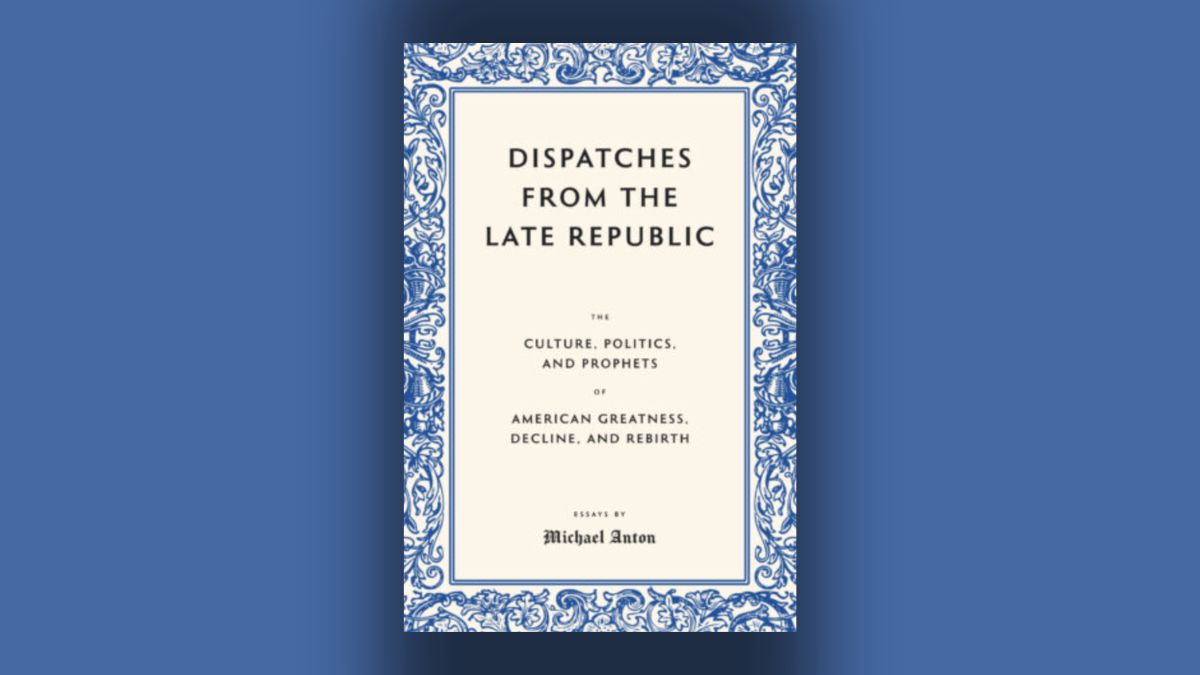
The curious thing about Anton is that as much as his formidable intellect and seeming impatience with casual conversation can make him seem bristly and impersonal to those unacquainted with him, in his writing, the former press secretary and speechwriter often wears his emotions on his sleeve. It’s an endearing quality of his prose, and routinely on display (with great effect) in his new collection of essays, Dispatches from the Late Republic: The Culture, Politics, and Prophets of American Greatness, Decline, and Rebirth.
For example, like the great majority of mankind, Anton is a fanboy. In his case, one of those preeminent heroes is the late Southern journalist Tom Wolfe, author of such timeless classics as Radical Chic & Mau-Mauing the Flak Catchers, The Right Stuff, and The Bonfire of the Vanities. Of twenty-two essays in this collection, three of them are about Tom Wolfe, whom Anton first encountered in the 1980s while an undergraduate at UC Berkeley. In time, they developed a friendly correspondence, eventually culminating in an interview in New York City while Anton was working there. On the day of the interview, Wolfe also took Anton out to lunch, asked him about his life, and encouraged him to write a book Anton hoped to write in the “New Journalism” style about Berkeley. Afterwards, Anton called his wife and apologetically declared, “That was the GREATEST DAY OF MY ENTIRE LIFE!” All of us can relate to something similar.
There’s also a moving reflection on the Beach Boys, whom Anton (rightly) describes as writing and performing music that represented the “pinnacle artistic achievement of a lost civilization, the middle-class, baby-boom, sun-soaked, clean-cut, work-hard-play-hard, bungalow-and-car culture of post-war Southern California.” (Anton, in case you were wondering, is a native of the Golden State.) The band’s success — and collapse as songwriter Brian Wilson descended into drug-induced madness — is a fitting exhortation regarding what Americans are capable of accomplishing, and a warning of what awaits them if addiction and debauchery are given free rein. I would argue that it’s wonderfully appropriate that in an America always willing to celebrate second chances, Wilson eventually emerged from his haze and enjoyed renewed popularity and success until his death last year. And rightly so — his music stands the test of time.
“Renaissance Man” is an apt description of Anton. Beyond his passion for tailoring and menswear — he pseudonymously published a book offering a “Machiavellian” reflection on men’s fashion — he is also an amateur chef, having cooked twice at the White House, including for a state dinner. Two essays in this collection discuss Anton’s predilection for culinary excellence, one of which amusingly portrays him jettisoning an arduously concocted demi-glace when he received a phone call from the national security adviser via the White House Situation Room demanding his presence downtown. There’s also a short, illuminating piece discussing how the late chef Anthony Bourdain was “good for food,” but “bad for chefs.”
Of course, Anton is a writer of politics and culture, and in that regard, Dispatches from the Late Republic does not disappoint. A 2021 piece from the magazine The New Criterion on Western civilization is particularly strong for its insightful, if biting commentary on America’s many problems, including, most notably, unprecedentedly high numbers of illegal (and legal) immigrants who are not assimilating. The piece ends on a decidedly mournful note: “Our regime cannot, at present, unload a cargo ship, stock a store shelf, run a clean election, handle parental complaints at a school board meeting, pass a budget bill, treat a cold variant, keep order in the streets, defeat a third world country, or even evacuate said country cleanly.” Those reasons quite neatly summarize why Trump was elected in 2024.
“That’s Not Happening and It’s Good That It is: A Quick and Dirty Guide to Regime Propaganda” is another gem. Here, Anton discusses a number of his pet theories, some of which have become common parlance, such as the “Celebration Parallax,” which is that “the same fact pattern is either true and glorious or false and scurrilous depending on who states it.” A perfect example of this in action, as Anton lays out, is leftist accusations that the “great replacement” theory is a contemptible racist conspiracy, even while liberal pundits and politicians regularly celebrate immigrants replacing native-born Americans. There’s also the “Law of Salutary Contradiction” (“That’s not happening and it’s good that it is”) and the “Enmity Counteraccusation” (“The enemy calls you its enemy for recognizing its enmity”). This is a trend that many employees suffering through DEI training find: DEI course instructors will tell the workforce that complaints that DEI is prejudicial toward white males or conservatives are, ironically, “divisive.”
Anton has chosen well among his vast array of essays across a variety of publications over more than a decade — I haven’t even mentioned his Claremont Review of Books review of Bronze Age Pervert or his four essays on foreign policy. They are all worth reading and likely to be relevant for years to come. I know I’m not the only one to say I hope he can find time to finish that novel about Berkeley — and perhaps write a cookbook, while he’s at it. I’d certainly pay for the privilege to feast at his table.