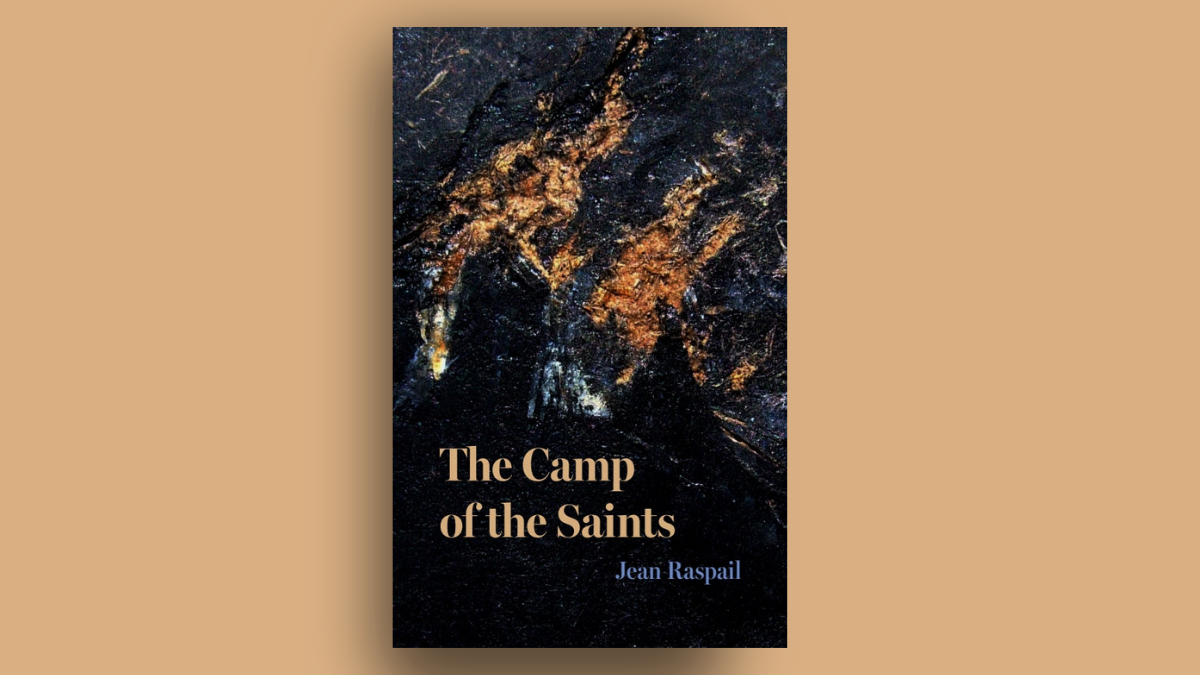

These days, many books like to boast of being “banned,” though it’s hard to take this seriously when many such books are prominently featured at bookstores and regularly assigned in English classes. In truth, the only real banned book of note — that is, a book that is consciously ignored, deliberately kept out of print, not allowed in libraries, and impossible to find in any bookstore — has been The Camp of the Saints by Jean Raspail, a French novel originally published in 1973 dealing with the issue of mass migration from the Third World. Despite the ongoing relevance of its subject matter — particularly given the rape gang inquiry in the U.K. and other immigration controversies across Europe — educators, publishers, and cultural gatekeepers, both in France and elsewhere, have deemed it too subversive for the public to read.
Thankfully, a few prominent voices on the Right, including conservative podcaster Matt Walsh, have revived interest in The Camp of the Saints. Although the book was out of print for decades, the publisher Vauban Books recently reprinted a new English translation of the book by Ethan Rundell. Soon after interest in the book surged after Matt Walsh’s endorsement, its listing on Amazon mysteriously disappeared earlier this year. After being called out by Walsh in turn, the listing is back up, yet no one has apologized or explained why it went down in the first place.
To be fair, some of the outrage over this book is merited. The Camp of the Saints really is an offensive book that challenges the status quo, handles controversy with bluntness and aggression, intentionally disgusts the reader on countless occasions, and induces profound doubts and despair about the world. In his introductory essay to the book, “Big Other,” Raspail proudly admits, “It is an impetuous, fierce, bracing book, almost joyful in its distress, but savage, sometimes brutal, and repellant to those pure souls who are spreading like an epidemic.” He intentionally put free speech and open public discourse to the test—and mostly found it wanting.
Yet, for all that, is The Camp of the Saints a good book? By any conventional standard, not really. As writer and physician Theodore Dalrymple remarks in his review of the novel, “It is very badly written, too long, verbose, and frequently boring.”
Although this assessment is not altogether wrong, it misses Raspail’s purpose in The Camp of the Saints. Like other books in the dystopia genre, the focus is on world-building and exploring the misguided principles that govern such a world. And like any satire, it portrays people as worse than they are to make a point on an issue. It just so happens that both the world and issues that Raspail discusses in his novel are extremely messy and defy a clear, compelling narrative. Moreover, when it comes to mass migration, everyone is guilty, leaving Raspail to give each actor their moment in the sun before gleefully crushing him under the weight of his own hypocrisy.
In many ways, Raspail’s novel is less a story about immigration and more about demographic patterns in the late 20th century when overpopulation in the developing world would start overtaking a morally and spiritually depleted developed world. Anticipating the arguments of the 1974 essay “Lifeboat Ethics: The Case Against Helping the Poor” by Professor Garret Hardin, Raspail concludes there is no truly moral solution to this problem: either the West (symbolized by a lifeboat) keeps out the developing world outside their borders and lets them die from famine and resource scarcity, or they let them in and consequently destroy their own countries (symbolized by sinking the lifeboat).
Everything in the novel’s basic plot serves to illustrate this dilemma. The story begins in India when a million indigent peasants are rallied to migrate to Western Europe. Led by a deformed child being carried around by a giant who kneads human excrement for a living, they embark on a collection of hardly functional steamboats and slowly make their way to Europe. As all this happens, the commentariat and leadership in France spend all their time squabbling about “The Last Chance Armada” and gradually lose the collective will to repulse them.
In itself, the premise is not what makes the novel such a popular target for bans and censorship, but more in Raspail’s dehumanizing characterizations. The Indians making the journey are routinely described as reeking subhuman hordes, copulating in their own filth and mindlessly trampling anything in their way. The French characters are either cynical, licentious scoundrels with a insatiable death wish, or they are gullible dupes incapable of independent thought. Additionally, the Arab and African immigrants in France are shown to be duplicitous and brutal, primed to betray their white neighbors at the first opportunity.
If one can make it past these unapologetically derisive descriptions — ironically coming from a person with extensive experience and sympathy for marginalized communities around the world — they may falter with the depressingly anti-climactic story. Aside from a few prescient points (e.g., Raspail predicts the appointment of a Latin-American pope who would sell the Catholic Church’s wealth, preach liberation theology, and advocate for the global poor) along with some amusing episodes (e.g., when European NGOs try to help the Armada only to be rebuffed by the migrants, or when a professor shoots down a hippie invading his home), the reader is subjected to rants both for and against immigration and tediously long lurid descriptions of the migrants.
And yet, for all that, The Camp of the Saints is hugely important book that deserves to be read and appreciated. Had Raspail pulled his punches and complicated his novel with more nuanced treatments of each character and situation, his novel would have far less of an impact. However injudiciously he may have described migrants from the third-world—which is clearly an amalgamation of the most primitive Third World peoples, not an actual portrayal of people from East India—he is right to express alarm at the potential of civilizational collapse. If a million poor migrants arrived on France’s shores all at once, what would the French or other Western countries do? Based on what they have already done with much smaller numbers of incoming migrants, they would likely just as passive, idiotic, and helpless as Raspail predicts.
Understanding this does not necessarily mean that Raspail calls for closing all borders and kicking out everyone of non-European descent. Rather, he is mainly highlighting the tradeoffs and complications that come from taking in so many immigrants from less civilized parts of the world. Many Leftists naturally like to pride themselves as more compassionate and enlightened for preaching open-borders and denigrating Western civilization, but Raspail exposes this shallow thinking and demonstrates how it quickly falls apart in practice.
Unfortunately, he does not follow this up by presenting a viable alternative, which ends up becoming the novel’s biggest weakness. At most, he tells what comes of the final outpost of French culture that he calls “The Village,” inhabited by the last few Frenchmen who refuse to submit to the new order (or disorder) after the Armada makes landfall. Needless to say, this settlement does not last long and is soon bombed in oblivion and swamped by migrants from the Armada. France’s superior culture alone means little if its guardians lay down their arms and abandon their reason.
Even if this may seem like a spoiler, no one who makes it this far in the novel will be reading it to see what happens in the end. Instead, they will be taking in the many horrors that will come with giving up on their nation and cultural heritage. They will learn the important lesson that migration encompasses all aspects of life and cannot be outsourced to clueless elites who hate their own country.
It would be an exaggeration to call The Camp of the Saints prophetic, particularly for Americans who have welcomed millions of immigrants, but it is nonetheless pertinent. Raspail warns of a very real danger that can destroy even a country if its people aren’t careful. Contrary to the objection that this novel will radicalize its readers, it will more likely alert them them to the true radicals who are using mass migration as a vehicle to carry out their destructive agenda. Today more than ever, this is something that all educated people should understand and internalize so that they can avoid the sad fate of Raspail’s Frenchmen.