
Years ago I proofread a college paper for my late sister where she had to analyze the 2010 film Kick-Ass. It’s based on a comic book about a high-schooler who decides to become a superhero, and right away he gets the crap kicked out of him by hardened criminals. The protagonist notes that it’s not as glamorous as the movies make it look, and that “nobody wants to be Spider-Man.”
My sister went on to examine that idea for three pages. All these years later — I still haven’t seen the movie — that line pops back into my head whenever I read a story about a vigilante. If someone were to play that part in real life, chances are it would be extremely unpleasant … unless you’re already familiar with unpleasant things, and you’re determined to do something about it.
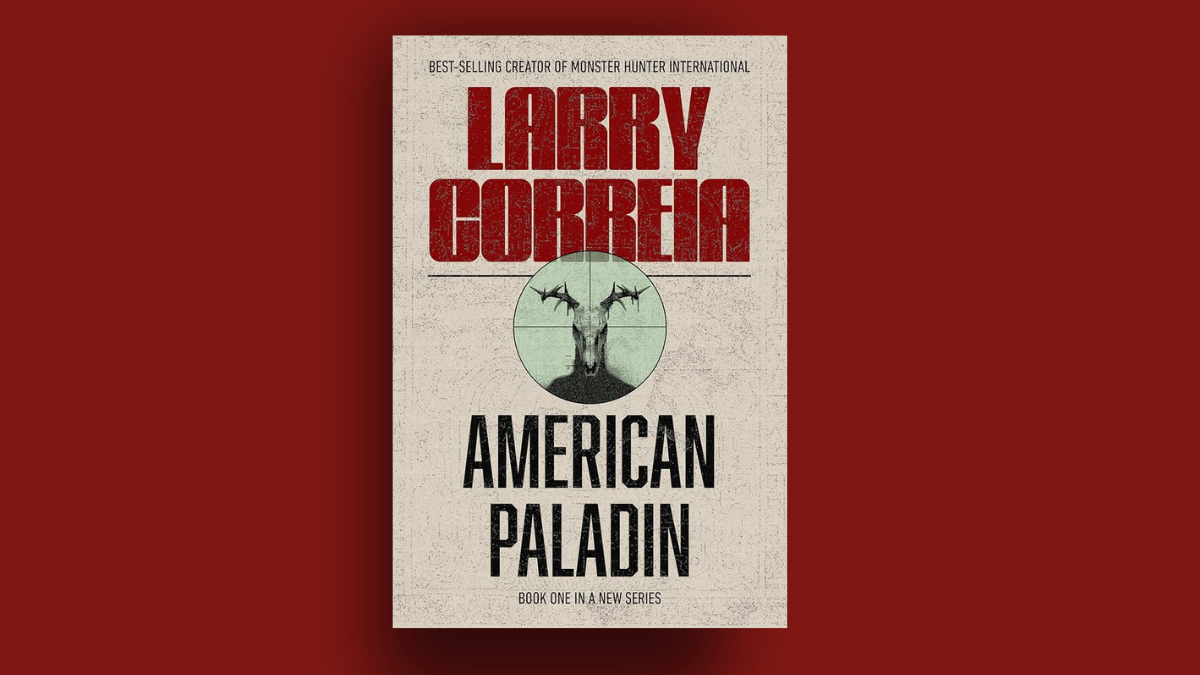
That is essentially the setup for American Paladin, the newest release from fantasy author Larry Correia. Since his debut novel Monster Hunter International dropped in 2009, Correia has made a name for himself as a writer of male power fantasies. To date he’s got more than three dozen titles under his belt (and I’ve read most of them.) His characters are usually tough, curt, practical men who kill monsters — or ninjas, or terrorists, etc. — with everything from guns to swords, magic, industrial equipment, and more.
One book famously features an army of zombie werewolves getting run through a municipal snowblower with a broken safety switch. It is disgusting and epic. If you’re a guy and you don’t like to read, you probably haven’t tried a Correia book yet.
American Paladin is more grounded than his other work; of all his books so far, it’s the one that most concerns itself the most with the logistics of becoming a superhero — or in this case, a vigilante in the vein of Jack Reacher. The main character, Mike Spears, is the sole survivor of a family camping trip that went horribly wrong, transporting his parents and siblings into a parallel dimension in the Mountain West. He saw things in the other side that he can never forget. Nobody would believe him if he told the truth, but he also can’t ignore what’s out there.
Now, fifteen years later, he’s determined to be ready the next time he encounters the other side. He spends years training in combat, everything from wrestling to jiu-jitsu, as well as knives, guns, and explosives. With a modest nest egg he lives off-grid and hones his skills as a hunter and assassin. He learns how to evade law enforcement while he tracks down mundane bad guys (like child predators), or the not-so-mundane ones (like demons who wandered in from the wrong universe.) He’s not an ex-Special Forces guy, or a genetically gifted athletic freak who never has to lift weights; he’s an everyman with a few advantages and some major baggage in his past. He’s seen horrible things and he uses his memories to motivate him in the fight against evil.
When we first meet Spears he’s getting pulled over for speeding, which is a problem because he has a dead pedophile in the bed of his truck. His competence is immediately on display; Spears has experience skirting the cops, and he uses that to get out of a ticket so that he can go find other pedophiles and kill them too. This is what he does: It may not bring him peace, but it definitely brings him purpose.
Mark Millar (the writer of Kick-Ass) was right when he said that nobody wants to be Spider-Man, mainly because it’s a thankless job, you get punched in the face, and you still have to pay the bills. Larry Correia created a setting and a backstory that carry his main character past those concerns and into the thick of the action; maybe Mike Spears doesn’t want to be Spider-Man, but he definitely can’t stand to let anyone else become another Uncle Ben. Burdened by knowledge and the scars of a life-changing incident in his teens, Spears accepts the mantle that nobody else wants, and commits himself to killing things that nobody else can.
I’ll spare you further details about the plot or the backstory; Correia does excellent work with pacing in his novels, and Paladin is no different. It clocks in at a tight 260 pages and none of them are slow. If Spears isn’t actively stacking bodies, he’s doing research, coordinating with a short list of allies, or improvising when something goes off-script. It’s all fascinating and high-energy.
The setting is also very easily recognizable; it’s our world, though this first installment is set in the fall of 2022, specifically. (There are reasons for this.) You get a couple of Joe Biden jokes, and earnest commentary against the influx of Californios into places like Salt Lake and Denver. Pseudo-Aztec demons come to our world and notice that we’re ruled by either the “blue donkey cult” or the “red elephant cult.”
True crime podcasts play a critical role in the plot early on, which just makes sense. If you’ve ever seen a YouTube video from the guys at The Lore Lodge then you know eventually someone, somewhere, would notice a pattern emerging around the guys that Mike Spears has killed. Correia keeps the story grounded while still concerning himself with the “how” of vigilantism.
Spears is an aspirational character not just because of his commitment to vanquishing evil, but because he possesses that unique quality belonging to great men in history: initiative. Nobody puts a gun to his head and makes him train, or makes him go out into the barren rural gaps between cities to fight evil, he just does it because he knows it’s there and he won’t ignore it. At great personal cost and with heavy sacrifice he commits himself to a life of labor and loneliness, and every successful mission makes the world a better place.
“Nobody wants to be Spider-Man.” Sure. But if someone did, why would they, and how would they pull it off? American Paladin gives you the answer. And it’s a high-adrenaline ride all the way there.