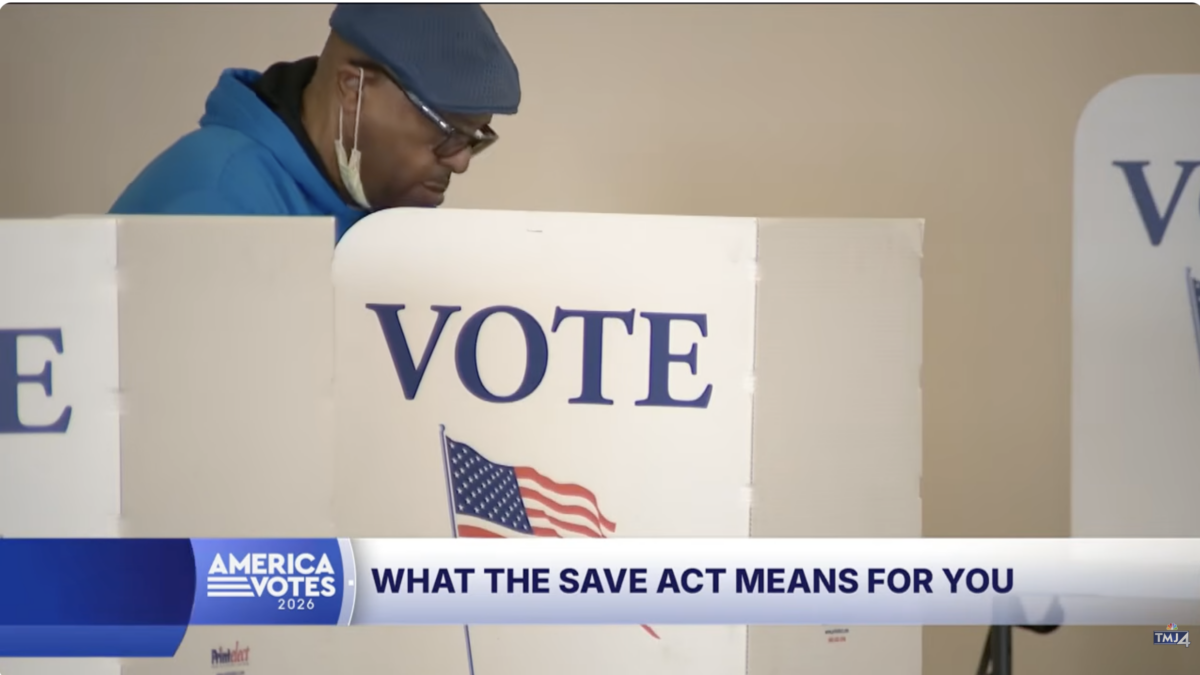

One of the hallmarks of free and fair elections is ballot secrecy. It’s just something most voters take for granted.
But in swing state Wisconsin, a little-known election law can turn the private act of absentee voting into a very public matter.
The Wisconsin Institute for Law & Liberty and the MacIver Institute are calling on the state legislature to fix a statute involving the processing of absentee ballots that negates ballot secrecy.
“It’s a loophole issue in Wisconsin that we believe should be resolved,” Nathalie Burmeister, associate counsel at the Milwaukee-based WILL, told The Federalist this week in an interview. “Our call to action is to ask the legislature to change the language in the statue.”
The law, as it stands, conflicts with Wisconsin’s constitution, Burmeister said.
‘Destroys the Secrecy of the Ballot’
The current law deals with how absentee ballots are processed in municipalities that use a centralized ballot counting center. According to the statute, the local board of absentee ballot canvassers “shall mark the poll list number of each elector who casts an absentee ballot on the back of the elector’s ballot.”
That’s a privacy problem.
Wisconsin statutes require absentee ballots to be counted in the physical location of the voting ward where they were cast, or ballots may be processed and counted in one single, central location known as “Central Count.” Under the latter provision, election officials in the 40 municipalities that employ central counts must write the poll list number of each voter who casts an absentee ballot on the back of the ballot. Each voter is given a unique number “and their name is recorded” on the poll list when their vote is cast.
“The poll list is a public record. As a result, someone could easily find out that John Doe was voter #452 on the poll list in the last election,” states a joint overview from MacIver and WILL, provided exclusively to The Federalist.
And the ballot is a public record. So it’s possible that someone could examine the poll list to retrieve the poll list numbers then look for the individual identifying numbers on the back of absentee ballot to figure out precisely how individuals voted.
“This completely destroys the secrecy of the ballot. Both the poll list and the ballots themselves are accessible to the public through Wisconsin’s open records law,” the press release states.
Municipal clerks, their employees, and other election officials also can connect the dots and figure out how each voter cast his or her ballot.
Burmeister said local elections officials are diligent about redacting the poll list numbers in delivering documents requested through the state’s open records laws. But she said it’s possible unscrupulous individuals could violate that trust — and the ballot secrecy protections guaranteed in Wisconsin’s constitution.
Burmeister said the information could be used to intimidate or bribe voters to choose particular candidates. While she said there’s no evidence of such election crimes, growing concerns about noncitizens and other ineligible individuals voting in U.S. elections makes the Wisconsin loophole more alarming. And more necessary to fix, the attorney said.
‘Cure This Deficiency’
The election integrity groups ask an important question that lawmakers need to answer: why does the Wisconsin Legislature put voters in the position where their ballot is not secret?
“There is no good reason for this law. In fact, there is no reason to have election officials place any marks on or write on any voted ballot, given the possibility that the extra writing could spoil the ballot,” the press release states.
“Even the mere potential for abuse or mistake is corrosive, and the ability to trace voted ballots to individual voters is a direct violation of the Wisconsin Constitution’s guarantee of a secret ballot. And, for those concerned about election integrity, there are other effective — and lawful — ways to address such concerns without jeopardizing voters’ right to secret ballots.”
Wisconsin is an outlier. All 50 states and the District of Columbia provide statutory or constitutional protections for ballot secrecy, but only Wisconsin and North Carolina have laws negating those protections, WILL and MacIver note. The Tar Heel State, also a battleground state, allows a unique number to be applied to a blank absentee ballot upon its release. The number is tied to the voter through the absentee ballot register, according to the election integrity reform advocates.
“Every other state protects the secrecy of ballot far better than Wisconsin (and North Carolina),” the press release states. “Given that a secret ballot is guaranteed by Article III, Sec. 3 of the Wisconsin Constitution, the Wisconsin Legislature needs to cure this deficiency and repeal this part of Wis. Stat. § 7.52(3).”
Burmeister said legislative fixes over the last two sessions have received bipartisan support, but have stalled. In the 2023-24 session, a bill sailed through the Assembly’s election committee but never made it to the floor.
“It’s an issue that’s been on the legislature’s radar for a while,” the attorney said. “Each voter has the right to cast their secret ballot, but that is being jeopardized. This is something all representatives should support.”