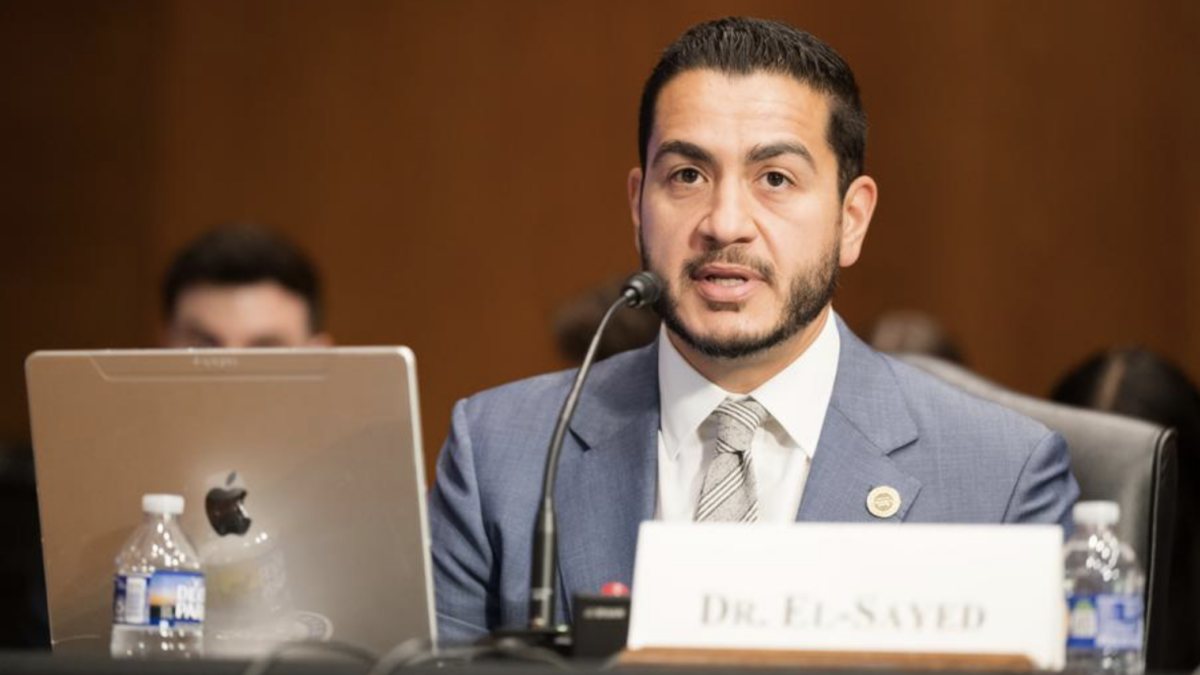
The candidate Democrats nominated for Michigan’s open U.S. Senate seat, Abdul El-Sayed, has embraced many radical positions in his career. When it comes to health care, he doesn’t have far to look to find out how radical his position is.
El-Sayed claims that he supports single-payer health care, but the actions of his family suggest otherwise. And in that respect, El-Sayed has company, because single-payer supporters don’t want to put their money where their mouths are.
Recently, El-Sayed appeared on NBC’s Meet the Press to discuss his campaign. He claimed that he supported single-payer because “it would guarantee [Americans] the health care they need independent of the circumstances, wherever they needed to go.”
But when it comes to guaranteeing health care, El-Sayed’s wife, Sarah Jukaku, does no such thing. As the Washington Free Beacon discovered last month, her psychiatric practice doesn’t accept Medicare, Medicaid, or any form of private insurance. Earlier this summer, the practice reportedly scrubbed a section from the FAQ page on its website that included the following: “Do you accept my insurance? No. Dr. Jukaku is out of network for all insurance companies.”
Other press reports indicate that the couple reported nearly $700,000 in combined income on their 2025 tax returns. That income would put El-Sayed and Jukaku in the top one percent of household income nationwide. Yet for the family to practice what El-Sayed preaches about “guaranteeing Americans the health care they need independent of the circumstances” would apparently put too much financial strain on these one-percenters.
But El-Sayed isn’t the first progressive on health care whose political rhetoric didn’t match his family’s actions. Nearly three decades ago, Vermont’s Rutland Herald ran a little article about a local physician practice.
Dr. Judith Steinberg told her patients in a letter that Community Health Plan/Kaiser Permanente has cut payments to her practice while raising rates to its insured. The decision by Steinberg’s group means several hundred patients in CHP’s commercial and its “Access Plus” Medicaid plan will be obliged to either switch doctors or switch insurers. The practice is the only CHP primary care provider in Shelburne … CHP serves about 30,000 of the 51,000 Medicaid clients who are in HMOs in Vermont.
None of this would merit news coverage, but for the fact that Dr. Judith Steinberg just so happens to be the spouse of then-Gov. Howard Dean, D-Vt. Dean’s wife dropped out of Vermont’s largest Medicaid plan while Dean was governor due to low reimbursement rates and onerous bureaucratic regulations the governor himself imposed. Recall too that Dean called legislation that lacked a government-run health plan not “worth doing” — except, of course, when it came to his wife’s medical practice.
I noted several years ago that the success of single-payer health care depends upon an inherently illogical question: “Will doctors and hospitals agree to provide more care to more patients for the same amount of money?” Making health care “free,” and offering it to more people (i.e., undocumented immigrants), will increase medical providers’ workload — and shifting to (unsustainable) Medicare payment levels would likely lower their overall compensation rather than increasing it.
Through their actions, people like Sarah Jukaku and Judith Steinberg have already demonstrated the answer to my question. Physicians will never stand for the increased workload and reduced compensation necessary to make single-payer’s math work.
That makes El-Sayed’s comments on Meet the Press about capitalism and corporatism particularly ironic. He decried “huge corporations that have used their power, in effect, to try and buy politicians, so that those politicians will turn around and help them use government to protect their position in markets.” But if El-Sayed and Sen. Bernie Sanders, I-Vt, think corporatism is bad now, just wait until the government gets full control of health care, and doctors have to increase their political contributions and come begging to Washington to receive a pay increase.
Unlike Elizabeth Warren in her 2020 campaign, at least El-Sayed admitted on Meet the Press that federal taxes will have to rise — and not just on one-percenters like him — to pay for single-payer. But he still isn’t being anywhere near honest with his would-be constituents about all the consequences of socialized medicine. When it comes to single payer, Michigan voters shouldn’t follow what Abdul El-Sayed says — but what his wife does.