How can artists best capture the essence of summer, especially in a year of such historic significance? Amid a sea of woke and politically correct artists, we have only to look to the painter Wayne Thiebaud (1920-2021), whose work celebrates the culinary delights of the season and the American way of life. After he passed at the age of 101, his art not only lives on, but grows in popularity and understanding.
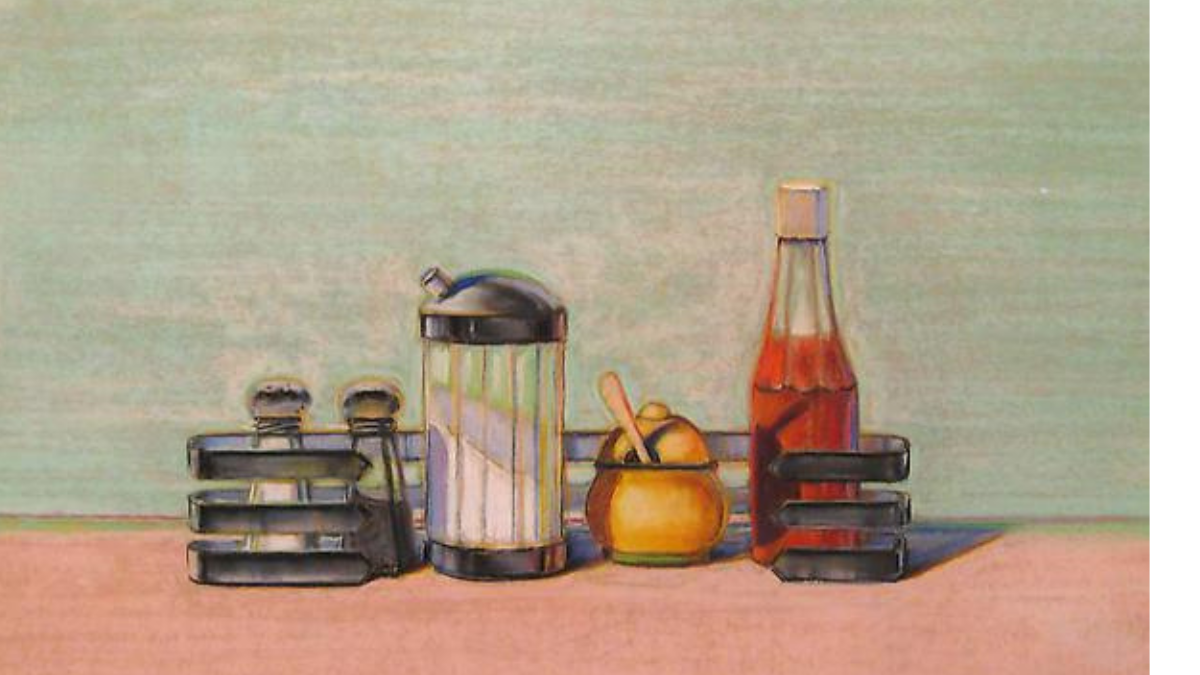
During his 70-year career, the artist painted landscapes and figures. But Thiebaud’s most famous canvases are colorful depictions of commonplace objects: gumball machines, lipstick tubes, paint cans, and food, particularly food, especially diner and picnic food reminiscent of his youth. Thiebaud’s paintings capture the spirit of summer. They evoke memories of beachside cookouts and backyard barbecues, making mouths water in real time. Cupcakes, pies, pastries, ice cream, and hot dogs populate his still lives in a most engaging and delectable manner. Of course there are also his cakes. Canvas after canvas of gooey, colorful cakes which delight the eye with rich color and tantalizing texture.
Cheryl Day, host of PBS’s My Family Recipe, bestselling cookbook author, and award-winning pastry chef, once wrote, “When I see Thiebaud’s painting, a visual parade of cakes dances in my head: brought by grandmothers, mothers, aunties, and sister bakers for all to enjoy. I see the community celebrations that these cakes bring to life: long tables unfolded, dusted off, and set with floral tablecloths at church socials, potluck suppers, weddings, and memorials.”
The artist’s work celebrates the American culture of family, tradition, and community, which is on full display in summertime: county fairs, parades down main street, family road trips, and beach cookouts. American culture is exemplified by the Fourth of July, when our nation celebrates its founding.
There’s a reason Thiebaud’s works have such powerful appeal. Although his subjects may seem obvious or even trivial, his style reflects a profound respect for the American way of life, as well as the history of art. He considered his work a continuation of earlier still-life painters such as Paul Cézanne and Édouard Manet, once explaining: “A very rich heritage of the tradition of art history gives us those standards of excellence, but also ways of doing things.”
Born in Arizona in 1920 and raised in southern California, Thiebaud’s vision reflects his upbringing in the golden West. Except for a sabbatical year in New York in the 1950’s, the artist worked his entire career in California. As a child he loved cartoons and comic strips, starting out as a commercial artist while still a teen, and working as a sign painter and animator for Walt Disney prior to serving in the Air Force in World War II.
Although repetition plays a big part in his work, all the objects in Thiebaud’s still-life paintings are unique. In “Cakes,” for instance, each cake has an individual personality, which is the point of the exercise. Above all, there is no implied or hidden meaning, message, or social commentary. In fact, Thiebaud strove to avoid preaching political messages in his work.
Instead, using vibrant colors spread with thick, almost icing-like application, he paints from a place of tenderness and nostalgia for his American childhood. We can see this in “Nine Jelly Apples,” 1964, a watercolor and graphite work from Yale University Art Gallery. Each of the nine apples is different, with differing shadows and colors reminiscent of Cezanne.
Thiebaud’s work presents a nonpartisan, unapologetic way of honoring American culture through food, family, and familiar objects. A generous teacher, he celebrated the art for art’s sake credo, rather than using his work and influence to promote political views.
As a result, Thiebaud’s popularity soared, reaching mainstream proportions. In 1988, the journalist Charles Kuralt profiled and interviewed Thiebaud on the television program CBS Sunday Morning.
Thiebaud was not just influential in the states. He has been celebrated around the world for his unique take on the American experience. The prestigious Courtauld Gallery in London wrapped a show in January of this year, featuring the work of the quintessentially American artist. The exhibition was Thiebaud’s first ever U.K. museum show. Reviewers raved. The Guardian described his still lifes as “staggering,” and The Financial Times called Thiebaud’s work “ravishing viewing.”
Even the condescending New Yorker Magazine, which recently featured an essay stating that “patriotism just isn’t cool anymore,” featured Thiebaud’s work on its cover ten times, most recently in 2023.
While other artists manufacture meaning to their work, Wayne Thiebaud saw the beauty and value in the everyday American experience. An artist and teacher of profound generosity, he avoided making his work “all about me,” or freighting it with political messages. He preferred to let the subjects of his paintings speak, revealing meaning about themselves through vibrant color, shape, and rich texture. In doing so, the painter resists the impulse to tell us what to think. Instead, he demonstrates his trust in the viewer to form their own opinions, which is one of the great gifts an artist can give.
Childhood memories, nostalgia for American culture, and an interest in exploring the aesthetic properties of everyday objects are the driving elements behind Thiebaud’s work. “[My subject matter] was a genuine sort of experience that came out of my life, particularly the American world in which I was privileged to be,” Thiebaud said.