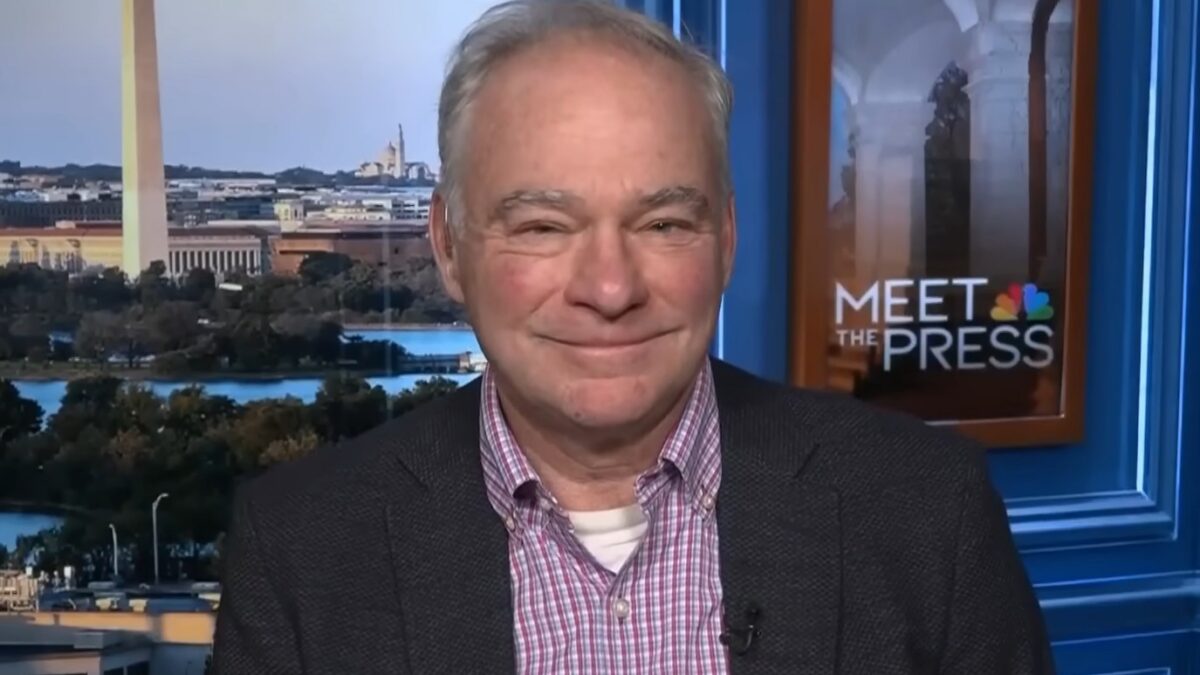
Sen. Tim Kaine, D-Va., admitted Sunday that the Democrats’ extreme gerrymandering effort was never about “fairness,” but rather about going after President Donald Trump.
On the eve of the election, Virginia’s junior U.S. senator acknowledged that the point of the gerrymandering plan proposed by his party is to disenfranchise millions of his constituents in order to rig opposition to Trump in the U.S. House of Representatives.
When asked how it was fair that 90 percent of Virginians will be represented by a Democrat, even though former Vice President Kamala Harris only won the commonwealth by five points, Kaine replied, “Ninety percent of Virginians are not Democrats, that’s true, but about 100 percent of Virginians want election results to be respected. We’re deeply worried that Donald Trump will try to interfere with the election results this November or in 2028, cause we saw him do it before.”
Despite Democrats’ consistent election interference and resistance to election integrity efforts like the SAVE America Act, Kaine argued that it was Republicans pointing out questionable circumstances in 2020 (ultimately resulting in a Biden presidency, anyway) that should be feared. The senator implied the current effort by Democrats to strip the American people of yet another Trump presidency by rigging the congressional map isn’t worthy of voters’ concern.
“We have to have a Congress that will stand up to it,” Kaine said. “In 2021, all five Republicans in Virginia went along with Donald Trump in his effort to overturn election results. And so we’re giving Virginians a chance to vote, which Republican states have not done, about whether they want to have a congressional delegation that will stand up against Donald Trump’s tyranny.”
So if Republicans represented congressional districts whose constituents expected their representatives to get to the bottom of what happened in the 2020 election, then apparently, from Democrats’ perspective, those constituents are no longer deserving of representation — because Kaine and the other Democrats disagree with them.
The last day to vote in the referendum is April 21. The date marks the end of a 45-day period in which Virginians weighed in on whether to remove four Republicans from Congress and hand Democrats a 10-1 congressional delegation advantage.
In the somewhat evenly split but blue-leaning commonwealth, a gerrymander failure would likely be driven by Democrats not showing up to the ballot box and independents switching from supporting Democrat Gov. Abigail Spanberger last to opposing one of her chief policy proposals only months into her first year in office.
While the effort has made Spanberger the most unpopular governor in memory for the commonwealth, Virginians have also been bludgeoned by incessant pro-gerrymander ads and mailers funded in the tens of millions by out-of-state donors. A slow-starting GOP countereffort has struggled to close the distance in funding and breadth of effect. Spanberger, meanwhile, just moved to further undermine Virginians’ electoral power by tying all 13 of the state’s Electoral College votes to whichever presidential candidate California decides, should the National Popular Vote Interstate Compact take effect.