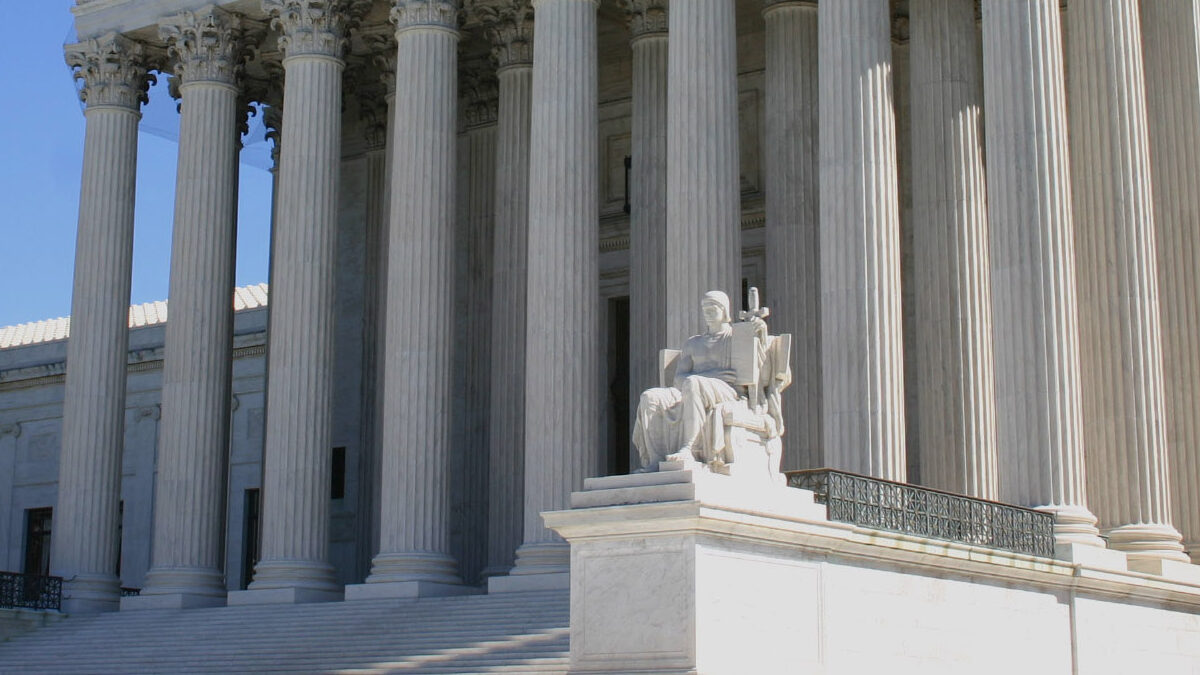

In National Republican Senatorial Committee v. Federal Election Commission (NRSC v. FEC), now before the Supreme Court, Republican committees are asking the justices to strike down limits on how much political parties can spend in coordination with their own candidates, arguing that those limits violate the First Amendment. Democratic Party committees and their allies, by contrast, are urging the court to uphold the restrictions — not primarily because the Constitution requires it, but because changing the rules now could disrupt elections and undermine what they call a “stable” campaign finance system. The court heard oral argument in this crucial political speech case in December and should issue its decision soon.
For decades, the court has recognized that the First Amendment’s core purpose is to protect robust debate about government and candidates, especially during election campaigns. In its landmark 1976 ruling in Buckley v. Valeo, the court emphasized that political speech lies at the heart of the First Amendment. As the court explained:
“[T]here is practically universal agreement that a major purpose of [the First] Amendment was to protect the free discussion of governmental affairs . . . . [I]t can hardly be doubted that the constitutional guarantee has its fullest and most urgent application precisely to the conduct of campaigns for political office.”
This has, indeed, been the court’s — and the country’s — guiding principle on free speech. Nothing is more important to a free society than the protection of political speech — especially during an election season, when Americans debate which candidates and ideas will govern them.
Yet in filings in NRSC v. FEC, and in commentary surrounding it, we see a troubling rejection of that principle. Instead, some advance a notion of free political speech as merely one value among many, something to be managed, limited, or deferred to preserve an unconstitutional status quo in order to avoid perceived “disruption” to the fall’s elections.
But the First Amendment exists precisely for that moment. It is not a secondary consideration, nor a factor to be balanced away. It is the most important guiding principle.
The NRSC is challenging federal limits on coordinated political spending, arguing that the core purpose of a political party is to support and work in concert with its own candidates. Defenders of these limits are urging the court to uphold them rather than reverse a misguided, 26-year-old decision that was based on a misreading of Buckley.
But today’s pro-regulation arguments go further than merely arguing to uphold a misguided precedent. They urge the court to maintain current restrictions in part because doing so preserves a “stable, predictable” campaign finance regime, reflects longstanding reliance on existing rules, and avoids disrupting elections.
Protection of Political Speech as Secondary
In filings before the court, Democratic Party committees intervening in the case to defend the law argue that limiting coordinated party spending is “a small price to pay to preserve ‘the integrity of our system of representative democracy.’” They emphasize the importance of a “stable, predictable campaign finance regime” and note that political actors have structured their behavior in reliance on the current system. And they downplay any constitutional urgency, asserting that there has been “no lack of robust campaign speech” under the present rules and case law.
These are not arguments about what the First Amendment requires. They are arguments about what regulators prefer.
Other filings take a similar approach. A friend-of-the-court brief submitted by the Brennan Center stresses that campaign finance regulation involves “careful weighing” of competing interests, demoting free speech to one of several competing priorities. Free speech must be balanced against other interests, it claims, such as strengthening the “overall health” of the political system.
That is a policy framework, not a constitutional one. The First Amendment does not instruct courts to balance speech against other interests and decide how much speech is “enough.” It exists to prevent the government from making that judgment in the first place.
This way of thinking — treating political speech as just another value among many — naturally leads to even more troubling conclusions. One prominent public commentator suggests that, even if the court finds a constitutional violation, it should consider “not only what [they] decide . . . but when and how those decisions should be implemented” and potentially delay relief until after an election cycle has passed.
That suggestion makes explicit what is implicit in the legal arguments: that the protection of political speech should give way to other concerns.
The First Amendment does not contain an election-year exception. It does not allow the government to restrict political speech because the existing system is familiar, or because change might be disruptive. And it certainly does not permit courts to acknowledge a First Amendment violation while postponing its remedy.
Diminishing Democracy
There is a benefit to not changing voting rules right before an election. Late changes in voting rules and procedures can be manipulated by those in power to favor one or the other party, and can generally confuse voters as to when and how they may vote. Campaigns, however, should not be confused with the mechanical aspects of elections. Elections are about who gets to vote and how votes are counted. Campaigns are the speech through which citizens persuade one another, challenge those in power, and ultimately decide the direction of the country. To treat election campaign speech as a “small price to pay” for other goals is to misunderstand both the First Amendment and the nature of democratic self-government.
If the First Amendment means anything, it means that protecting political speech — especially at election time — is non-negotiable. If the court finds that the challenged restrictions are unconstitutional, it should say so at the earliest opportunity, and not delay a ruling until after the election.
For all of the claims about restricting political speech in the name of “protecting democracy,” advocates forget an essential truth: the lifeblood of democracy is free political speech. Subordinating that right to other, extra-constitutional values diminishes democracy itself.