
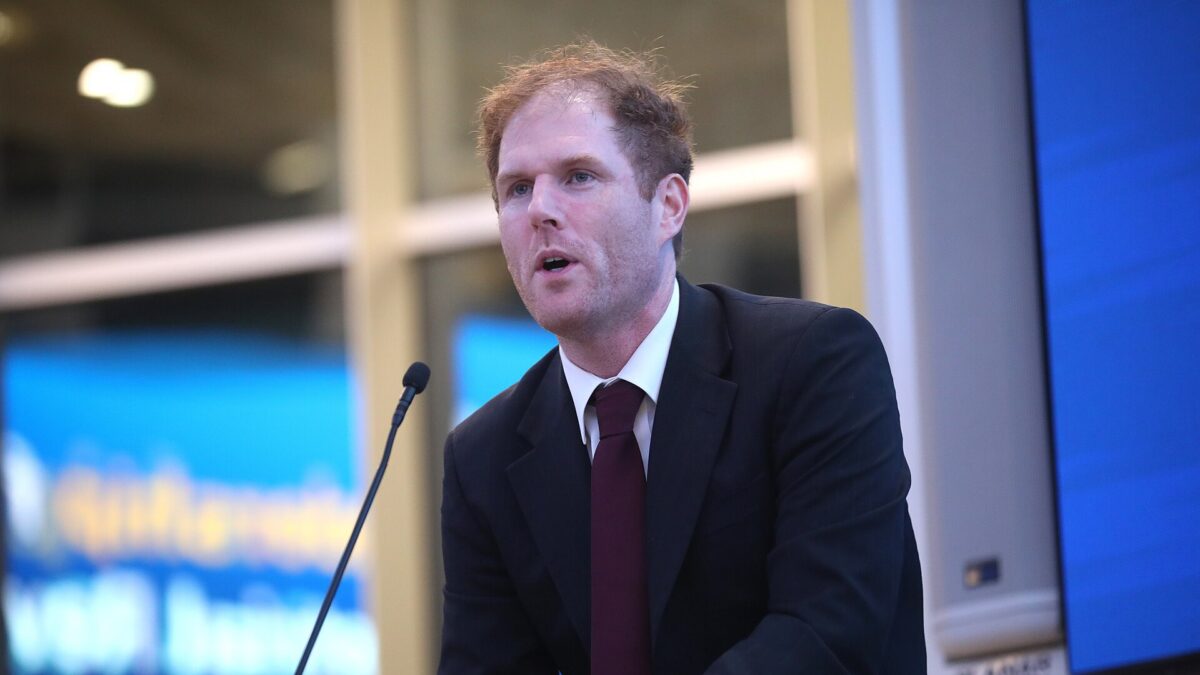

An Arizona state judge sided with Maricopa County Recorder Justin Heap on Thursday in a legal battle over the locality’s key election responsibilities. The ruling effectively kneecaps an agreement negotiated by Heap’s anti-election integrity predecessor that stripped Heap of his chief election duties.
Released on Friday, the decision by Maricopa County Superior Court Judge Scott Blaney determined that the Maricopa County Board of Supervisors (MCBOS) “acted unlawfully and exceeded its statutory authority by seizing [Heap’s] personnel, systems and equipment and refusing to return them.” Heap was sworn into office in January 2025 after defeating then-Recorder Stephen Richer — a vocal opponent of election integrity advocates — in the 2024 Republican primary and winning the subsequent general election.
“I am grateful to the court for this clear and decisive victory for the rule of law and for the voters of Maricopa County,” Heap said in a Friday statement. “The court confirmed that the Board cannot override state law, use funding as leverage, or take control of election duties assigned to the Recorder. This ruling restores both the authority and the resources necessary for my office to do its job.”
The legal battle’s origins can be traced back to less than a month before the 2024 November election, when the lame-duck Richer struck a new Shared Services Agreement (SSA) with the MCBOS to effectively strip key election responsibilities and resources from the recorder’s office and give them to the board. As The Federalist previously reported, this included giving the MCBOS control over Heap’s IT staff and finances and greater involvement in early voting, a process typically overseen by the recorder’s office.
Maricopa is Arizona’s most populous county and boasts a history of chaotic and poorly administered elections. Upon entering office, Heap attempted to negotiate a new SSA with the MCBOS to re-acquire his office’s prior election powers. The GOP recorder ultimately filed a lawsuit in June 2025 after months of resistance by the board.
Represented by America First Legal, Heap argued that “Arizona’s statutes are clear: the Legislature has delegated to the Recorder, and not to the Board of Supervisors, numerous responsibilities for election administration, and the Board of Supervisors has a mandatory duty to fund the Recorder’s conduct of his duties.”
In his decision, Blaney ruled that the “evidence at trial established that the Recorder’s inability to exercise meaningful control over election systems and staff will likely cause concrete operational harms, including inability to timely process provisional ballots under [Arizona law], resulting in voters being denied tabulation of the full ballots they had voted and to which they were entitled.” He further determined that such “harms” will not “resolve and may likely increase” without intervention by the courts.
In analyzing the facts of the case, Blaney determined that the MCBOS is statutorily obligated to fund Heap’s office so that he may “fulfill his election administration responsibilities” as specified by existing law. He additionally ruled that the board “may not use its budgetary authority to usurp the functions of the Recorder or to coerce the Recorder into ceding statutory authority as a precondition of receiving necessary funding,” and that the MCBOS’s “transfer” of Heap’s IT staff and resources to “entities under [its] control … without the Recorder’s consent” strips him of his ability to execute his statutory duties.
“The Court finds specifically that the IT staff, servers, databases, and websites seized by the Board and that were previously under the control of the Recorder are necessary for the conduct of the Recorder’s duties,” Blaney wrote. “If the Board elects not to return to the Recorder the IT staff, servers, databases, software, websites, and equipment that it has taken from him, then the Board is obligated under [Arizona law] to fund all necessary expenses for the Recorder to independently hire IT staff, secure office and warehouse space, develop replacement databases and software, and procure all equipment necessary for the conduct of his office.”
The Arizona judge notably observed that Heap “has consistently expressed willingness to cooperate with the Board,” but “the Court does not see the same willingness from the Board.”
Blaney concluded his ruling by recognizing Heap’s statutory authority to carry out the election responsibilities delegated to his office by Arizona law and that the MCBOS has a “nondiscretionary duty to fund all necessary expenses of the Recorder” as expressed in the current statute. He further required the MCBOS to return all IT staff and resources under the recorder’s control prior to the October 2024 SSA to Heap or “immediately fund the replacement of these personnel and items” so that he may execute his legal duties as recorder.
For more election news and updates, visit electionbriefing.com.




.jpg)