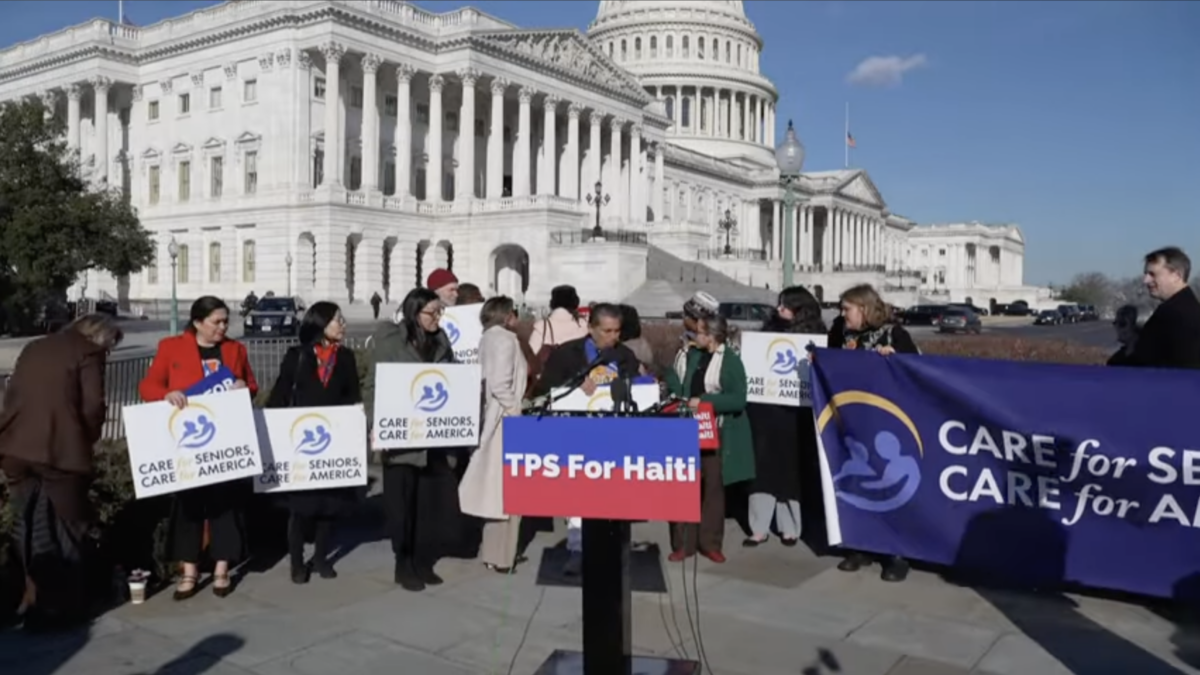

Congress proved once again on Thursday that the word “temporary” rarely means what it says when several Republicans joined Democrats to extend the longstanding Temporary Protected Status (TPS) for Haitians by another three years.
As Theo Wold, former deputy assistant to President Donald Trump, pointed out on X, “Somalians first received TPS in 1991. Haitians first received TPS in 2010. Both were supposed to last 18 months but continue until this day. Mass migration didn’t take over America over night. It happened through years of ‘temporary’ exceptions.”
His post came just hours after 10 so-called Republicans voted alongside Democrats to extend “Temporary Protected Status” to Haitians. Notably, designations for TPS are supposed to last between 6 and 18 months, as pointed out in these pages by Hart Celler. But “law is silent on how long a designation should last once conditions improve — a silence that has allowed TPS to become a revolving door of indefinite extensions for some …”
In other words, “temporary” doesn’t mean what it is supposed to.
Haitians were first granted TPS in 2010 following an earthquake. Presidents have consistently renewed the status, citing things like political instability and violence. Fox News’ Bill Melugin reported Thursday that during one surge in the open border crisis of President Joe Biden, more than 15,000 Haitians crossed the border illegally, many of whom “discarded their IDs and paperwork showing they had been living and working in South American countries for years (mostly Chile) as they prepared to make fraudulent asylum claims.” Then-Department of Homeland Security Secretary Alejandro Mayorkas “later admitted 12,000+ of them were released into the U.S.”
What was sold as a “temporary” humanitarian measure has become a semi-permanent pipeline for mass migration. Trump, for his part, has tried to rein in the abuse and exploitation of the program that was never supposed to function like a de facto amnesty. While he has had successes in his bid to end TPS for Venezuelans, he’s headed to the Supreme Court over ending TPS for Haitians. Despite the pushback from 10 spineless Republicans and the open-border left, the president appears to be one of the only Republicans keenly aware that “temporary” should be taken literally.
But the difficulty Trump has is that Democrats (and some Republicans) have warped the definition of “temporary” to execute their legislative priorities. They label policies or programs “temporary,” knowing full well once they’re in place they’re almost impossible to undo, save for a few exceptions. But “temporary” is a much easier sell.
The Deferred Action for Childhood Arrivals (DACA) program is one prominent example. It provides a deferral for deportations for two years and work permits for so-called “Dreamers” or those who claim they were brought to the country illegally while a child. Democrats framed it as “temporary” and “revocable,” asserting that the program “simply says that for three years, you are not a law enforcement priority.” The program was billed as a stopgap until Congress passed the DREAM Act.
While U.S. Citizenship and Immigration Services is not currently processing new applications, existing recipients can keep renewing their “temporary” status, according to USA Facts, which stated that “DACA renewals have historically been higher in odd years than in even years” and noted that there were more than 285,000 DACA renewals in fiscal year 2025 alone.
The same fight played out over the supposedly temporary Covid relief subsidies for Obamacare that caused a government shutdown in late 2025. Under the “American Rescue Plan,” Democrats increased the Obamacare subsidies temporarily. That “temporary” extension was then extended again through 2025 under the Inflation Reduction Act.
Both “temporary” programs were billed as temporary pandemic relief. While Democrats claimed the relief was merely temporary, they surely didn’t expect — or intend — for them to be temporary, which is why they shut the government down in 2025, demanding the “temporary” provisions be extended yet again. Ultimately Republicans were able to get the government open without extending a “temporary” program.
This playbook is now showing up in Virginia, where state Democrats are painting their proposed redistricting map — which will strip Republicans of several seats — as a “temporary” measure.
Should the Constitution of Virginia be amended to allow the General Assembly to temporarily adopt new congressional districts to restore fairness in the upcoming elections, while ensuring Virginia’s standard redistricting process resumes for all future redistricting after the 2030 census?
But if history is any guide, “temporary” redistricting will last exactly as long as it needs to — to benefit Democrats. That is, once the new map is in shape and implemented, Democrats will not seek to undo it after the 2030 census. And by the time Republicans are in a position to challenge it in 2030, they will likely be met with the same excuses they are met with now by Democrats when it comes to ending “temporary” programs.
From immigration to redistricting and everything in between, Democrats have turned “temporary” into a scheme to push their legislative priorities. And apparently, some Republicans still haven’t caught on.