
When was the last time you saw an objectively good Christian movie? I am not talking about faith-based, Hallmark-style slop marketed to older Christian women and pastors. I am not talking about an over-the-top gospel tract, with an altar call scene slammed into the third act, pretending to be a movie. I’m talking about a Christian movie that rivaled the biblical imagery and depth of J.R.R. Tolkien or C.S. Lewis.
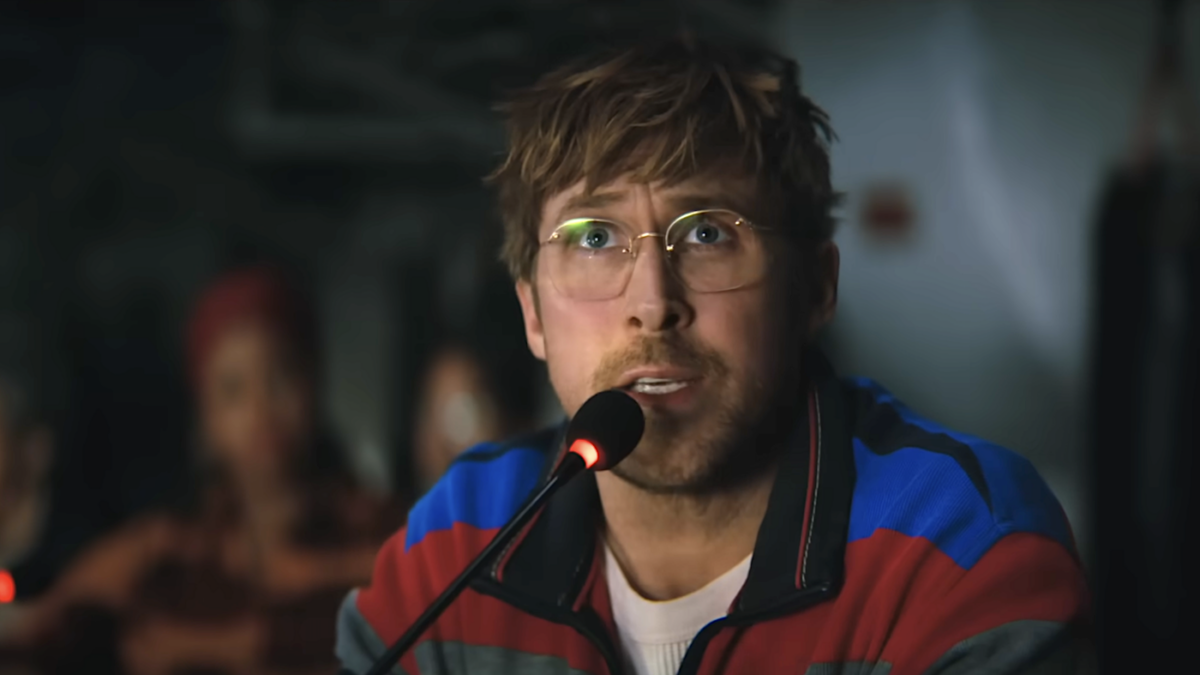
Last week, I went to see Project Hail Mary, a movie adapted from Andy Weir’s novel, knowing nothing about the book or the film ahead of time. The movie, directed by Phil Lord and Chris Miller (Spider-Verse films and The Lego Movie), follows Ryland Grace (Ryan Gosling), a school teacher who was blacklisted by the scientific establishment because of his research that contradicted scientific orthodoxy. His research catches the attention of Eva Stratt (Sandra Hüller) of Project Hail Mary, a mission to solve the sun’s drastic cooling. A “Petrova Line” of bacteria is spreading through the universe, ending the life of stars everywhere.
Project Hail Mary is an incredible near-future science-fiction epic with themes of bravery, friendship, and sacrifice, wrapped in a Gospel allegory that even the most hardened of materialistic atheists must accept.
Warning: spoilers ahead!
Let’s start with the obvious. When the movie opens, we see the ship, the Hail Mary, full of (Ryland) Grace. The first shot we see of Grace is him with long hair and a beard, waking from the coma he was placed in for the journey. He’s wearing a body suit that is shaped around his head like a robe. We’re introduced to Grace with an obvious comparison to Christ in the tomb, resurrecting from the dead.

Grace awakens to find that his two fellow passengers have already died, leaving him alone and stranded in deep space. Throughout the film, the audience travels back and forth between the present and flashbacks, which slowly reveal how Grace got here. He was a teacher. He was an outcast for his teachings. Stratt, the mother of the Hail Mary project, reached out to him to discover why the universe was dying. His teachings, which were rejected by the scientific Pharisees of his day, turned out to actually be true.
Grace learns about the Astrophage, a bacteria that travels from solar system to solar system devouring stars, including Earth’s sun. They are enemies of light, spreading darkness throughout all of creation. At one point, Grace asks Stratt if she believes in God, to which she responds, “It is better than the alternative.”
Back on Earth, Grace becomes an expert in everything dealing with Project Hail Mary. When a research lab accident kills one of the would-be astronauts before the mission, Grace is asked to become the third astronaut on board. It is a one-way trip with no hope of survival. He refuses. He is a coward. He pleads for the cup to be removed from him.
But Grace is forced to go against his will. Stratt explains to him that he does not have a choice. He is captured by guards and placed in an early coma, waking up on the ship several years later. This clear death and resurrection makes him a Jonah, refusing to go to Nineveh, with the Hail Mary being Grace’s whale. He needs to be converted whether he wants it or not. But from the moment he wakes up on the ship, he never once doubts whether he can proceed. He accepts the call.
In deep space, Grace meets an alien creature, Rocky, who is also trying to figure out how to save the world, and the two become best friends. In Scripture, Jesus says to Peter, “On this rock, I will build my church.” The film reaches its climax when Grace, the Christ figure, willingly sacrifices himself to save Rocky, the proverbial church, and all of creation.

I am just beginning to scratch the surface of all the biblical parallels. But here’s just one more. At the end of the film, after creation is saved, the question remains: Will Grace return to Earth? We don’t get a definitive answer, but it is implied that someday soon, he will return.
Project Hail Mary was not written by a Christian. It was written by a self-described agnostic, Andy Weir. But somehow, an unbeliever was able to pack biblical images into his science-fiction epic. Not once did it feel like he was preaching to the audience. There was never an altar call, and Scripture was never read. The midpoint didn’t have a pastor. Yet Weir, as an unbeliever, was able to produce perhaps one of the best Christian movies of all time — one that inspires men to be men, to risk their lives and sacrifice for others.
It is to our shame that with the millions of dollars invested in Christian movies, they wind up being nothing more than campy, Church-themed, Hallmark slop marketed to Christian Bookstore Beckys. Five different God’s Not Dead movies don’t count as science fiction. The Christian film industry has siloed expectations as to what a Christian movie can actually be, and the result has been a decades-long embarrassing blemish on the Christian entertainment industry.
Project Hail Mary should inspire us to invest in a different kind of masculine Christian storytelling that breaks the existing market categories and challenges the conventions of the female-driven faith-based market. It’s generated some $420 million at the box office, as of this writing. Those numbers don’t happen with Christian “Fix Him Up” movies. (That’s a real industry term, by the way. It’s a Christian movie marketed to women, disguised as marital intervention.)
I’ve spoken to hundreds of insanely talented artists and filmmakers with incredible stories, skills, and craft. They tell me that it is not a lack of talent, it is the capital that rejects masculine projects because the Christian entertainment industry was built for women.
If you ask me, that sounds like a market ready for disruption. But for that to happen, it’s going to require a Hail Mary. And that requires courage and risk.