
Alan Alexander Milne, the British author responsible for Winnie-the-Pooh, one of the most beloved characters of children’s literature, had one child: Christopher Robin, the inspiration for Pooh’s best friend. Christopher, in turn, had one daughter, Clare Milne, who died childless in 2012. And he’s not alone — the same is true for Mark Twain, Laura Ingalls Wilder, and Kenneth Grahame. It’s a depressing thing to consider, that some of the most-beloved authors of children’s literature over the last 150 years have no one to carry on their family name.
Yet, perhaps for many younger Americans, it’s not so sad. About twenty percent of women ages 40-44 have never had children. A recent survey found that almost forty percent of women ages 20–29 who had never given birth did not expect to have any children in the future. A growing percentage of Americans do not care about projecting a legacy into the future, and for reasons that would have befuddled earlier generations: They don’t want children; they want to focus on other things; they are concerned about the world, affordability, environmental concerns; or they don’t even like children. No Winnie-the-Pooh for them!
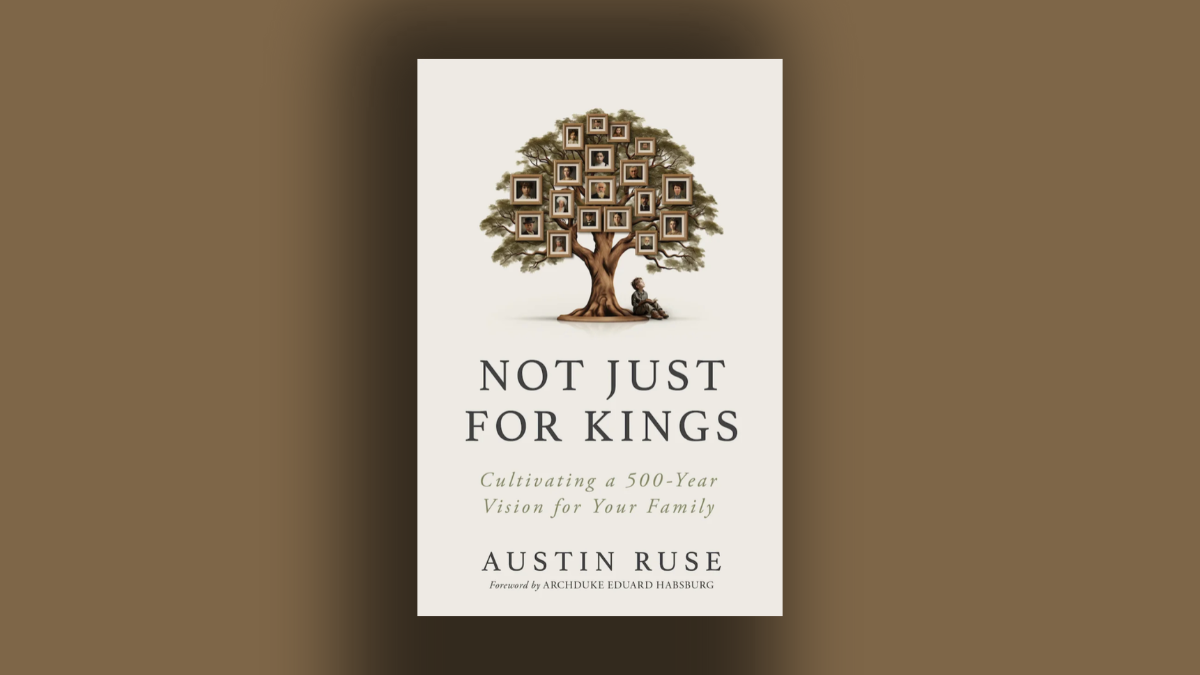
Conservative activist and author Austin Ruse wants to counter this civilizational suicide. In his new book Not Just for Kings: Cultivating a 500-Year Vision for Your Family, he draws on his own family experience, the stories of some of the great families of history, and a variety of contemporary examples to urge readers to consider what is necessary for a family name to “blaze for centuries.” It is a commendable, but at times uneven, project.
Why Bother With Projecting a Family Legacy?
Ruse is on firmest ground when arguing that pursuing a family legacy is an extension of what we might call filial piety, the obligation to honor and respect those who have come before us. “To consider that our lives are our own is the true egotism, vanity, and narcissism,” he writes. “It is not about you. It is about them,” the “them” being our ancestors.
Certainly most civilizations have understood that our ancestors, even if they are dead, maintain a claim on our lives. Our existence is a gift we owe to God, but also to our parents, who, with varying degrees of success, created the circumstances for our happiness and flourishing. Perhaps part of the reason why an increasing number of Americans have no interest in children is because many of us no longer think this way — decades’-worth of deconstructionist and woke education have trained generations of American youth to view their forebears with suspicion and cynicism. Unless you are a member of a certified victimhood identity, you are told that your ancestors were not heroes worthy of emulation, but exploitative colonizers, enslavers, misogynists, and religious fanatics to be denounced. You owe those people nothing.
Yet that narrative is decidedly and disastrously wrong. It is erroneous not only because of its blinkered view of history — there’s no denying our modern conception of human dignity arose out of the Christian West — but because it is a repudiation of natural and divine law. It requires only a few minutes of reflection to realize how much parents (at least, most of them) suffer and struggle to make their children happy. Moreover, the Fourth Commandment, “Honor your father and your mother,” is the first commandment with a promise: “that your days may be long in the land which the LORD your God gives you.” To honor one’s parents (and, by extension, one’s ancestors) is part of realizing our own human flourishing. On a natural level, it’s not hard to appreciate why: Our parents have acquired wisdom through their own successes and failures, and so the more we listen to and learn from them, the better our own lives will be.
Moreover, as Ruse rightly posits, whether we like it or not our family shapes our identity. Families tell us who we are and inculcate values that, try as we might, are impossible to destroy. The virtues, vices, and physical characteristics of your ancestors are learned behaviors and in your DNA. You can spend your life trying to suppress or escape that identity by repudiating your heritage and fashioning your own bespoke identity, but it will never satisfy you or make sense of your story in the way that coming to terms with your family will. That’s the case even for those from broken, messed-up families. It’s simple biology and psychology.
Even our names are a reflection of our parents, a gift rather than something we choose. “It is the root of identity — the first thread binding a person to a larger group. The name may be a long-standing family name or the creative whim of elated parents,” Ruse writes. I wish Ruse had directed some of his notorious rhetorical firepower on this, though I know it would have been impossible not to offend readers. But it simply needs to be said: A lot of families choose bad names for their children that say more about their affections for what’s trending or celebrity culture than about values that transcend the zeitgeist. Name your kids after biblical figures, saints, respected people in your family three, or all three. Thankfully, the befuddling phase of naming boys seemingly anything that rhymes with “Aiden” is coming to an end.
How To Build a Legacy
So, if we can appreciate, however inchoately, that our ancestors have purchase over our lives, what should we do? Ruse has many suggestions, some more feasible and reasonable than others. We should know the story of our family and pass it on to our children. Surely that seems to be the example given to us by the ancient Israelites, whose sacred texts are full of genealogies and stories of those families. The Jews’ continued existence (and prosperity) suggests the importance of knowing and perpetuating what Ruse calls our “family saga.”
We also must embrace a familial model where men are welcomed and celebrated as leaders. You can call this “patriarchy,” if you want, but, as Ruse argues, “patriarchy is a system. We do not need a system. We need a man, a person — the patriarch.” Pace ridiculous, performative hyper-masculine memes, this is servant-leadership, where men are custodians of both their families and their family stories. “He is called to lead by moral example, to sacrifice himself — his comfort, his preferences, his very life — in service to those entrusted to him, and to pass on his legacy, both the story of the family and the culture in which it lives,” Ruse writes.
The family must also foster a spirit of magnanimity. Parents and children must forgive each other and avoid pettiness. They should prize relationships over always needing to be right or demanding that family membership means holding to restrictive requirements related to opinion or lifestyle. That’s not love and mercy, but coercion, and it often has the opposite of the intended effect.
Ruse is on weaker ground in his argument that people need to stay in the community in which they grew up. I understand the sentiment here — America is a historically transient and peripatetic place, and it makes family formation across generations maddeningly difficult. But it’s also simply the way this country functions. Many professions are somewhat geographic specific; sometimes our kids meet and marry people from other parts of the country. The more salient point, I would propose, is regarding retirement. People undermine communities by moving away when they retire, rather than staying and fostering the kind of circumstances where their kids want to stay. For example, to help their kids get on their feet, parents could make an informal contract with their kids post-college: As long as they get a job and are prudential with their income, they can live at home for a certain amount of time to save money for a first house. Hopefully, their kids will marry and have kids, and grandparents will stay close to help offset the expenses of childcare, as well as pass on the virtues and stories of their family.
The weakest parts of Not Just for Kings are the many pages Ruse devotes to his own family history and that of various families he has met, especially what he calls the “great Northern Virginia clan” that takes up much of the third part of the book. Better served in a different autobiographical or biographical format (I am confident Ruse could write a good one), the overemphasis on Ruse’s network in Northern Virginia narrows a narrative that rather needs to be universalized through better examples from Scripture, history, and the literature of Western civilization. There is no shortage of such laudable families, noble and lowborn.
Nevertheless, Not Just for Kings makes an excellent, much-needed argument: We should be seeking to build a family legacy that will long outlast our years on earth. This is not because we need to narcissistically project ourselves into the future, but because it is encompassed within our filial responsibility to our forebears, and our duty to our children to give them a sense of identity and meaning in an increasingly atomized world.