
Supreme Court Justice Samuel Alito has never been a big talker. Aside from his succinct yet effective contributions to oral arguments, the senior justice is known for his calm and shy demeanor. Try to find an interview of the guy on YouTube and one will come up with a very short list of results.
But after serving 20 years at the Supreme Court, Alito is now speaking out in a major way — his way.
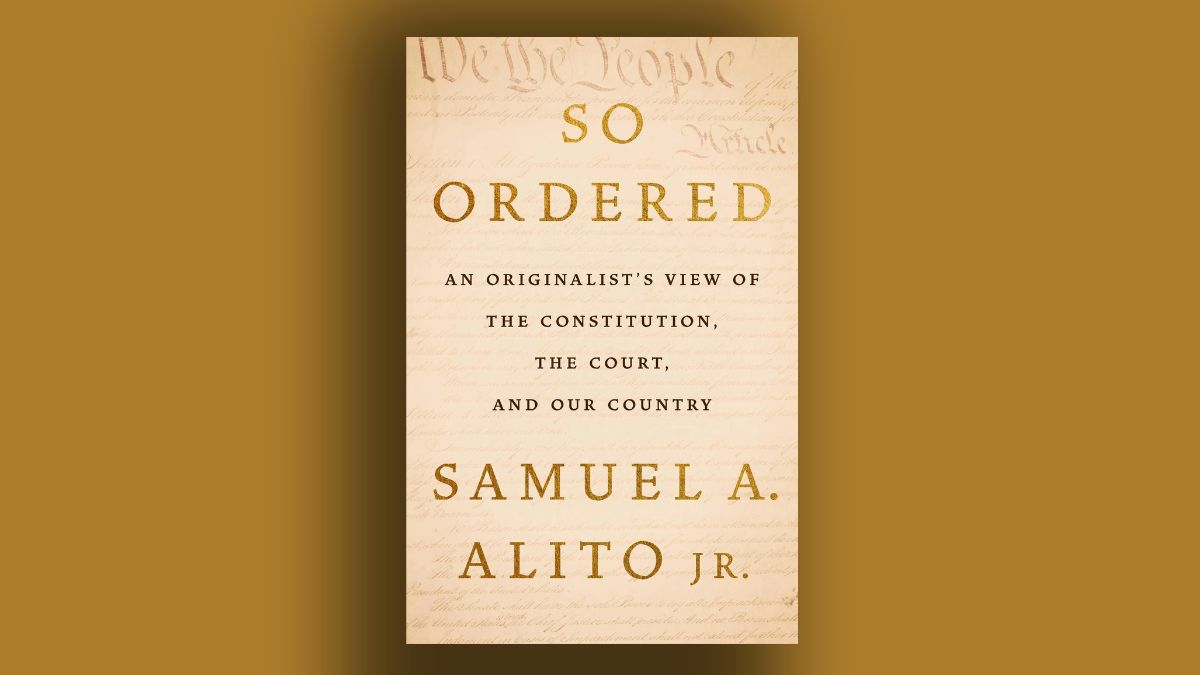
The Bush 43 appointee published his first book, So Ordered: An Originalist’s View of the Constitution, the Court, and Our Country, on Tuesday. Largely based on speeches he’s given in the years since joining the high court, the literary work includes Alito’s thoughts about judicial interpretation, the state of the Supreme Court, and a variety of other issues impacting the nation.
As the title alludes to, a big feature of the book revolves around Alito’s discussion of originalism, the judicial philosophy that focuses on interpreting the Constitution as it was written at the time it was written. The senior justice not only delves into the history of originalism and how it’s become a prominent theory among modern judges and intellectuals, but he also provides a list of “wrong turns” originalists sometimes make when assessing the law in a given case.
One example provided by the justice is “Icarian originalism.” Named after the mythological Greek boy who flew too close to the sun, the mistake comes when an originalist “soars too high” and “loses sight of what the text of constitutional provisions would have meant to ordinary people when those provisions were framed and adopted.” “Instead,” Alito wrote, “it is too quick to read certain constitutional provisions to embody broad abstract principles and to justify results that would have astonished those who framed and ratified those provisions.”
Alito’s assessment provides a roadmap for originalist judges “to keep originalist jurisprudence on course.” In doing so, he hopes to ensure proper adherence to the Constitution across the judiciary to the benefit of all Americans.
But it’s not just better originalist judging that Alito sees as a necessary component to preserving the American experiment.
He also devotes an entire section of the book to the fundamental role religious liberty has played throughout U.S. history and demonstrates why it’s needed for the nation’s survival.
Protecting religious freedom has become a core facet of Alito’s decades-long work at the Supreme Court. The Bush appointee notably authored the 2014 Burwell v. Hobby Lobby Stores decision defending religious business owners from Obamacare’s contraception mandate. He was also in the majority in Masterpiece Cakeshop v. Colorado Civil Rights Commission (2018) and 303 Creative v. Elenis (2023), in which government actors attempted to force Christians to bake a wedding cake and create a wedding website that violated their sincerely held beliefs on marriage, respectively.
Yet, in spite of these victories, Alito warns that religious freedom is a right that cannot be taken for granted. While the “primacy of spiritual values and the progress of the moral life” is a “legacy to be proud of,” he wrote, Americans must honor their obligation to “never let it die.”
The senior justice also underscores persistent threats to the Constitution. This includes the “stress test” the Covid outbreak and its accompanying restrictions placed on Americans’ constitutional rights, which he said, “highlighted disturbing trends that were already present before the virus struck, trends that we must resist and reverse …”
Taken individually, these speeches and writings shine various lights on different issues facing the republic. But when assembled together, as they are in So Ordered, they all seem to emphasize an essential ingredient to America’s survival: courage.
Throughout the book, readers are greeted with speeches about the Founding Fathers and the courage it took to found America; about the courage Abraham Lincoln possessed to lead the nation through the Civil War; about cake designer Jack Phillips’ courage in fighting the lawfare against his Christian faith; and countless other stories epitomizing such behavior.
Some Americans may face similarly difficult battles in the years ahead. Others may face smaller ones by comparison. But whatever one’s circumstances, the unspoken challenge posited to readers is for them to confront these challenges with the fortitude required to preserve the union.
For judges, it means having the bravery to abide by originalism, even if doing so is seen as the “unpopular” thing to do. For voters and lawmakers, it means having the boldness to restore proper separation of powers to a government that’s lost it. And for Americans writ large, it means replicating the willpower of America’s forefathers to become citizens who will take ownership of their country and promote a virtuous society.
Justice Alito has spent every day of the past 20 years doing this at the Supreme Court for Americans far and wide. Now, it’s time for the rest of the nation to do the same. It is so ordered.