
Universities across the country, often with the help of state legislatures, are attempting to recover some of the actual purpose of higher education, with many doing so by establishing new civics schools on their campuses.
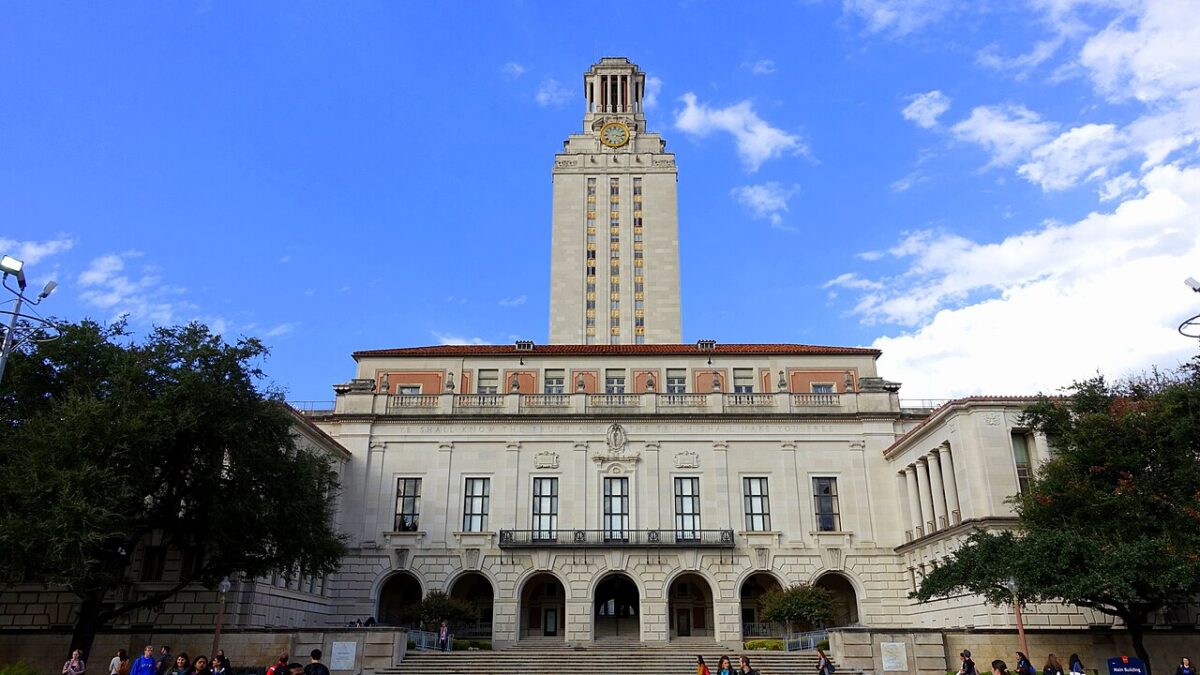
The University of Texas at Austin, according to a new cover story from Texas Monthly, is experiencing a “conservative takeover” of unfathomable proportion. Tales are told about a “degree of fear” that has seeped into every classroom and how the university leaders “contribute to authoritarianism and white supremacy.” A UT film professor moved out of the country because the school was, in the author’s telling, “no longer a place that supported marginalized people.”
These lamentations are just the latest in the grand scale of brooding and warning about the ejection of far-left nonsense that has fully taken root in higher education. Whether it be Texas Monthly reporting on professors who believe they’re living under “McCarthysim,” Vanity Fair weeping about the “beginning of the right’s higher ed crusade,” or The Chronicle of Higher Education dedicating a few hundred words to how new schools of civics are a “right-wing plot,” one begins to suspect the quarrel is less about education than about who gets to decide which books, questions, and traditions are still worthy of study.
New civics schools on college campuses are attempting to recover what’s long been lost. In Texas, it’s the School of Civic Leadership at UT Austin that will prepare students to take on “the enduring questions of the human condition and American constitutional tradition.” At the University of Florida, it’s the Hamilton School for Classical and Civic Education that proudly proclaims it is “leading a higher education revolution.” More than a dozen other new schools and centers across the country are making similar promises.
The very idea of offering students an opportunity to study the “Great Books,” or what’s commonly known as the Western canon, would, on the surface, appear to be a universally accepted good. But not to some.
Plato begins the Meno with a seemingly simple question: “Can you tell me, Socrates, whether virtue is acquired by teaching or by practice; or if neither by teaching nor by practice, then whether it comes to man by nature, or in what other way?” For more than 2,000 years, this simple query has refused to die, despite what the modern leftist academy would prefer you to believe. Again, while higher education was supposedly a way station on the path toward wisdom, it has made a dogma of skepticism and, in turn, become saturated with the motives and appetites of a particular flavor of intellectual intransigence.
We now live in the ruins of this ideological rot of our universities and require a foundational demolition. But the American people have lost faith in that quasi-religious character ascribed to our educational institutions. According to Gallup, just 38 percent of people have “a great deal” of confidence in higher education, while a growing number (25 percent) say they have “very little” or no trust in how colleges are educating students.
There are many debates about when it all began. One can simply peruse the cafeteria of explanations. Books such as America’s Cultural Revolution and The Origins of Woke attempt to provide a framework for understanding today’s leftward lurch. Each of them, in their own way, acknowledges that education is broken. But often it’s only those who oppose the resurgence of a classical paradigm on college campuses who are willing to say education has a political purpose. Ultimately, education forms a fundamentally deeper character for a person, a character that shapes the very political order it depends upon.
Thomas Jefferson, writing to John Adams in 1813, saw that the university had a true and honest purpose for America: an educational aim that would give rise to a “natural aristocracy” to guide “the instruction, the trusts, and government of society.” However, America has handed that formative power over to leftist orthodoxies that have swallowed our universities and, with them, the authority to decide which virtues, traditions, and truths shape the next generation of elites.
The situation America faces with our university campuses is no longer one of mere contemplation. There is no longer time left to wonder “what to do?” and whether a few civics schools will be enough to turn the tide. The wave has already broken on shore. Plato, Locke, Shakespeare, Tocqueville, the founders — all have been found guilty of insufficient modernity. And the authors of current discourse are more than willing to label those nudging higher education back toward its proper function as far-right reactionaries, bigoted conservative ideologues, or even worse. As a recent Goldwater Institute report has forewarned, there is big money behind efforts to “knock out” civics schools.
The “Great Books” and classics are already labeled right-wing because their enemies, as Leo Strauss puts it, “demand[] that each generation reinterpret the past on the basis of its own experience and with a view to its own future.” The university is an “activistic” entity that is hostile to the fundamental doctrines of civilized law that America, as we have come to know it today, has maintained despite its jealous opposition.
America will not sustain itself without an educated people. Those who are willing to teach enforce the standards. There will be a need for the great men of this age who necessarily accept the harder duty, which is more than mere commentary. If the “Great Books” and civics education are now “right-wing,” so be it. Only one side now is willing to inherit the charge of preserving and perpetuating our civilizational inheritance that made our country great in the first place.