
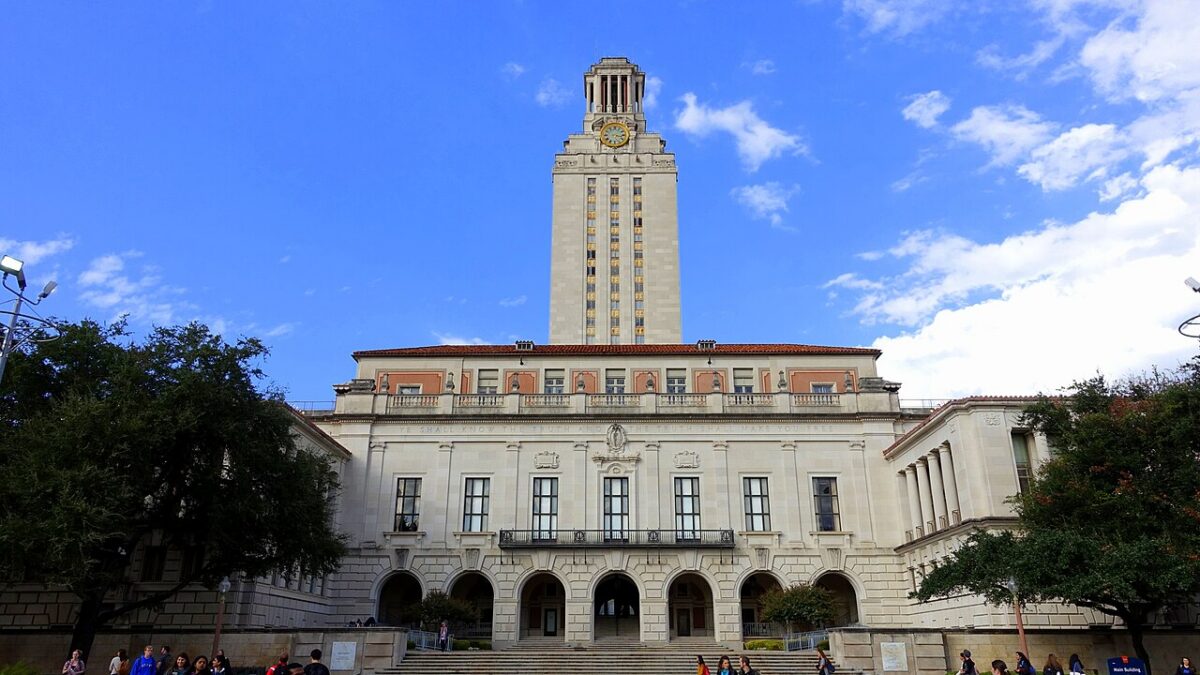
The recent reaction to the video of a large section of seemingly South Asian fans cheering at the University of Texas at Austin football game drew attention to the skewed demographics at that school and the state’s university system writ large.
Racial and ethnic minorities make up 68.9 percent of undergraduates, and 56.2 percent of undergraduates are women. Meanwhile, only 13 percent of enrolled undergraduates at UT Austin are white males.
That number surprised many, but Texas law has been artificially inflating racial “diversity” at its universities since the 1990s.
While on the one hand, Texas law requires that no more than 10 percent of non-residents of the state be admitted to universities, there is another 10 percent rule that helps to artificially boost “diversity” at its schools.
Texas had attempted to use race as an admissions criterion in the 1990s, but in 1996, the federal Fifth Circuit Court ruled that Texas was not allowed to do so.
The decision had immediate impacts that revealed how race-based admissions had affected admissions. The class admitted immediately after the 1996 ruling saw major decreases of Hispanic (minus-15 percent) and black (minus-25 percent) enrollment.
In 1997, the Texas legislature responded to the court decision with an explicit attempt to shoehorn in racial “diversity” to the UT system. The Texas legislature passed the “Top 10 Percent Law,” which required that the top 10 percent of each private or public high school graduating class would receive automatic offers of admission into the UT system or any state-funded university.
That wiped merit out of the equation, because the rule does not account for the 10 percent of academic performers in Texas, but rather the top performers at each high school. Doing so allowed lower-income, lower-achieving schools overall (which typically correlate heavily with non-white areas) guaranteed slots because the students were only competing against others at their school, instead of applicants across Texas.
A 2009 decision allowed UT Austin even greater ability to find students from outside the 10 percent framework. Now they are only required to fill 75 percent of Texas resident slots with automatic admissions, and the top 5 percent are guaranteed slots at the Austin flagship campus. That means only 15 percent of UT Austin slots given to Texas high schoolers are truly based on merit, before the 90 percent threshold is met and the last 10 percent can be filled with out-of-state or foreign students.
The result is that the high-performing students attending Texas’s top high schools, which are overwhelmingly white and Asian, are being discriminated against by lower-performing students who happen to outperform their low-performing classmates. In other words, a class of 500 students with an average SAT score of 1300 would have the same number of slots for the same size class where the average SAT score is 1050.
The percentage system discriminates against high performers at smaller schools as well. If a student wants to get into UT Austin from a private high school with a high-performing graduating class of 200, they must be in the top 10 students there. If they are number 11, they will not be guaranteed a slot. On the other hand, a public school with a 1,000-student graduating class has 50 slots up for grabs.
All 200 students at the private school could outperform the 1,000-student public school, but that does not matter in Texas. Moreover, it is possible that a high-performing high school could send its top 5 percent of students to Ivy Leagues, other private institutions, or out-of-state schools, but that does not mean it falls to the next student in line. Rather, it means that the school did not use its UT Austin slots for that graduating year, and the next-best students are still locked out of UT Austin.
Today, that system is still in place, and when the race-jiggering admissions policies are coupled with Texas’ demographic change over time, we see the heavily skewed demographics at schools like UT Austin.
Since 2000, Hispanics have made up the vast majority of demographic change in Texas, but while Asians represent a much smaller percent of the overall population, they have more than doubled their share of the population in the past 25 years.
In 2000, white people made up 52.4 percent of the Texas population, while Hispanics made up 32 percent and Asians, which includes Indians, made up 2.7 percent. Census Bureau estimates for 2025 show that whites are now down to 37.3 percent, Hispanics are up to 40.9 percent, and Asians are at 6.7 percent. According to Every Texan, Indians make up the largest share of Asians in Texas at 32 percent of the total.
As The Federalist CEO Sean Davis noted, “People are upset by the systemic displacement and replacement of Americans, specifically white men, with foreigners across every major institution in America. That it is happening in a state like Texas makes it even more stark.”
Despite the fact that white Americans are now a minority in Texas, the state still tips the scales in favor of non-whites in their admissions, making the burden of any prospective white students to be accepted into schools much harder than any other group.










_-_DSC08595.jpg)