
You have to count, or none of it makes sense. Remember that Congress created the H-1 labor category in the 1950s to allow temporary labor from foreign experts “of distinguished merit and ability,” after which Congress created the H-1B visa in 1990 to allow visiting workers to do scientific and technical work in the U.S. that requires “theoretical and practical application of a body of highly specialized knowledge.”
The premise of the H-1B visa is that it allows the rocket scientist who lives overseas to come contribute to American industry for a while, doing highly specialized work that no American is able to do. It was created as a gap-filler, a way of importing brilliant minds for work that requires esoteric knowledge. With that in mind, look at this H-1B application from Stanford University:
Since Stanford is specifically looking for a Financial Analyst 3, you can look at the skill level and job duties associated with that category and level by looking for other help-wanted ads for Financial Analyst 3 positions at the same university. Here’s one. It requires a bachelor’s degree and an ability to perform “accounting-focused analysis,” with “strong Excel skills.”
There’s apparently not a single American who has a bachelor’s degree and understands accounting, so Stanford has no choice but to import a foreign laborer to fill in this extraordinarily technical knowledge gap. And, I mean, knowledge of Excel? Of course you have to look overseas for so rarefied a skill. May I interest you in buying the Brooklyn Bridge?
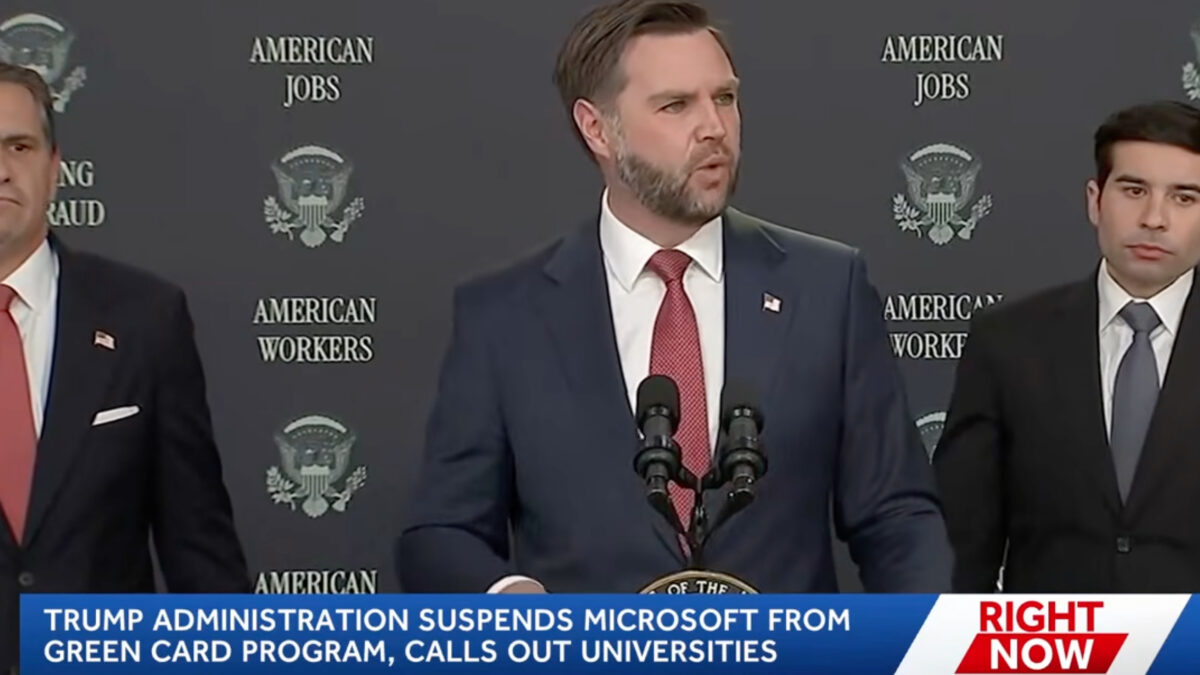
At his recent press conference on the abusive corporate use of foreign labor visas, Vice President J.D. Vance mostly talked about this topic: the H-1B visa, the general specialized labor document. And universities are very much implicated in that discussion.
But the other kind of temporary labor visa that he discussed is also important. It’s the J-1 visa, and it allows universities to import foreign laborers for temporary work as researchers, usually in STEM fields.
Predictably, Reason magazine published a defense of the J-1 visa in response to Vance’s press conference, under the headline, “No, Giving Immigrants Research Jobs Is Not Fraud.” But they got the whole thing completely wrong, starting with the fact that the J-1 visa isn’t for immigrants. It’s explicitly and exclusively a nonimmigrant visa, for temporary labor.
They also didn’t count, and here’s where we get into the numbers. If you get a STEM Ph.D. at an American university, the one place you’re almost certainly not going to get a job in your field is at an American university. A 2023 paper on recent post-Ph.D. academic employment found that, on average across academic fields, “only 25.2% of 2000–2013 STEM Ph.D. graduating cohorts are ever observed in a tenure-track position, compared to an average of 42.8% for 1960–1980 cohorts.”
See also this 2024 paper on individuals with engineering doctorates, which finds that about 12.4 percent will end up with tenure-track jobs, and “most engineering PhD graduates will never secure a tenure-track faculty position.”
Famously, American universities have an overproduction problem: They’re issuing far more Ph.D.s than the job market can absorb. As the headline to that linked story says, “Science PhDs face a challenging and uncertain future.”
While results vary by field, the same is true for postdoctoral fellowships, which are usually understood to be a waypoint on the road to tenure-track employment at a research university. Here’s a chart from the NSF’s National Center for Science and Engineering Statistics on the percentage of Ph.D.s who got postdocs in several fields in recent years:
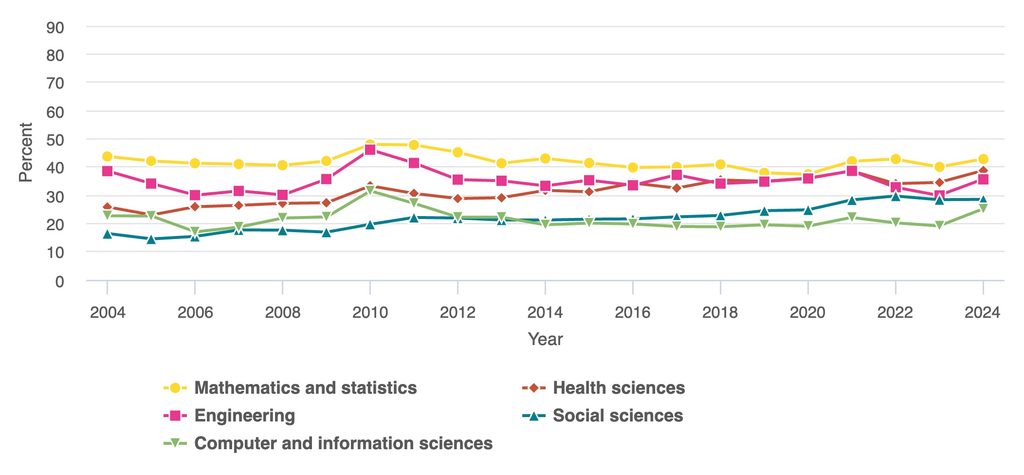
Some of these fields have such good prospects that they almost soar to somewhere near half. There are other stories to tell about this chart, and some of these Ph.D. recipients are working in private industry, but many people who earn science and engineering Ph.D.s from American universities aren’t finding research jobs in American universities.
With that fact in mind, go look at Stanford’s page on the university’s postdoctoral scholars, which proudly gives you this information: “About 66 percent of postdocs are international.”
The Federalist sent a series of questions to Stanford University about the institution’s use of J-1 and H-1B labor, but we have not received a response.
All of these declining academic prospects for American scientists and engineers arrive in the context of federal grant dependency, and the much-discussed “perverse incentives” of an academic climate in which junior faculty live or die on their ability to score money from the government. If you want to be a professor of science or engineering, you have to produce cash for your university. Cheap foreign labor arrives in that environment, not in the quest for pure knowledge.
Watch carefully for rhetoric about the university as a great intellectual center for the pursuit of scientific understanding for its own sake, and the need to import foreign researchers simply because of the richness of the expert knowledge they bring to America. Academia is not too pure to respond to financial incentives.