
Things are happening in higher education, and conservatives have good reason for optimism, though many victories may be reversed with a change in political leadership. One theater of action usually goes unnoticed: general education.
The term sounds bland, and gen ed policies often look at first sight like a mush of bureaucracy and bean-counting. But changes to general education are one of the handiest levers of reform available to conservatives.
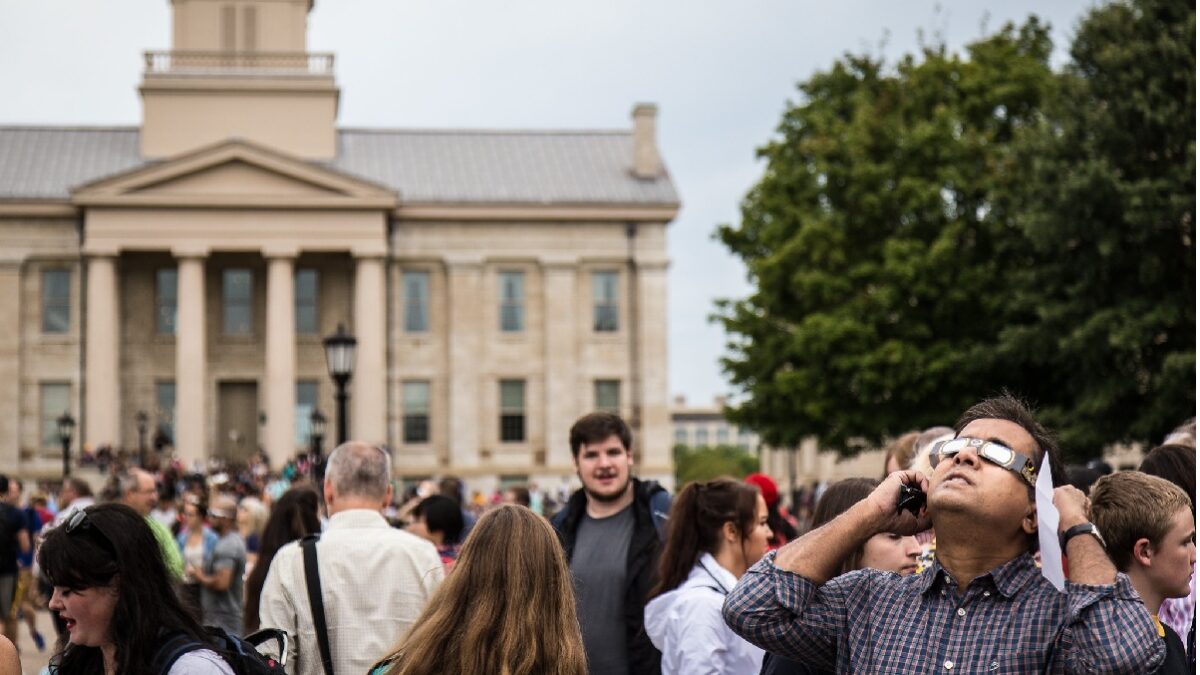
Prime example: This summer the Iowa legislature passed and Gov. Kim Reynolds signed a law mandating that college students in the state take one course in U.S. history and one course in American government. Courses shall be introductory and straightforward, covering central and momentous features of our past and present. The law stipulates, too, that courses at University of Iowa shall be designed and run by the new Center for Intellectual Freedom on campus, not by history, political science, or related departments. (I am on the board of the center.)
To appreciate what Iowa politicians have done, consider what general education requirements are for. The model goes back many decades, to when colleges and universities began to divide into disciplines in which students would major then graduate with a specialized preparation.
General education took place before that, in freshman and sophomore years. It introduced students to a body of knowledge that all recipients of a degree possessed regardless of major. Students learned of seminal developments in the course of history, masterpieces of art and literature, breakthroughs in science and technology, great ideas and revolutionary events and monumental figures.
All students took a long survey of Western Civilization, U.S. history from the Puritans forward, freshman composition, foreign language, and basic math and science courses. To graduate knowing nothing of the Renaissance, the Founding, and Newton’s laws was disallowed.
Iowa institutions agree with this conception. Iowa State says, “courses in general education are designed to establish a strong, intellectual foundation for all specializations,” while University of Iowa promises that its “Core requirements provide students with a broad foundation of knowledge.”
Those descriptions imply that no advanced courses or special-topics seminars may count; the content of the courses approved for gen ed credit must be capacious and broadly applicable to our country and culture. Indeed, the very number of qualifying courses must be limited.
If you examine the list of approved courses at Iowa State, however, fully 379 entries fall under one area alone, Arts and Humanities. Some of them do fit the traditional gen ed mold in their breadth and centrality, such as “History of Christianity: Early to Medieval” and “Survey of British Literature to 1800.” Many more, however, are boutique courses that contribute only marginally to foundational knowledge, including “Racism in American Popular Media,” “Science Fiction,” and “Principles of Sports Media and Communication.”
At University of Iowa we have 11 required areas. Under one, Understanding Cultural Perspectives, are 70 offerings; under another, Values and Society, we have 69. It is good that basic courses on the Bible, classical mythology, and American religions count, but not that “Brazilian Culture and Carnival” and “Black Television Culture” do, too. The set-up enables each student to customize his curriculum and do so with niche courses with a political slant.
The new law requiring broad surveys of U.S. history and government curtails it. No longer can students get a degree and not encounter the Bill of Rights, the Civil War, the Pilgrims and Puritans, and the Depression. Traditions, actions, and expressions that make up our history and polity will not be random knowledge. Courses that focus on one identity group or pursue tendentious topics (“Racism in . . .”) are disallowed. An American core is preserved, the foundations of our republic taught and tested.
Indiana has recently taken a different action illuminating how the current structure of general education at many colleges can actually hinder reform. Last year, officials set about consolidating or eliminating departments and programs that produce fewer than 15 bachelor’s degree recipients per year. It was presented as a cost-efficiency measure.
This regulation shifts the measure of a department’s success from the number of students who enroll in its courses to the number of students who select it as their primary major. This is disastrous for many departments and programs that have few majors in spite of the size of a public university such as Indiana, which produces more than 8,000 bachelor’s degrees a year.
The Department of African American and African Diaspora Studies lists 11 professors on its faculty page, but according to the U.S. Department of Education, only four students in 2024-25 graduated with an undergraduate degree in that field.
How does the department justify its existence, then? By offering 21 courses that meet gen ed requirements in Bloomington, including “Survey of Hip Hop” and “Contemporary Black Film.” Students enroll in one of them and get a gen ed category out of the way.
Although hardly any kids proceed to the major, the head of the department can go to the dean at year’s end, point to overall enrollments, and declare, “We’re doing great! Give us more resources.” The bare fact of so few majors suggests that, without the gen ed designation, which coerces students into the room, those enrollments would shrink considerably.
In this case, general education shores up otherwise unpopular departments. It explains, too, the existence of gen ed categories that have a political edge. At Rutgers University, there is a “diversity” requirement whose courses teach students to “Explain the processes or histories that create or fail to create just, productive, egalitarian and collaborative societies,” while at U-Mass in Amherst, the Social and Cultural Diversity strand has courses in which “Students will gain knowledge of structural and cultural forces that shape or have shaped discrimination based on factors such as race, ethnicity, language, religion, class, ability, nationality, sexuality, or gender.” The “studies” departments provide those courses.
Such requirements are all too common, and one purpose is to ensure the survival of certain programs. A reform that drops the DEI angle in general education and instead requires basic civics and history instantly alters the ideological nature of the curriculum.
Conservatives have been writing books and issuing exposés of bias for many years. Those efforts haven’t slowed the course of political correctness one bit. What has happened in Iowa, Indiana, and a few other states lays out another path of reform.
Recently, the Washington Post ran a story with the headline, “Why colleges are cutting back Black studies departments.” It mentions actions in Iowa, Indiana, Texas, and Kansas that have either closed African American Studies or merged it with other departments.
Protests at the cuts have been markedly weak as well, perhaps because the numbers are so stark: the Post story noted that for the last three years only 700 of the hundreds of thousands of degrees granted have gone to African American studies majors. Students are voting with their feet, and with legislators acting accordingly, general education may no longer support the progressive agenda, but instead oppose it.