
We have an intentions versus outcomes problem, and Vice President J.D. Vance is becoming more vocal about it.
In 1952, the McCarran-Walter Act reorganized the American immigration system over President Harry Truman’s overridden veto. Among the features of the new law was a provision allowing for the temporary entry of “an alien having a residence in a foreign country which he has no intention of abandoning … who is of distinguished merit and ability and who is coming temporarily to the United States to perform temporary services of an exceptional nature requiring such merit and ability.” That law created the H nonimmigrant classification for guest workers, which included a new H-1 category for highly skilled visitors.
In 1990, Congress amended those requirements, replacing the language about “distinguished merit” with a “speciality occupation” category for work that requires “theoretical and practical application of a body of highly specialized knowledge.” (You can read a detailed legislative history of the H-1B visa here.)
The thing we know as the H-1B visa was born in that definition, and you can see the implication: America was opening its doors to the finest minds in the world, allowing brilliance to flow to our shores. How could we turn away the extraordinary gifts of the German physicist, the deep skill of the Scandinavian chemist, the exquisite professional expertise of the Taiwanese materials engineer?
From the most recent annual report of the Department of Homeland Security on the “Characteristics of H-1B Specialty Occupation Workers,” here’s what we got:
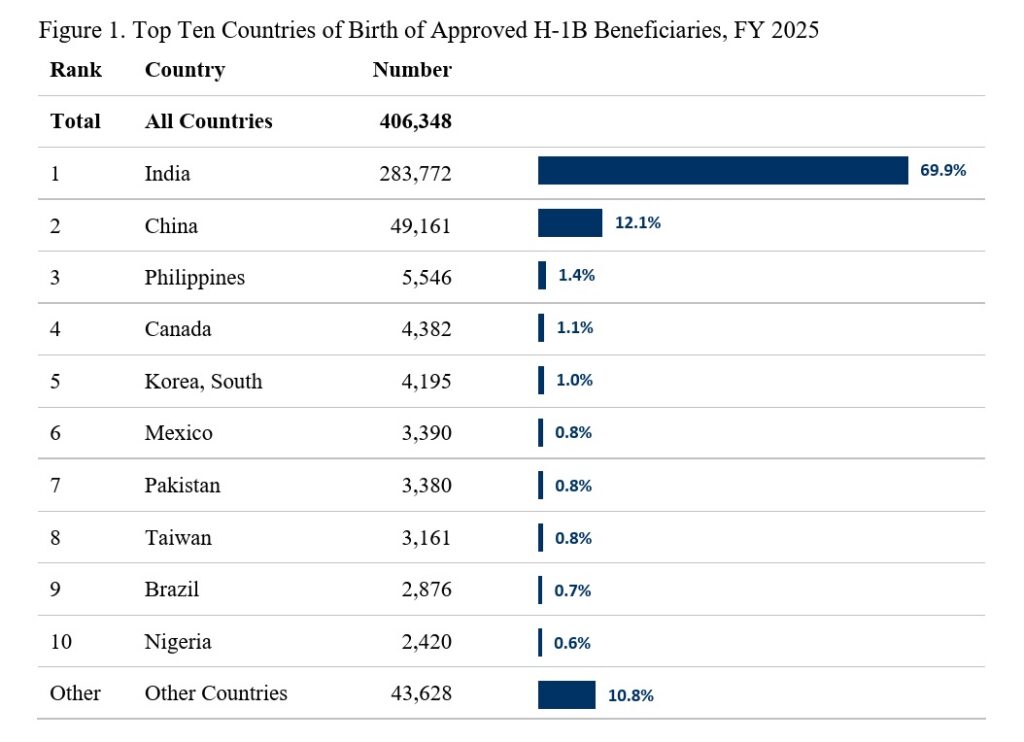
The H-1B visa has become a pipeline to India for cheap software guys, sitting under florescent lights in Palo Alto and fixing the glitches on the app you just used to order a burrito delivery. The much-noticed crisis in H-1B visas is a topic of both political controversy and growing scholarly scrutiny, all of which was recently discussed at length by Robert Verbruggen at City Journal. Among other conclusions, Verbruggen writes, “Manhattan Institute senior fellow George Borjas made waves with his finding that H-1B holders are underpaid relative to similar Americans.”
You can click on the link to that paper from Borjas to find this conclusion: “On average, H-1B workers earn 16 percent less than comparable natives.”
A category of nonimmigrant temporary labor that was designed to bring scientific and technical knowledge to the United States has become a tool to lower American wages and replace American workers. As the Wall Street Journal reported in 2025, “Amazon, the largest H-1B sponsor in the U.S., won approval for more than 14,000 H-1B visas in fiscal 2025 — the most of any company — even as it has announced layoffs affecting tens of thousands of jobs in recent years.” Americans leave with a pink slip, foreign workers arrive with a visa, and “on average, H-1B workers earn 16 percent less than comparable natives.”
Software engineers arriving from India on H-1B visas are mostly not the huddled masses yearning to breathe free, taking their shot in America like your grandma who paid her own way to Ellis Island with a steerage-class ticket. Rather, they mostly come from India-based body farms like Infosys, which sell cheap tech labor by the box lot.
Last year, the Trump administration imposed a $100,000 fee on many new H-1B visas, though the collection of that fee has been blocked by federal judges.
In a new order issued this month, Trump explicitly required federal agencies “to consider petitioner employers’ recent or planned layoffs of similarly situated U.S. workers when considering H-1B visa applications,” pursuing a reduction of new applications under conditions of increased scrutiny.
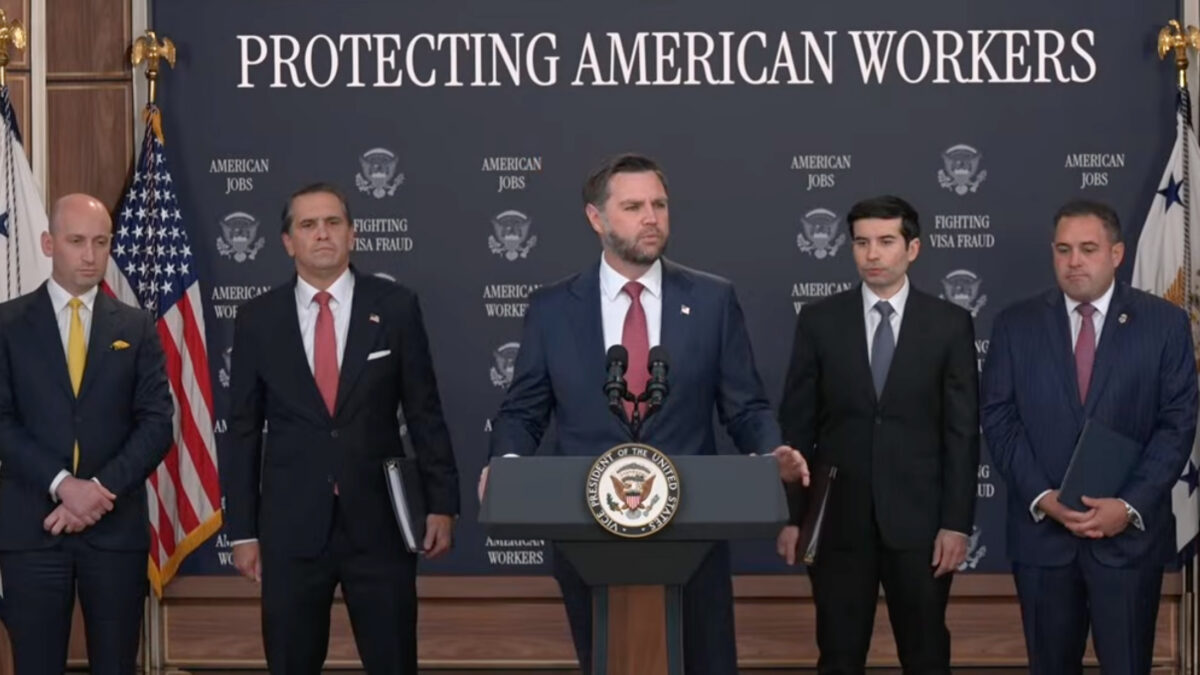
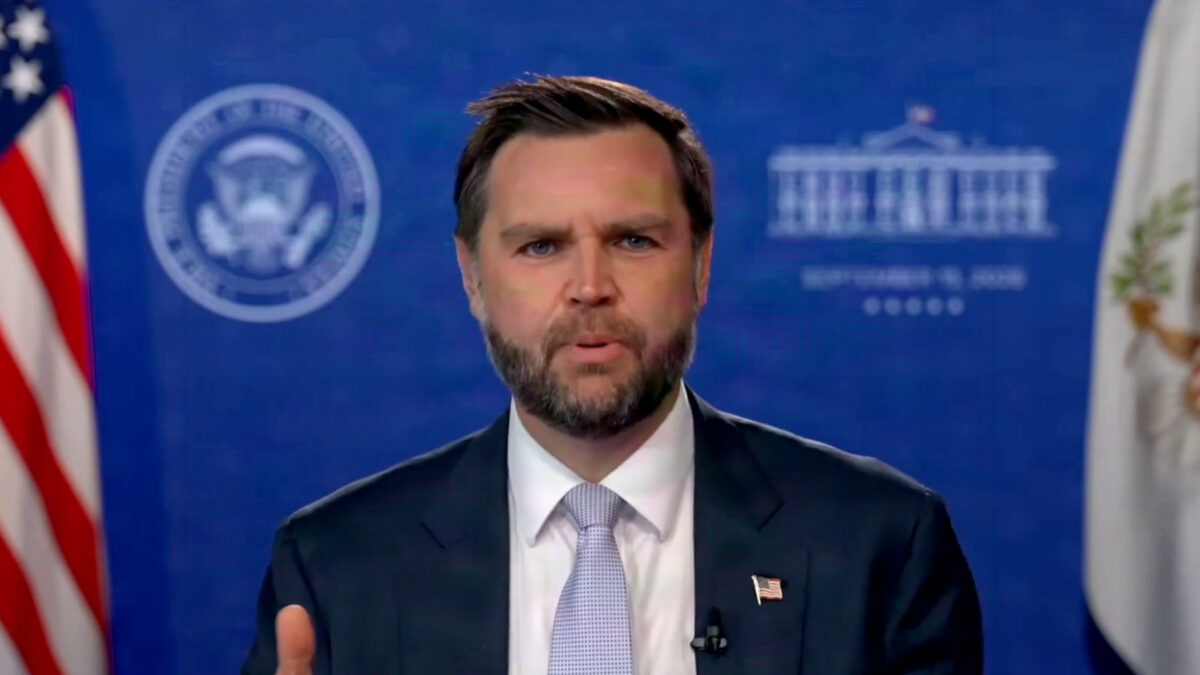
Though he framed it this week as his own position rather than a policy statement from the administration, Vance is becoming more explicit about his view that the specialty occupation visa needs more than tinkering and may be beyond salvation: “My view is the H1-B program is completely broken.”
The appearance of debate inside the administration suggests the possibility of a growing crackdown, but real action to sharply limit H-1B visas would require congressional action. Many bills on that topic are parked in committee, right now, and here’s one example as a closing thought: The “High-skilled Immigration Reform for Employment Act,” H.R.6305, was introduced in November by Rep. Raja Krishnamoorthi, an Illinois Democrat. It would sharply increase the annual cap on new H-1B visas, from 65,000 a year to 130,000.
As Krishnamoorthi notes in his press release on the bill, “The legislation is supported by ITServe Alliance, the nation’s largest association of IT services organizations.”
Elections matter.