

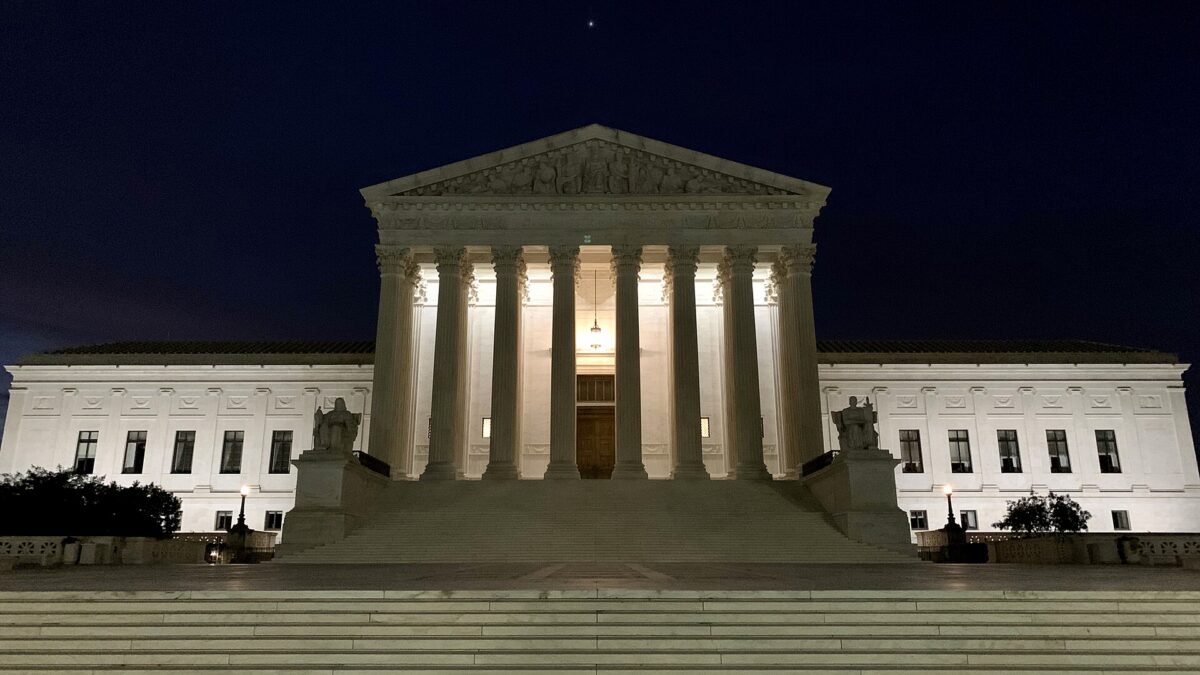
The U.S. Supreme Court has agreed to hear a major case involving a core tenet of President Trump’s deportation agenda.
The high court announced on Thursday that it will hear arguments in Rhoney v. Barbosa da Cunha during its 2026 term. The case deals with whether the federal government can detain certain categories of illegal aliens during their removal proceedings without a bond hearing.
At issue is a revised Department of Homeland Security (DHS) policy adopted last year. As described by SCOTUSblog, the guidance relies “on a provision of federal immigration law indicating that noncitizens ‘shall be detained’ for a removal proceeding ‘if the examining immigration officer determines that’ they are ‘not clearly and beyond a doubt entitled to be admitted’ to the United States.”
“Until last year,” the outlet noted, “the government had not applied that provision to noncitizens who already had entered the U.S. and spent years or even decades here.” By applying this new policy, the administration aimed to detain these individuals without a bond hearing.
According to the government’s brief, the Rhoney case centers around Ricardo Aparecido Barbosa da Cunha, a Brazilian national who unlawfully entered America “around 2004 or 2005” and was arrested by immigration officials at a traffic stop last year. The Trump administration subsequently initiated removal proceedings against him “for being present in the United States without being admitted or paroled, and being inadmissible under [federal law], for not possessing valid immigration documents.”
As such, the agency concluded that Barbosa da Cunha would be detained throughout the rest of his removal proceedings. An immigration judge later denied his request for a bond hearing.
Barbosa da Cunha filed a habeas corpus petition challenging his detention without a bond hearing, claiming that the administration had violated the Fifth Amendment’s due process clause and the Immigration and Nationality Act (INA). A federal district court later granted his request and ruled that the INA provision cited by the government “does not apply to [Barbosa da Cunha], and that instead his detention is governed by [a separate INA provision], which permits release on bond or conditional parole while an alien’s removal proceedings unfold.”
As a result, Barbosa da Cunha received a bond hearing and was subsequently released on bond in October 2025. The 2nd Circuit Court of Appeals later upheld the lower court’s ruling.
The Supreme Court’s decision to take up the case likely stemmed from the circuit courts’ split on the policy. According to CBS News, two of them have sided with the administration, while nine have ruled against.
A date for oral arguments in Rhoney v. Barbosa da Cunha has not been announced as of this article’s publication.











.jpg)