
I traveled to Belgrade, Serbia, this past weekend as an international observer of the country’s Oct. 25 parliamentary elections. What I witnessed was a remarkably thorough system of election security, administered by election officials representing competing political parties, with multiple safeguards designed to prevent fraudulent voting.
What I also witnessed was an opposition movement seemingly prepared to reject the legitimacy of the election if it lost, based on a carefully prepared preelection narrative that had little connection with reality.
The irony, of course, is that the opposition won, so the anticipated (and feared) protests turned instead to an exuberant celebration that lasted well into the wee hours of the morning.
The Student List, a political movement that emerged from nearly two years of student-led protests against the government of Aleksandar Vučić, won a decisive victory. According to preliminary official results, the Student List received approximately 52.7 percent of the vote, securing 140 seats in Serbia’s 250-member parliament. The governing coalition received approximately 39.2 percent, securing 104 seats. Vučić conceded defeat.
But the election-day rhetoric preceding that victory deserves scrutiny, particularly because it illustrates a dangerous tendency in democratic politics: the willingness to treat elections as legitimate only when one’s preferred candidates prevail.
Preparing Specious Allegations
Before the polls had even opened, representatives of the Student List were already promoting specious allegations that appeared designed to provide a trigger for potentially violent protests should the Student List not prevail on election day.
One involved the voter rolls. Opposition activists complained that hundreds of thousands of registered voters lacked complete addresses, including street names or house numbers. Radio Free Europe/Radio Liberty reported that approximately 500,000 registered voters had incomplete addresses, presenting that fact as a potential indicator of electoral fraud.
That sounds alarming — until one considers the realities of rural Serbia. In many small villages, formal street names and house numbers are simply not used in the manner familiar to Americans. And they are certainly much less of a concern when voting is in person rather than by mail. An incomplete street address is not, by itself, evidence of a fictitious voter. Yet the information was pressed by a compliant media as though it were, helping to craft a narrative that might have later served as a trigger if one had become necessary.
Certainly, the voter rolls should be examined for duplicate registrations, nonexistent voters, or other irregularities. But the absence of a conventional street address does not establish any of those things. Treating it as proof of massive fraud, without more, was irresponsible.
Spreading Suspicion of Voter Intimidation
The second allegation involved claims that government employees had been instructed to photograph their completed ballots to demonstrate that they had voted for the governing party — a particularly troubling form of voter intimidation if true.
Here, too, the reality I observed was quite different from the sweeping allegations.
At the polling places I visited, election officials were acutely aware of the possibility that voters might photograph their ballots, as the Student List leaders and their media friends had been raising that concern in the period leading up to the election. And they took affirmative steps to prevent it.
In some precincts, officials required voting booth curtains to remain open sufficiently to allow election workers to observe whether voters were using their phones. In others, officials simply instructed voters to put away their phones before marking their ballots.
At one polling place, the party representatives conducting the election informed me that a voter actually did photograph his completed ballot. Election officials intervened, directed him to delete the photograph from his phone, and verified that he had done so before allowing him to deposit his ballot in the ballot box.
This was not a case of election officials turning a blind eye to potential misconduct. It was an example of election officials enforcing the rules in real time.
To be clear, my observations cannot establish that improper ballot photography never occurred elsewhere. Indeed, Serbian election-monitoring organizations reported incidents at other polling places. But the incidents I personally witnessed demonstrated a determination to prevent precisely the misconduct that opposition spokesmen were alleging.
More importantly, the officials enforcing those rules were not merely representatives of the governing party.
Serbia’s Election Safeguards
Serbia’s election procedures contain several safeguards that Americans would do well to study.
First, the polling places I observed were staffed by representatives of both major competing political movements. In most cases, representatives of one or more smaller parties were present as well.
This bipartisan — and frequently multipartisan — participation was not merely ceremonial. Representatives of the competing parties not only actively monitored the voting process but they were the ones actually conducting it, ensuring that the rules were followed and that neither side could easily manipulate the proceedings.
Second, every voter was required to present photographic identification.
The identification documents were carefully scrutinized and compared against a comprehensive precinct voter roll. And unlike in too many U.S. states, there could be no last-minute, same-day additions to the rolls. Election officials verified that the individual presenting the identification was the person listed as eligible to vote.
Third, after identification was verified, the voter was required to sign the voter roll next to his or her name, creating an additional record that the registered voter had appeared and received a ballot.
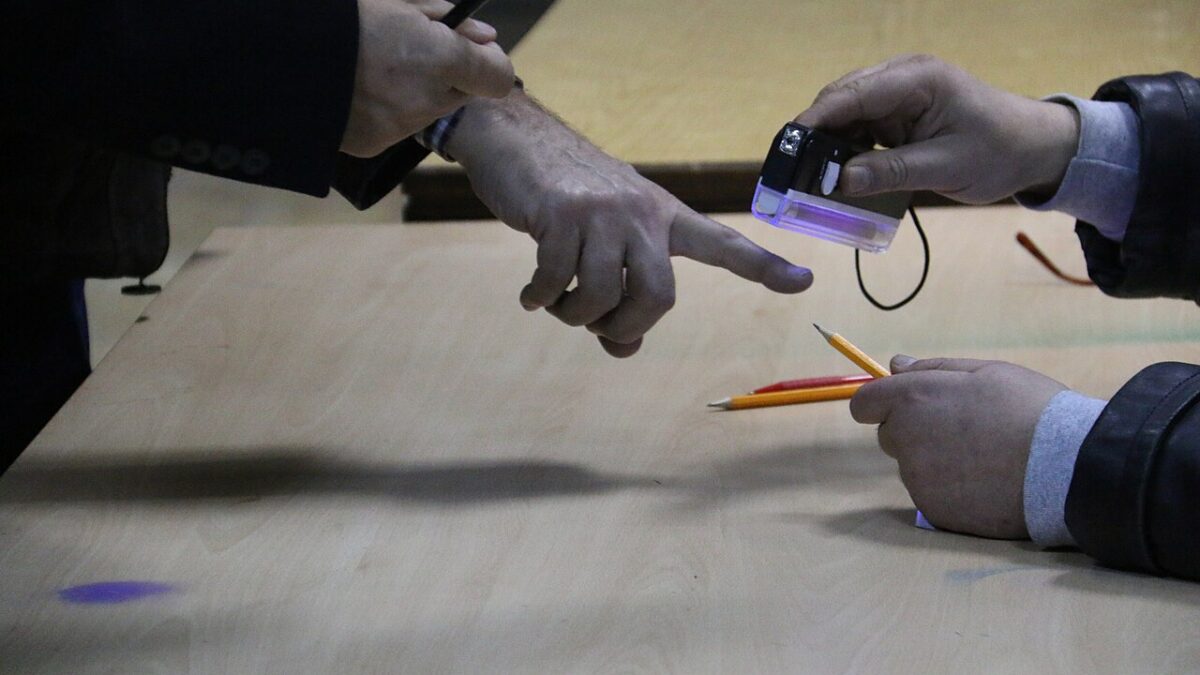
And fourth, Serbia employs an election security measure that is virtually unknown in American elections: indelible ultraviolet ink to prevent multiple voting.
At the beginning of the voting process, each voter’s right index finger was examined under an ultraviolet light to determine whether the individual had already voted. Before receiving a ballot, the voter’s finger was sprayed with a special liquid visible under ultraviolet light.
The purpose was straightforward. If the same person attempted to vote again, whether at the same polling place or another, the ultraviolet scan would reveal the prior marking.
Another important safeguard was that voting had to be conducted in person. There was no widespread mail-in voting of the sort familiar to Americans. Even Serbian citizens living abroad had to appear personally at designated polling places in Serbian embassies or consulates. And Serbians living in Kosovo — the independence of which Serbia has not recognized — faced an even greater burden: because polling places were not established there, they had to travel into Serbia proper to cast their ballots. The Serbian Republic Electoral Commission confirms that 60 polling stations in the Serbian municipalities of Vranje, Kuršumlija, Raška, and Tutin served voters from Kosovo and 93 overseas polling stations operated in 37 countries.
The combination of photographic identification, a precinct-specific voter roll, the voter’s signature, multiparty election supervision, and ultraviolet marking created multiple layers of protection against fraudulent voting.
No election system is perfect, of course. And a system that works well in the polling places I visited may not have worked equally well throughout the country. Independent Serbian observers reported problems elsewhere, including some alleged failures to use identification checks and ultraviolet marking consistently.
Nevertheless, what I personally witnessed was an election process in which the safeguards were taken seriously, the rules were enforced, and representatives of competing political parties had meaningful opportunities to police one another.
That experience makes the opposition’s preemptive fraud allegations particularly troubling.
Serbia has a history of political protests, some of them violent. The student-led movement itself arose following the tragic collapse of a railway station canopy in Novi Sad in November 2024, which killed 16 people and sparked widespread accusations of government corruption.
Those concerns deserved serious attention. So, too, did legitimate questions about the fairness of the electoral campaign and the use of government resources.
But there is an enormous difference between demanding honest elections and preparing to declare an election fraudulent merely because one’s side might lose, without anything more than carefully curated narratives echoed by a friendly media.
The latter is not a defense of democracy. It is a threat to democracy.
Fortunately, the decisive Student List victory meant that the threatened confrontation over an opposition defeat never materialized. The governing side accepted the result, and Serbia now faces the challenging task of forming a new government.
Broader Lesson
There is a broader lesson here, including for Americans.
Election integrity should not be a partisan issue. Voter identification should not be considered an affront to democracy. Requiring voters to sign a voter roll should not be controversial. Nor should reasonable measures to prevent repeat voting or to ensure that election officials representing competing political parties can observe and enforce the rules.
These are common-sense safeguards designed to protect the fundamental democratic principle of one person, one vote.
But there is another principle just as important: political movements must be willing to accept legitimate electoral defeats, subject, of course, to lawful challenges supported by actual evidence of misconduct.
Democracy cannot function under a heads-we-win, tails-you-lose standard in which victory proves an election was fair while defeat automatically proves it was stolen.
The Serbian election offered a valuable illustration of both principles. The procedures I witnessed demonstrated how seriously election security can be taken. The pre-election, carefully crafted allegations demonstrated how easily concerns about election integrity can be weaponized for political purposes.
And the ultimate result offered one final lesson: an opposition movement that feared the election might be stolen from it instead won a decisive victory under the very procedures it had been questioning.
That ought to give everyone — both in Serbia and here at home — something to think about.