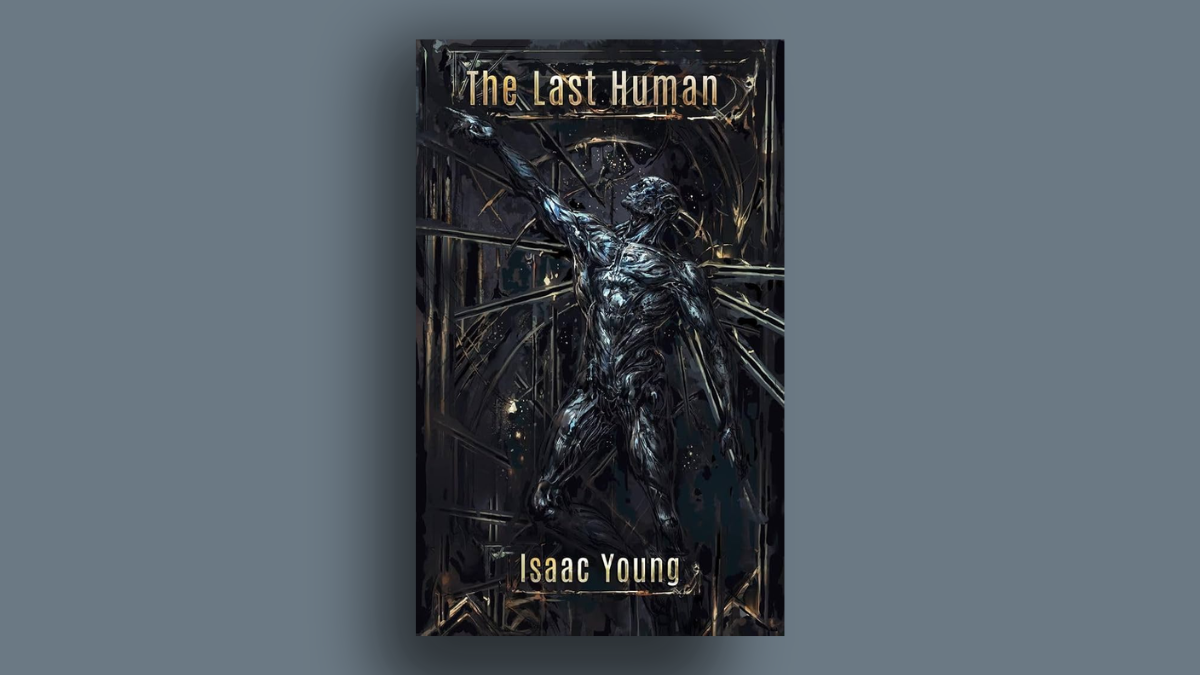

As with any other literary genre, good science fiction is mainly defined by its character development, plot progression, clear and expressive language, and a thoughtful treatment of universal themes. What makes it special is that it also exhibits a certain degree of prophecy. Far from making a few accurate predictions about technology or events in the future, the prophecy of science fiction requires constructing a whole universe based on countless predictions that all follow consistent logic — otherwise known as “worldbuilding.”
The Last Human by Isaac Young is good science fiction that succeeds in both crafting a compelling story with likable, interesting characters along with a world that is both unique yet familiar. More importantly, it does not resort to cheap gimmicks like incorporating overdone leftist narratives of racial oppression or cringe LGBT romances (like the execrable yet critically acclaimed The Fifth Season by N.K. Jemisin), nor does it indulge in shallow pulp escapism.
The first installment of a series, the book recounts the early life of the galactic warlord Vas du’Kaal. Vas is one of the last living human beings in the universe since most of the human race has since been wiped out by war and cultural decay. Until their collective demise, human beings had become a godlike race, capable extending their own lifespans past a thousand years, conducting interstellar travel and conquest, and even seeding intelligence in alien life across the cosmos. As humanity has dwindled, once colonized alien races have evolved to take over what has been left by their mythic progenitors.
At the beginning of the novel, 14-year-old Vas is living as a slave working for an insect-like alien race, the Mantza, who never realize that he is a human. Utterly neglected and poisoned by the toxic atmosphere of the planet, Vas is saved by a mysterious bounty hunter Amon Russ, another human who goes on to become a kind of father figure. Russ’s alien partner Ingrish, a telepathic fox-like alien, plays the role of mother and helps rehabilitate and educate Vas as he spends his formative years on Russ’s ramshackle spaceship, the Aphelion.
Much of the novel deals with the relationship dynamics of the family and this develops Vas’s maturity. Beyond meeting certain physical needs, a family fulfills certain psychological and emotional needs that all human beings have, even those who spent their childhoods in an alien insect hive. Like an infant, Vas is utterly dependent on his adopted parents since he cannot communicate and has no frame of reference to comprehend his current situation.
As a narrative device, Vas’s helplessness and ignorance make him the ideal narrator since the reader learns about the world along with him. As a matter of characterization, this makes Vas necessarily dull since he was never allowed to cultivate a personality. Then again, this could be an unintentional weakness of the book, since the other characters are similarly flat. Ideas and feelings are expressed in various scenes, but the psychology and internal reality behind these conversations could use more attention to help differentiate the voices.
In Young’s defense, he is covering an enormous amount of ground in other areas by essentially creating a whole universe out of nothing. Without relying on well-worn sci-fi tropes and cliches, he is able to describe intricate, diverse settings, filled with different cultures and races, all without losing coherence. Moreover, it is all surprisingly original. Rather than pattern his universe along some given episode in history (i.e. the Roman Empire, Medieval Europe, modern-day America, the Western frontier, etc.) and project it into the future in outer space, he describes a world that’s authentically fresh and distinct. As John Carter explains in his excellent review of the novel, the best way to describe this world is a post-colonial interstellar Dark Age where a once dominant civilization has retreated, leaving younger alien races fighting to replace them.
However, this is not really a political book. As the title implies, the novel mainly focuses on the boundaries of what makes a person human. Indeed, this is a question that Vas asks himself repeatedly. Both he and Amon have a number of traumatic experiences that disrupt and partially destroy their physical and mental integrity, and yet neither of them ever lose their humanity. This fact ultimately reflects a spiritual worldview that traces identity and consciousness to an immaterial soul instead of the body.
Such an assumption breaks from most science fiction, which typically cast identity and consciousness as phenomena that emerge from sufficiently complex structures (i.e., if an organism or machine is complex enough, it will show intelligence, be self-aware, and act more or less like a human). Along these lines, if technology is sophisticated enough, consciousness can be uploaded or downloaded. Once this philosophy is adopted, humans are usually robbed of their exceptionalism and all values become relativized as different alien species are shown living and thriving in their own way.
In The Last Human, this whole arrangement is flipped. Humanity is quite special, even divine, and unfathomably powerful. True, by the time Vas comes into the world, the last remaining humans have evolved into something different from 21st century humans who live only a century and have yet to leave the solar system, but he still faces the same existential questions about meaning and morality.
Fortunately, these deeper reflections end up enhancing the actual story without bogging it down in pretentious philosophizing. They remind the reader that Vas is not just some incidental figure caught in the middle of a bad situation, but a pivotal figure in the great history of his species. He may be the one to finally restore humanity, or he may pass on the glories and burdens of humanity to another race. Whatever might be the case, the events of Vas’s early life obviously figure into his rise to power and are therefore important.
Although The Last Human goes a long way in establishing the foundations of a great space opera, the story is far from complete. The first novel works well on its own, but Vas still has a millennium of life ahead of him and requires more volumes to recount his saga and answer the big questions. When does he truly enter adulthood? Does he make any friends? What allows him to break out of his troubled beginnings and become a great conquerer? Does he ever fall in love?
Nevertheless, for this series to continue, readers must go and buy the book. Because Young has been shut out from the publishing world for not being adequately diverse and progressive, he has been forced to raise money, write his novels, and promote his work all on his own. He is one among many talented young writers who have been cruelly overlooked because of the woke agenda infecting the publishing world. While The Last Human deserves to be purchased and read for its own merits, it is also an ambitious project that should be supported by non-leftist readers who are fed up with the leftist garbage currently filling today’s libraries and bookstores.
In this sense, one could say that Isaac Young is not just a great young writer with a story to tell, but also a trailblazer looking to triumph in a once great world that has fallen into disarray — a little like his protagonist Vas du’Kaal.