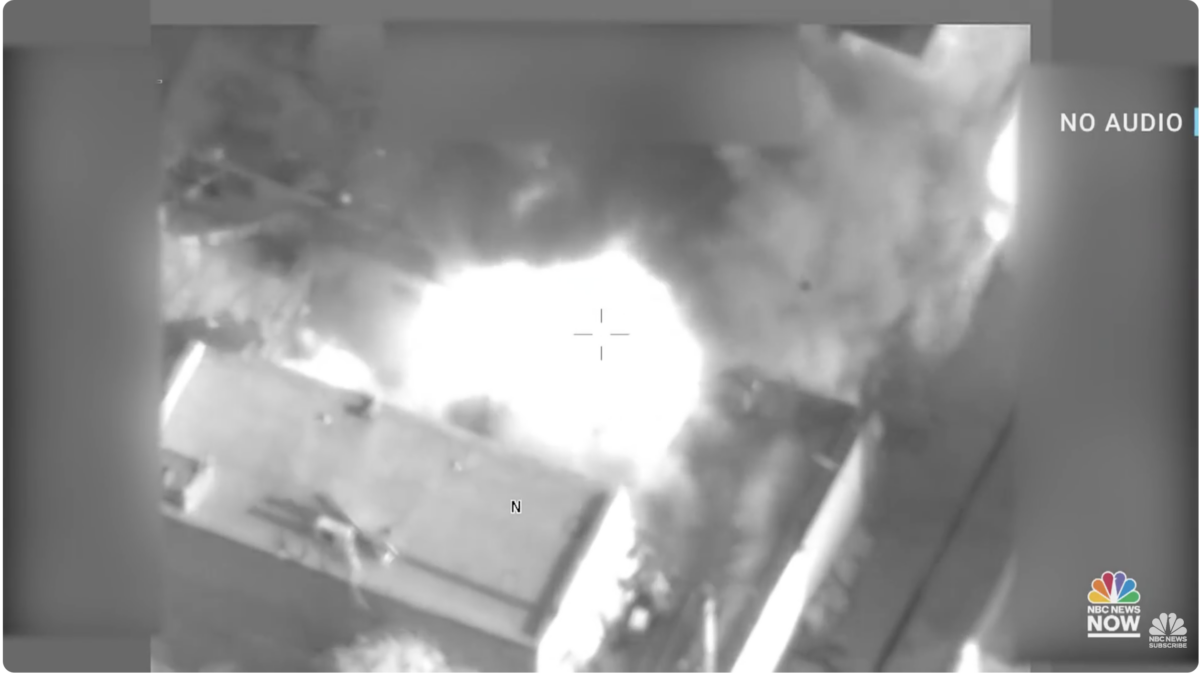
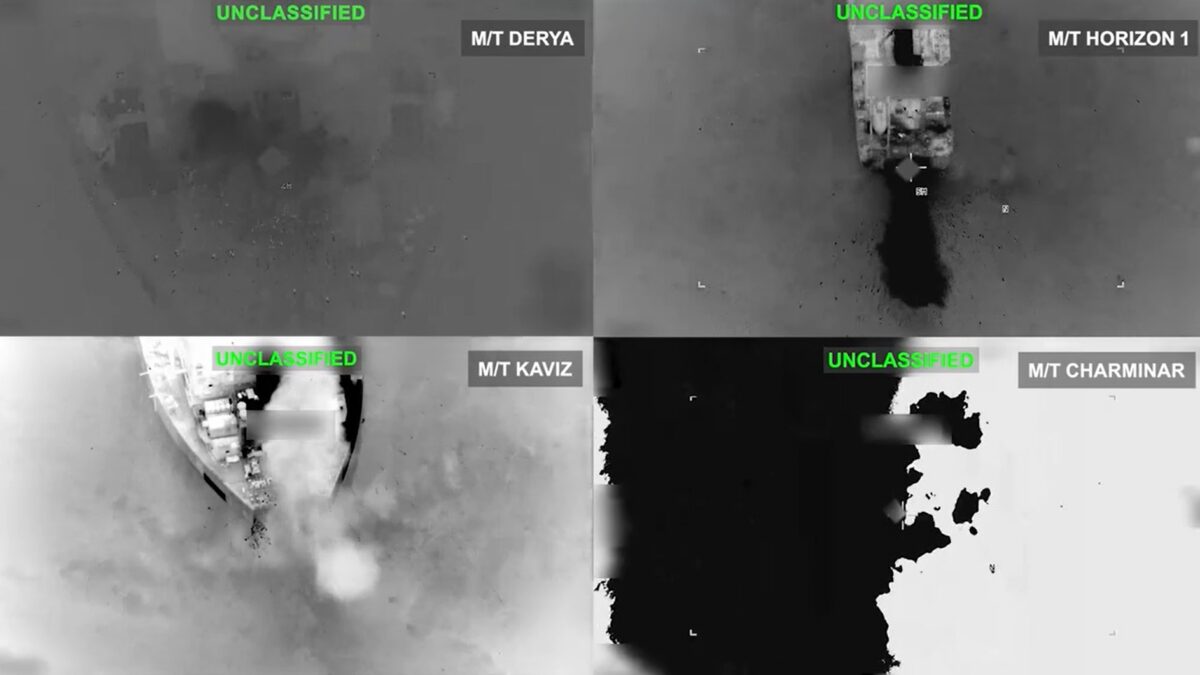
U.S. Central Command (CENTCOM) announced Tuesday it destroyed five Iranian crude oil vessels in retaliation for targeting a U.S. Navy warship, but notably, four of the ships appear to have been sailing under the flags of random African and small island nations.
“Iran has used the tankers as part of a multibillion-dollar shadow network that funds the IRGC and its regional proxies,” a CENTCOM dispatch reads, announcing the names of the ships: M/T Kaviz, M/T Charminar, M/T Horizon 1, and M/T Riesco, which were struck in the Gulf of Oman, and M/T Derya, which was struck near Kharg Island.
Public marine tracker websites indicate the first four ships were sailing under the flags of Comoros, Palau, and Zimbabwe, while the Derya appears to have been sailing under the Iranian flag.
According to sites like MarineTraffic and VesselFinder, the Riesco was sailing under the flag of Zimbabwe, which is a landlocked country in southeast Africa that does not even have its own navy. According to an article published in February in The Maritime Executive, Zimbabwe has zero legally registered ships and does not even have a maritime authority, but has been the subject of false flag operations in the past.
The Charminar and Kaviz were both sailing under the flag of Comoros, a small archipelagic country in southeast Africa. According to Business Insider Africa, Comoros is a popular country in which oil tankers affiliated with Russia will claim registration to avoid international sanctions. It reportedly has one of the fastest-growing fleets in the world, which expanded by more than 270 percent since the start of the Russia-Ukraine war. The United States, United Kingdom, and European Union blacklisted 110 ships flying the Comorian flag last year.
“This flag of convenience system enables vessels to change identity, name, and flag repeatedly, a practice known as ‘going dark,’ which obstructs international monitoring,” the website Maritimes Crimes reports.
The tanker Horizon 1 was flagged in Palau, a small country in Micronesia.
As of 2024, Palau had one of “the fastest-growing shipping registries flagging shadow vessels,” according to the Australian Broadcasting Corporation. The country has reportedly deregistered some such vessels and claims it “screen[s] vessels against known sanctions lists.”
According to Canada’s Macdonald-Laurier Institute (MLI), China, which is not sanctioned in the same way, has gotten into the same game, but from the other side: It facilitates trade among heavily sanctioned countries.
The arrangement has allowed countries like Russia, Iran, and North Korea to get products to market through both transportation and payment networks, which, MLI says, allow China major influence over those countries, as well as weakening the effectiveness of Western sanctions.
“Shadow fleets operate on the edges of a coastal state’s exclusive economic zone (EEZ), or on the high seas, to avoid apprehension by law enforcement,” MLI states. “This creates a parallel maritime system of purposeful sanction evasion, theft, clandestine offloading, and other harmful activities that exploit flaws in existing oversight legislation.”