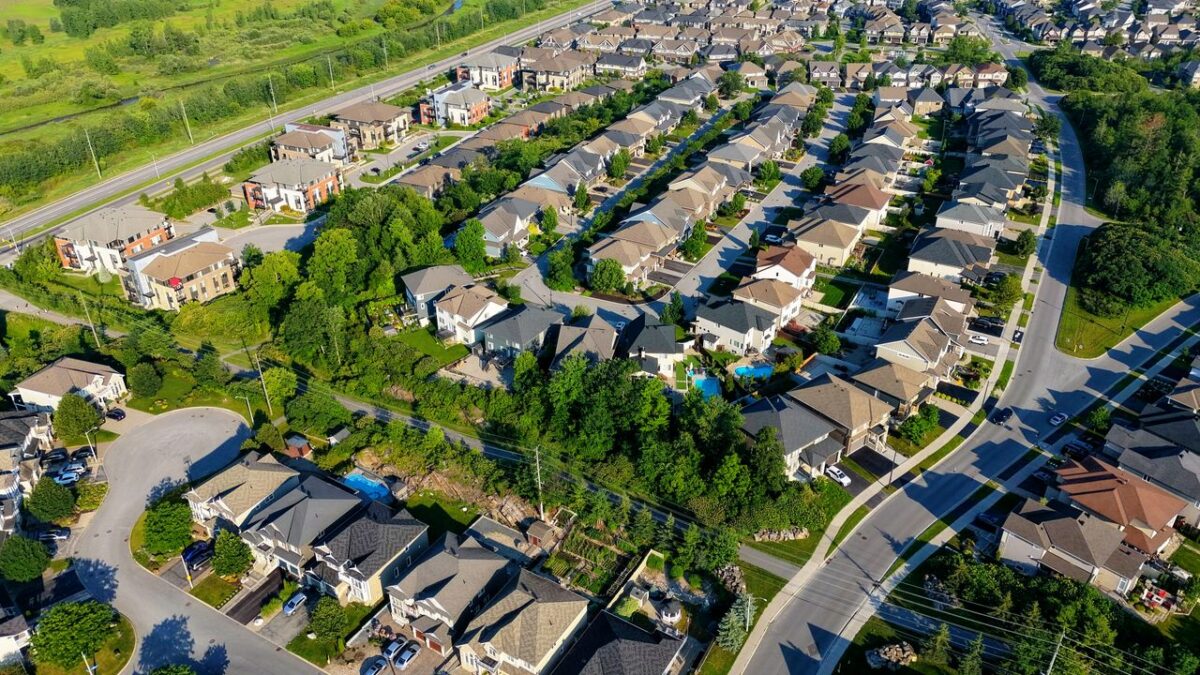

Across America, families have spent decades moving to the suburbs in search of what many cities increasingly struggle to provide: low-crime neighborhoods, homeownership, clean streets, and room to raise a family. Now some of the country’s most successful suburbs are being encouraged to remake themselves in the image of the city’s families left behind.
The movement often comes under the appealing label of “Missing Middle Housing.” Advocates want communities built around single-family homes to make room for duplexes, triplexes, townhomes, apartments, and other higher-density development. The argument is usually framed around affordability and housing choice. But changing the physical makeup of a community also changes its infrastructure demands, municipal finances, neighborhood character, and public-safety needs.
Carmel, Indiana, offers a timely case study. Carmel became one of America’s most desirable suburbs by offering precisely what many families seek: an exclusive, low-crime suburb where tax dollars are directly reinvested into the hard-working families who earned their place there.
Yet after a recent carjacking, Mayor Sue Finkam blamed neighboring Indianapolis for exporting crime while advancing a “Missing Middle Housing” plan intended to introduce more housing density. That contradiction deserves attention.
Public safety is shaped by more than criminal justice policy. Development decisions influence population density, infrastructure, local government spending, neighborhood stability, and demands on police and emergency services. If suburban leaders want to preserve what made their communities successful, they should examine not only the problems crossing their borders but also the consequences of policies they adopt within them.
Just before launching her campaign on crime in Indianapolis, Finkam released Carmel’s “Missing Middle Housing” proposal. Drafted by Berkeley, California-based Opticos Design, it cites Minneapolis, Portland, and Seattle as examples Carmel can look to as it pursues higher-density housing.
That raises a question with implications far beyond Indiana: Why should America’s most successful suburbs take their cues from cities struggling to preserve the very qualities suburban families value?
Empirical research suggests land-use patterns and density mandates play a major role in that urban decline. A spatial study of crime patterns in Louisville, Kentucky, found that new crime hotspots emerged following the redistribution and concentration of affordable housing.
Indiana researchers found similar associations. A 2006 study from Indiana University’s Center for Urban Policy and the Environment found: “Areas with predominantly low density residential housing are associated with violent crime levels that are 50 to 75 percent below the overall average. Areas with predominantly medium to high density housing are associated with violent crime levels that are 40 to 65 percent above average.”
Density alone does not cause crime. Poverty, unemployment, family disruption, and land use all matter. But development patterns and public safety should not be treated as entirely separate policy questions.
Higher density also carries potential fiscal consequences. An 11-year economic panel study by researchers at Florida State University found that greater concentrations of rental and multifamily housing were associated with higher effective property tax burdens for long-term homeowners.
Adding residents also means accommodating greater demands on roads, utilities, emergency services, schools, and infrastructure.
A Rice University Baker Institute report found that tax exemptions for subsidized multifamily housing in Harris County, Texas, cost local taxing entities $355 million between 2020 and 2025, with projected costs approaching $2.2 billion over the next decade. While tax-subsidized housing is not synonymous with every “missing middle” development, the example illustrates a broader principle: Housing policy is also tax and infrastructure policy.
This local push is further accelerated by federal overreach. Suburbs that accept housing grants from the U.S. Department of Housing and Urban Development (HUD) often find themselves bound by federal mandates, such as the Affirmatively Furthering Fair Housing rule, that condition funds on high-density upzoning and subsidized housing construction. Whether out of ideological compliance or sheer political cowardice, local leaders who sign onto these federal schemes effectively surrender local control, override single-family zoning, and pave the way for localized urban decay.