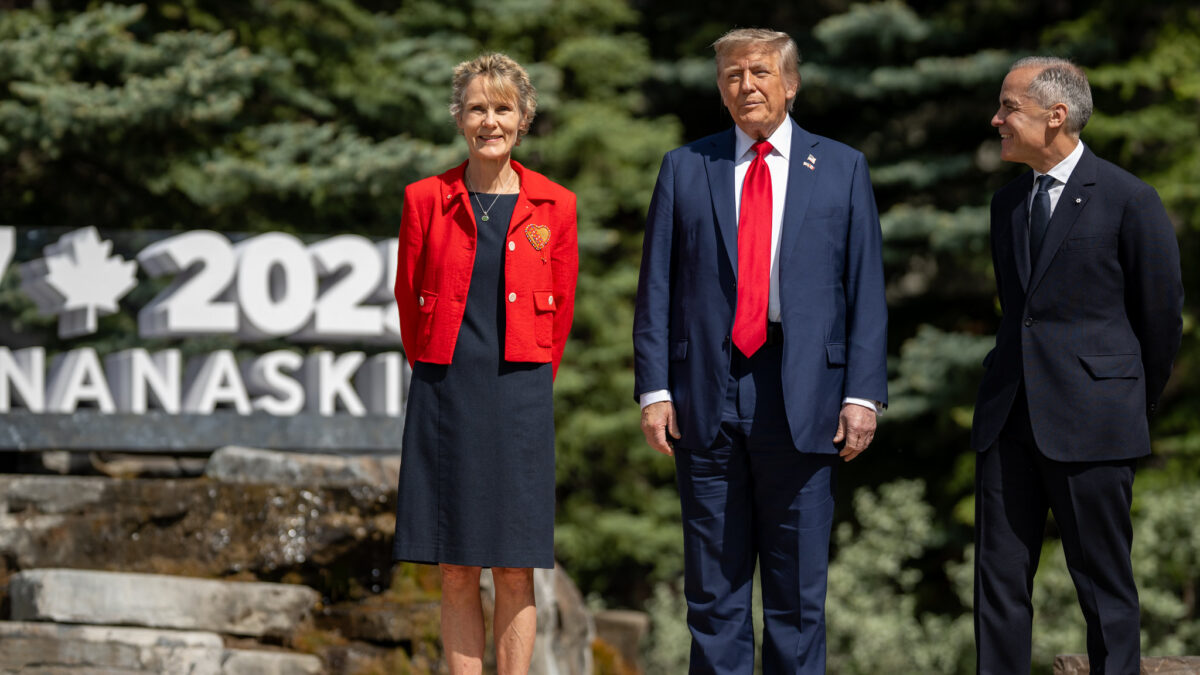

Canadian Prime Minister Mark Carney is in Strasbourg this week selling a “unique alliance” with the European Union while courting Chinese capital at home. The pitch is straightforward: President Trump’s tariffs and “51st state” taunts make Canada’s century-old economic marriage to the United States too risky. Thus, Canada should diversify toward Brussels and Beijing.
One massive problem: geography, capital flows, language, and supply chains dictate otherwise. These harsh facts on the ground make the European Union option, in particular, a political fantasy.
Canada cannot join the European Union. The EU treaties limit membership to a “European state.” Associate membership — the novel status European Commission President Ursula von der Leyen floated with Carney in the room — does not exist in European Union law. Creating it, or concluding a deep association agreement, requires unanimity in the Council and, in practice, mixed-agreement ratification by all 27 member states. That is the same hurdle that has left the Comprehensive Economic and Trade Agreement (CETA) with Canada, provisionally applied since 2017, still unratified by ten countries, including France. Any new “alliance for the future” covering defense industry, critical minerals, artificial intelligence and the Arctic will face the same veto. Calling Carney’s EU opening a fool’s errand is an understatement.
On the other hand, Canadian exports to China jumped 30 percent in the first half of 2026, driven by energy and minerals. Carney’s January deal traded limited Chinese electric-vehicle access for lower canola tariffs and a goal of 50 percent export growth by 2030. Chinese state-backed funds showed up at this week’s Toronto investment summit. But Ottawa treated the Chinese market as a security risk for years — for prudent reasons. And Canada swinging the trade doors open to China will certainly draw American retaliation. What the China opening does not do is reroute oil pipelines or auto parts.
The United States remains Canada’s gravitational center. Roughly 75 percent of Canadian goods exports have historically gone south; even after tariffs, America still dominates. Manufacturing is only 10 percent of Canada’s gross domestic product, but it is the high-wage, integrated part of the economy that Europe cannot absorb. Ontario auto parts do not slot into just-in-time chains in Slovakia or North Africa.
American investors hold about 46 percent of the stock of foreign direct investment in Canada and supplied more than half of 2025 investment inflows. Canadian companies hold nearly half their outbound foreign direct investment in the United States. Further, Canada’s deteriorating business climate, the inevitable result of decades of left-wing misrule, has encouraged capital to flow south. A KPMG survey found 42 percent of Canadian manufacturers have already moved production to the U.S. or plan to, with 77 percent expecting to act within two years.
As for energy, Canadian heavy crude is refined in the United States Midwest and Gulf Coast; there are no East Coast export terminals. And the proposed Canadian pipeline that would have allowed that, Energy East, is dead. Canada has 840,000 kilometers of pipelines pointing south. Reversing that takes 15-20 years and capital that is not coming from Brussels.
English, contiguous borders, shared time zones, and North American Aerospace Defense Command have largely hardwired the U.S. and Canada. Europe and China cannot transcend these ties.
Trump’s rhetoric (a negotiation tactic?) is deliberately humiliating — “Governor Carney,” maps painted in Stars and Stripes, jokes about annexation. It works as leverage because the dependence is asymmetric. Canada treats United States market access as existential. Washington treats Canadian supply as convenient. The United States can source heavy oil from Venezuela, shift more auto production to Mexico, and live with higher lumber prices. Carney’s talk does not create pipelines or factories.
Defense exposes the same gap between aspiration and capacity. Canada finally hit the North Atlantic Treaty Organization’s old 2 percent of gross domestic product target in 2025-26 after decades as a free-rider. Carney now talks of 4 percent by 2030 and the alliance’s new 5 percent goal by 2035. Spending more does not instantly produce ships or fit soldiers. Internal briefings in 2024 showed 72 percent of Canadian Armed Forces personnel overweight or obese — worse than the civilian population. Readiness and medical releases suffer. The navy still operates four aging Victoria-class submarines, with the first of a planned 12 German boats not due until 2034. Polar icebreakers are under construction but will not arrive until the early 2030s. The existing Coast Guard icebreaker fleet is mixed and aging. Canada’s Arctic is vast; its ability to patrol it year-round remains thin at best. So long as Canada’s military cannot independently enforce sovereignty in the Arctic, its lecturing others about alliances wears thin.
Carney’s bet is that shared values with Europe and commodity demand from China can buy time. But time for what? Does Carney expect a new Democratic president in Washington to be accommodating to Canadian trade barriers and anemic defense spending? That’s likely a bad bet.