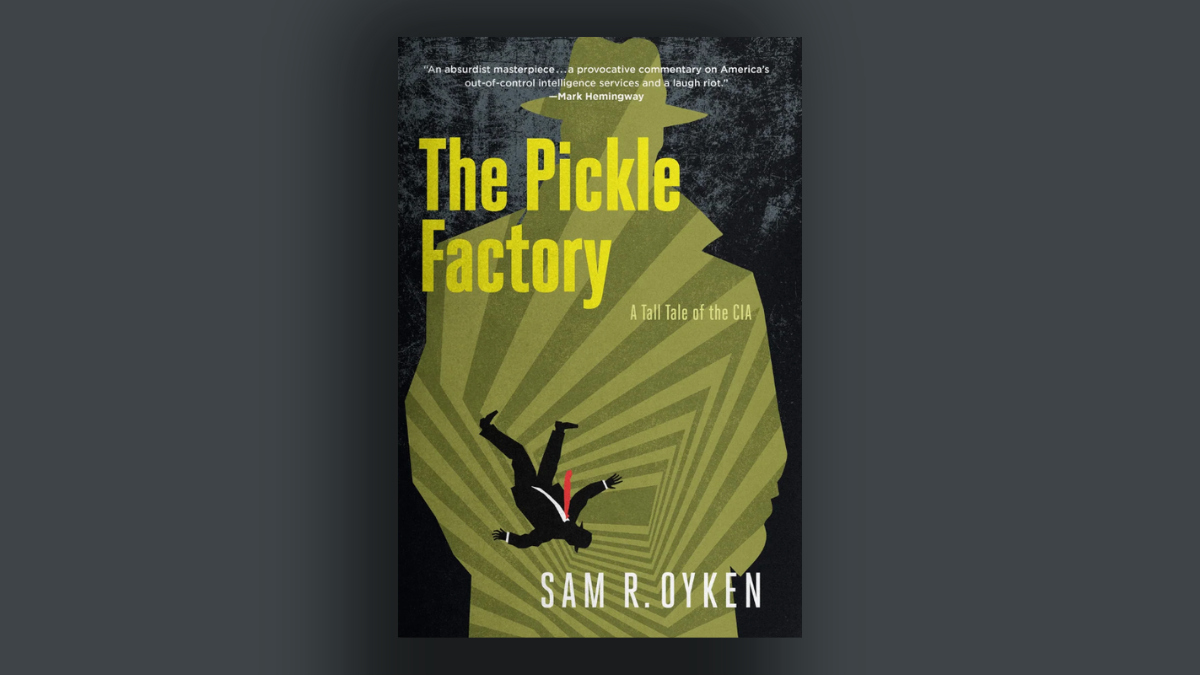

The Pickle Factory is what happens when the ghosts of Catch-22 and a retired operations officer collaborate on a field manual for survival. Author Sam R. OYKEN – an all-caps CIA-style pseudonym, not an alias – has forged an intelligent and literary satirical espionage novel about the terminal-stage bureaucracy of CIA Headquarters.
OYKEN’s tall tale about Andre B. KRAY shows the Agency as a sort of USAID without the sense of mission. KRAY is a clandestine service officer under Non-Official Cover, an NOC, recalled to Langley after a decade abroad.
KRAY is the real deal. He’s an intelligence professional who wants to do the purposeful, old-fashioned work of recruiting agents, running operations, and living an adventurous life for Uncle Sam without benefit of diplomatic immunity or legal protection. Quick-witted but a bit naïve about life inside the Beltway, he comes home to discover that at Headquarters, his primary traits, competence and integrity, suddenly become a liability. KRAY’s faults assist his tradecraft, and humble him for greatness or disaster.
His division chief, P. Richard Wacker, assigns him to Project GOOWIKI, a “Transformational Human Resources Worldwide Outreach Program.” GOOWIKI is the perfect prop for OYKEN’s satirical take on the unmoored intelligence leviathan. The program is a highly classified, multibillion-dollar initiative designed to continue the employment of people who have never met a foreign agent but can discuss “synergies” until the hot venti White Chocolate Mocha with steamed oat milk foam with drizzle gets cold.
The deadpan humor is original. It’s cumulative, building from the repetition of small inanities-turned-insanities. Often it requires a second look or two. It arises from the clash between KRAY’s straightforward tradecraft instincts and the Rube Goldberg process machine that took the bureaucrats decades to build.
CIA Headquarters has become a distant American cousin of Monty Python’s Ministry of Silly Walks, though OYKEN doesn’t say that. The GOOWIKI briefings, the endless reallocation of imaginary deployments, the solemn invocation of “Human Resources” as a strategic imperative – all are rendered with the matter-of-factness of someone who has sat through too many such meetings.
When KRAY suggests that pseudonym nameplates might help Wacker’s new “Funny Name” initiative, the room reacts as if he has proposed populating the Seventh Floor of Headquarters with a congressional oversight audit team.
The dark humor serves the same function as Joseph Heller’s 1961 novel Catch-22 about a World War II combat pilot faced with the absurdity of a self-serving commander, illogical military bureaucracy careerism, and corruption. But unlike Heller’s hero, KRAY doesn’t desert to the Swedes. He doesn’t desert at all.
OYKEN’s satire homes in on the real, undisputable chief weakness of the CIA. Unrelated to the book, the Agency screams to the world in gigantic capital letters on its homepage about being “THE NATION’S FIRST LINE OF DEFENSE,” followed by a boastful power shot that it’s “the world’s premier foreign intelligence agency,” as if people need reminding. (See for yourself at cia.gov.)
All this small-handed chest-thumping, of course, conceals the CIA’s internal substitution of groupthink and managementspeak for sound judgment, the cult of Human Resources, and the elevation of contrived metrics and “transformation” over the hard, unglamorous work of recruiting foreigners as agents to risk their lives for American interests. (There’s also the matter of the agency’s weak analysis, which OYKEN doesn’t cover much because KRAY is in the Directorate of Operations.)
And then there’s Headquarters’ institutional instinct to punish anyone who might hint that the emperor has no clothes. Or that the empress belongs in the Company’s “Plus-Sized Mafia.”
OYKEN uses fiction as tough love on the American intelligence profession that he clearly values deeply. He doesn’t invent the absurdities that become the jokes. He just picks them from the vine.
Wacker boldly presides over his division with strategic pettiness. With a Frappuccino-fueled physique as fit and trim as the bureaucracy around him, Wacker is no Bond villain. No, he is more unsettling. This villain is a perfectly ordinary, thin-skinned, mediocre man who has risen by never questioning the premise that the apparat’s survival matters more than its purpose. Wacker strives for excellence by appointing patsies and dimwits under him. He reflexively punishes anyone who embarrasses him. He keeps a prayer rug and Kleenex in his office, and a smorgasbord of Nabisco within reach.
FILBERT, Wacker’s yes-man deputy, and HR apparatchik EVERSHAG complete the picture of a CIA division more interested in replicating itself and in process than in producing intelligence for a president to make life-or-death decisions. Real decisions that, when made poorly, senselessly doom good people to their deaths.
However, in some cases, looks, like character, can be deceiving.
OYKEN’s comedic style allows the reader to savor the indictment of a once-vital institution that’s supposed to conduct still-vital functions, but has lost the ability to be honest with itself. The laughter is the sound of recognition. So much of the story rings true. Langley is just the setting of a near universal tragicomedy. Similar satires await all other large bureaucracies.
Rapid-fire breakaways – as if novelist Thomas Pynchon and Family Guy’s Seth MacFarlane conspired to hijack OYKEN’s manuscript – provide clever, if sometimes weird, context to the intelligence community present and past.
Enter BUTTONFLY, the very much alive “Ghost of CIA Past.” This Old School CIA man serves as the story’s Greek chorus and as KRAY’s sherpa. Members of the anti-Marxist element of the Old Boy network used to mentor aspiring young people at Association of Former Intelligence Officers events before AFIO fell to the 51 Hunter Biden laptop signatories. BUTTONFLY’s conversations with KRAY are dry, unsentimental, and devastating in their assessment of how far the Agency has drifted from its original noble anchorage back when it was lovingly known as the Pickle Factory.
What follows from their meeting in a Starbucks line becomes the most entertaining investigation in recent spy fiction. KRAY travels the world on thin pretext to determine details of GOOWIKI. With a considerable amount of cash with no receipts necessary, KRAY goes on a jet and jangle-wagon odyssey to meet members of BUTTONFLY’s network in London, Paris, Zurich, New Delhi, Kathmandu, Bangkok, Hong Kong, and points in between. Each contact has long made peace with the fact that Headquarters now treats real operations the way HOA Karens in suburbia treat an unpermitted toolshed.
KRAY’s new contacts are survivors, some openly cynical, some privately idealistic. Their conversations carry the weight of men who have watched their beloved institution become a self-licking ice cream cone. Remarkably, not a bitter burnout among them.
KRAY’s conversations with BUTTONFLY move the story forward – gently sardonic, unsentimental, and stiletto-like in their refusal to pretend that competence is still the Company’s coin of the realm.
With current intelligence fiction tending to oscillate between cartoonish thriller and somber procedural, OYKEN has produced something rare: a thoughtful book that is funny enough to make you laugh out loud in public and serious enough to make you put it down and wonder, often, how much of the author’s lies are true. And to wonder how much at CIA headquarters is another GOOWIKI.
(For what it’s worth, John McLain narrates a lively audio version that he really gets into as the book progresses. He conveys the visual annoyance of blacked-out redactions through falsetto “bleeps.” His different voices build the characters.)
The novel refuses to end in despair. OYKEN, himself a former NOC, clearly wants to make American intelligence great again. The question is, how? Read the book to find out. KRAY is duly punished for his author’s crime. His personal fate itself is a short wilderness of mirrors. In that wilderness lurks the double edge to the tall tale title of The Pickle Factory.