

Throwing away an old pair of socks is a matter of the greatest imaginable complexity. It requires an extensive state plan, supervised by a nongovernmental organization that imposes mandatory payment obligations on the company that made the socks. The socks have to be safely discarded, and that requires extensive planning by a public-private partnership.
Following the passage of SB 707, the Responsible Textile Recovery Act of 2024, every significant manufacturer of textile products that sells its products in California (even if the manufacturer doesn’t make anything there) has in theory been forced to join a “producer responsibility organization” (PRO) that will develop a textile recycling plan. Penalties for intentional noncompliance will run $50,000 per day “if the violation is intentional or knowing,” and a misstatement to state regulators regarding textile recycling will be regarded as perjury, a felony. Read the bill: Its intent is to minimize the “environmental justice impacts” of your discarded socks.
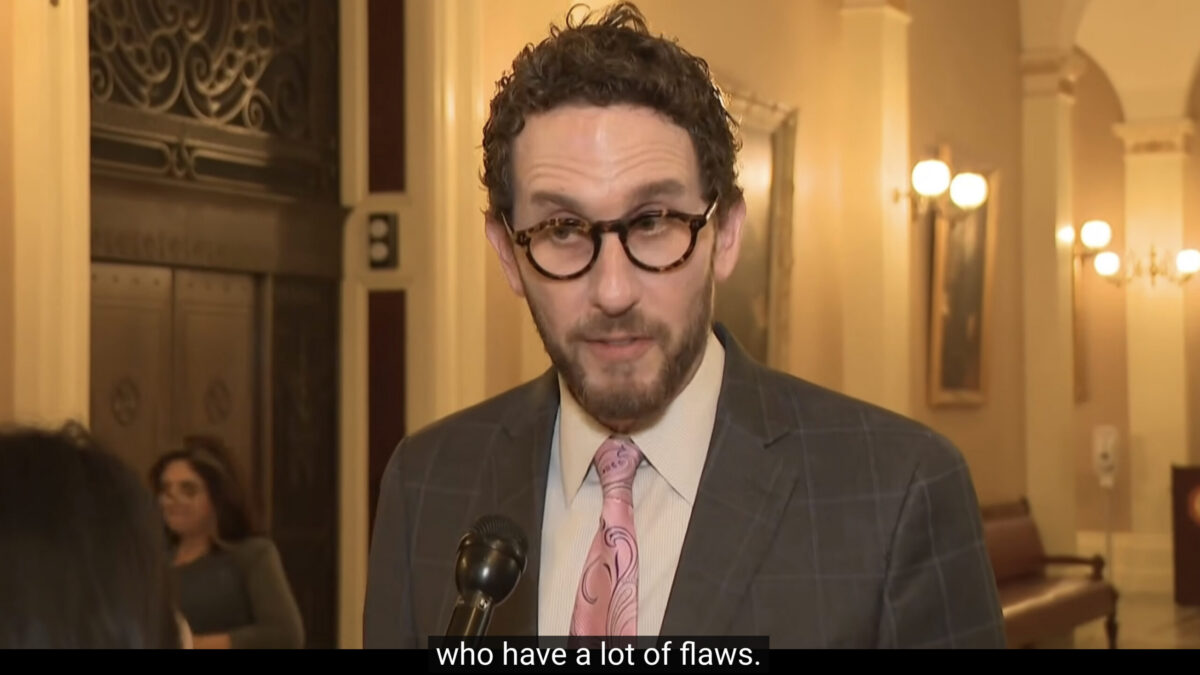
The Responsible Textile Recovery Act of 2024 was authored by former state Sen. Josh Newman, who now teaches as an unpaid senior fellow in the School of Social Ecology at UC Irvine.
A whole compliance industry is springing up around the new law, starting with the requirement that every company that sells textiles in California join the PRO by July 1 of this year. Producers with “aggregate global turnover” of less than $1 million are exempt from compliance. In a complex chain of legal compliance, participation in the PRO may also fall upon wholesalers, retailers, distributors, and importers.
If you pay attention to California politics, you already knew that an NGO was going to be involved. The state has chosen a single NGO, Landbell USA, to be the designated statewide PRO. Landbell USA became a nonprofit in February of this year, but is part of an international organization that already serves as a PRO in other countries: Landbell Canada, Landbell Deutschland, and so on.
The final cost of compliance is still up in the air, but you can read the compliance “roadmap” at the Landbell website: “For the 2026–2027 cycle, registration requires a flat annual fee of $1,000. These funds support the development of the producer portal and the Statewide Needs Assessment. In the future (targeted for 2030), fees will shift to an eco-modulated model, where products designed for durability and recycling will receive reduced rates.”
So if you make or sell any kind of textile product in California, this is what you face today: Your as-yet-undetermined future costs will “shift to an eco-modulated model,” actual numbers not yet known.
The state’s textile recovery program is being administered by the $2 billion-a-year Department of Resources Recycling and Recovery, which is still writing regulations to implement the law. You can read their textiles page here. The agency will be holding a “Textile Stewardship Informal Regulatory Concepts Workshop” next month to “solicit feedback on regulation concepts related to the requirements outlined in the Responsible Textile Recovery Act.”
Law firms with textile clients are posting compliance schedules, so you can see the timeline for implementation here. Final implementation of a statewide stewardship plan is expected by July 1, 2030. It takes time to figure out how to discard a sock.
Here’s what the new law is turning out to mean in practice: In Texas, the unusually awesome Buffalo Wool Company, which makes textile products sourced from American plains bison, has turned off its California shipping options. Ron Miskin, who runs the family-owned business, told The Federalist that he has no objection to textile recycling, and he sees the point of trying to keep a flood of cheap synthetic material out of the waste stream. But he’s also trying to make sustainable products that don’t get used up and thrown out, and the costs and complexity of compliance with California’s new textile law are a bridge too far.
“Our stuff doesn’t end up in landfills,” he told The Federalist. “We’re not high volume. Our stuff is stupidly expensive, but it works. It lasts.”
With no staff in California, Buffalo Wool Company already owes payroll tax in the state, and is drowning in California taxes. Now comes a new regulatory program with compliance costs that are still undetermined. The Federalist asked Miskin what it was going to cost him to comply with SB 707. His answer: “I don’t have a flippin’ clue.”
“My number one concern is making sure that we keep making textiles in the US,” Miskin said. California is making that goal as hard as possible.
The Federalist has asked the California Department of Resources Recycling and Recovery for an estimate of the cost and staffing required to enforce SB 707, but we haven’t yet received a response.