
As the Supreme Court made waves with its landmark ruling protecting women’s and girls’ sports, the court also published another landmark ruling that met with little public discussion: Chatrie v. United States.
Chatrie focused on answering the question of whether or not law enforcement accessing Google Location History data constituted a Fourth Amendment search. The court determined that it did, explaining that “[a]n individual has a reasonable expectation of privacy in records about his cell phone’s location, and police intrude on that constitutionally protected interest when they demand the information … from a third-party tech company.”
In reaching this decision, the court focused on the intricate and intertwined nature that cellular devices play in everyday life, all while the Location History “tracks and tracks and tracks” the device and subsequently the user carrying it. The location data collected provides the government “a virtual panopticon with which to scrutinize its citizens’ activities” and thus qualifies for Fourth Amendment protections.
This is significant, as Fourth Amendment searches require probable cause, which must be asserted in detail by law enforcement seeking a warrant to conduct the search. The warrant must be approved by the correct judicial authority, and the search must be properly conducted to ensure it adheres to the parameters outlined in the warrant.
So what does this have to do with K-12 education? A lot, it turns out. While it is no surprise that schools collect location data on students through EdTech programs and apps, most parents have no idea the extent to which their own location data is collected and used. One example of this is the Thomson Reuters CLEAR software, which allows designated school district personnel to “[a]ccess license plate data and develop pattern of life information” on students and families:
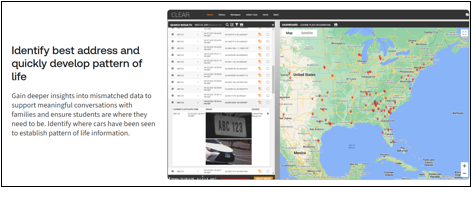
While marketing itself as a solution to help school personnel save time verifying student addresses, the software capabilities go far beyond address and residency verification, with features such as alert functions to allow district personnel to “[g]et notified immediately when any relevant information changes with a student.” These expansive surveillance functions are not surprising, given the company’s own description of the product as a “powerful online investigation software” with applications in law enforcement and investigative financial services, among others.
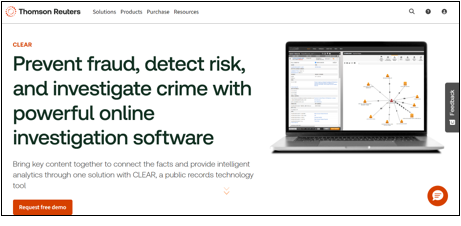
Notably, parents are not informed of the intense level of location surveillance being conducted on them, their student, and their family members. The CLEAR searches are not being conducted by law enforcement personnel, but by school administrators. No warrants are needed, no uniform compliance protections are in place.
The questions go deeper, as programs such as Google Workspace for Education and many other EdTech applications collect student location data based on tracking and storing school-issued device locations. These devices are often carried by students outside the classroom — to sports practices and work and coffee dates … and ultimately to their private homes. This essentially mimics the “virtual panopticon” referenced in Chatrie as it captures the student’s pattern of life via their location history — which is fully accessible to designated school administrators at all times. Even as students have reduced Fourth Amendment protections at school, they do still have them, and they certainly have them outside the school premises.
The tension between these K-12 education programs and Chatrie is bound to create a stir as parents — and their students — begin questioning these surveillance practices and asserting their Fourth Amendment constitutional rights.
Please visit Truth in Education’s website to learn more about data collection and to obtain an opt-out form covering a variety of sensitive subjects along with instructions on how to file it with your child’s school.
Already have an opt-out and need help enforcing it? Have questions about your school district’s data collection capabilities? Contact us at info@truthineducation.org.