
The Counterlawfare Institute obtained a previously undisclosed June 8, 2025, memo laying out a blueprint for the Department of Justice to investigate Anthony Fauci and the National Institutes of Health’s contributions toward the influential “Proximal Origin” scientific paper that argued the Covid-19 virus originated from nature, not a lab.
The memorandum was written by Michael Caputo, a former senior Department of Health and Human Services (HHS) official who later served as an adviser in the U.S. Attorney’s Office for the District of Columbia, and addressed to Ed Martin, then director of the Department of Justice’s Weaponization Working Group. It later emerged that Caputo was under secret federal surveillance at the time.
In the memo, Caputo encourages the DOJ to investigate whether federal officials misled U.S. intelligence and directed millions of taxpayer dollars to scientists who “falsely distracted the public from government misconduct that lead to massive illness and deaths worldwide.”
The administration later imposed financial consequences on the paper’s publisher, suggesting that at least some action followed. Some recent revelations from Sen. Rand Paul, R-Ky., may also trace back to this effort. But what became of the broader investigation, whether it was formally opened, remains active, or was allowed to lapse, is unknown.
HHS Weaponization
The memo lays out an investigation into whether Fauci, then-director of the National Institute of Allergy and Infectious Diseases, and other federal officials manipulated government power, scientific opinion, official data, taxpayer funding, and intelligence agencies to misdirect the Covid pandemic response, conceal the American government’s possible responsibility for the emergence of Covid, and mislead the public about the origin of the virus.
The memo explicitly contemplates “sufficient evidence of misconduct and a likelihood of prosecution,” while calling for the victims whose careers and reputations have been destroyed to be identified and made whole. It notes that National Institutes of Health Director Jay Bhattacharya had a team working on a briefing.
Whether the newly unearthed Fauci diaries emerged from that effort is not yet known. HHS Secretary Robert F. Kennedy Jr. has said that it took officials “about eight months to dig these out of 11 separate servers, where they had been sequestered and secreted.” Most significantly, the memo identifies the publication of “The Proximal Origin of SARS-CoV-2” paper not as an isolated scientific failure, but as the opening move in what the memo described as a “curated misinformation effort.”
Fauci’s Central Role
The memo places Fauci at the center of the “Proximal Origin” operation, pointing to his role in the paper’s development and later promotion. As the memo notes, the paper’s authors sought extensive input from Fauci, his boss, then-NIH Director Francis Collins, and others while developing the paper. Fauci worked hand in glove with them as their private suspicions of a laboratory origin were transformed into a publication purporting to dismiss that very possibility.
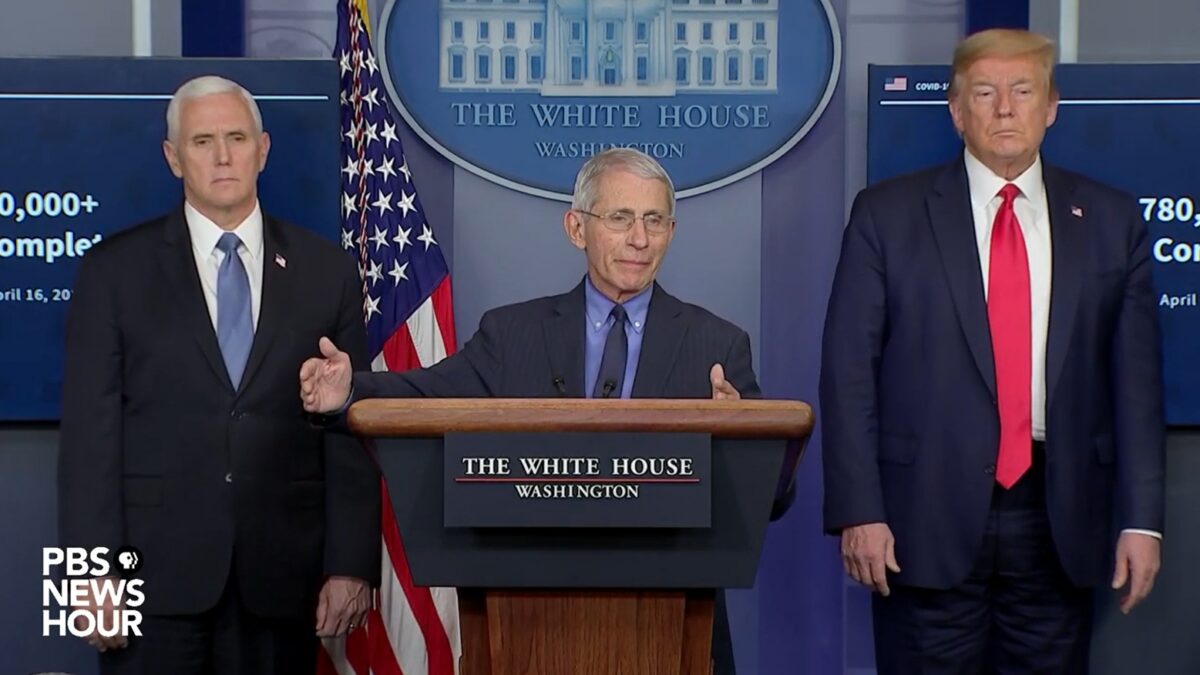
Then, on April 17, 2020, Fauci stood beside President Trump at the White House podium and presented the paper as the independent work of scientists with whom he claimed no familiarity. He said that he did not have the authors’ names in front of him and conveyed the impression that he did not know who they were. That was false.
Fauci knew exactly who the authors were. He had worked closely with them as the paper was developed. He knew what they had initially believed, how their conclusions had changed, and the extent of his own involvement in producing the scientific authority he was now presenting to the country as independent.
The deception therefore operated on two levels. First, Fauci worked with the authors to produce a paper dismissing a laboratory origin. Then, just as the memo described, he promoted that paper from the White House as outside validation of the government’s position, while concealing his own role in its creation.
The government helped create the scientific authority that protected it from scrutiny, then pointed to that authority as proof that independent experts had vindicated it.
A Paper Designed to End the Debate
Published by Nature Medicine on March 17, 2020, the paper assured the world that SARS-CoV-2 was “not a laboratory construct or a purposefully manipulated virus.” That conclusion was not treated as a tentative assessment of incomplete evidence. It became the supposed scientific resolution of the origin question.
As the Caputo memo emphasized, Collins promoted the paper through the official NIH director’s platform, while Fauci invoked it from the White House podium. News organizations used it to dismiss laboratory-origin reporting as conspiracy theory. Technology companies relied upon the resulting consensus to suppress competing accounts.
Rather than merely participate in the debate, the paper was used to close it. Collins, who had helped shepherd the paper’s development, was openly frustrated when it failed to do so.
Responding to a Fox News report on the lab-leak theory one month after publication, Collins emailed Fauci: “I hoped the Nature Medicine article on the genomic sequence of SARS-CoV-2 would settle this. But probably didn’t get much visibility. Anything more we can do? Ask the National Academy to weigh in?” The message strongly suggests senior government officials were not simply evaluating competing theories, but looking for additional ways to shut the debate down.
The paper’s public certainty bore no resemblance to what its authors were saying privately. The authors had serious concerns about the virus’ unusual features, its apparent adaptation to human infection, the furin cleavage site (which had never been observed in a naturally occurring SARS-like coronavirus), the experiments being conducted in Wuhan, and the possibility that engineering or laboratory passage had played a role.
They then entered intensive discussions with Fauci, Collins, Jeremy Farrar (then head of the pharmaceutical-funded British medical foundation Wellcome and now the WHO’s chief scientist), and others whose agencies and institutions faced enormous exposure if the pandemic had arisen from research linked to American funding. What emerged was a categorical dismissal of laboratory construction and purposeful manipulation.
Funding Friendly Scientists
The memo also pointed to what appeared to come next. Just two months after publication, Fauci’s agency awarded Kristian Andersen, Robert Garry, and their collaborators an $8.9 million grant to study the transmission of infectious diseases from animals to humans. The memo expressly noted allegations the grant was a reward for the misinformation they had supplied, allegations Andersen later denied under oath.
That denial has become harder to sustain in light of documents Paul recently unearthed, in which a senior NIH director privately acknowledged that Fauci’s office had the power to weigh in on grant awards. The new evidence does not by itself prove that the grant was a payoff, but it directly undermines the familiar defense that Fauci could not have influenced the process because grants were decided through an independent system.
Government influence was laundered through scientific authors. Their conclusion was authenticated by one of the world’s most prestigious medical journals. Government officials then cited that journal as proof that outside experts had independently vindicated them, while the scientists who produced the desired conclusion appeared to receive millions more in federal funding. That is the broader pattern the Caputo memo identified as a “curated misinformation effort.”
Inquiry Reached Nature Medicine
The Caputo memorandum followed a March 28, 2025, letter from Martin to João Monteiro, editor-in-chief of Nature Medicine. Martin asked how the journal protected the public from misinformation, whether its positions were influenced by funders and sponsors, whether it accepted competing viewpoints, and how it handled allegations that authors had misled their readers.
Did Nature Medicine know what the authors had said privately? Did it know how closely Fauci, Collins, Farrar, and other powerful officials and funders had worked with them? Did the journal receive a complete account of how the paper had originated? Did it investigate once the authors’ private doubts became public? Martin requested a response by April 18, 2025.
We do not know whether Nature Medicine responded or what became of Martin’s inquiry after he left the U.S. Attorney’s Office for the District of Columbia. We also do not know whether the current U.S. attorney continued the matter, whether it was transferred elsewhere within the Justice Department, or whether it ended.
Just 19 days after the Caputo memo, federal science agencies began cutting subscriptions to Springer Nature, the corporate parent of Nature Medicine. The Departments of Agriculture and Energy canceled contracts involving roughly $3 million that year, while agencies across the government had planned to spend as much as $25 million on Springer Nature subscriptions, about half of it through NIH.
That was a meaningful institutional consequence, one whose timing and target closely tracked the concerns raised in the memo. But the Caputo memo called for something far larger than withholding taxpayer money from the publisher. It laid out an investigation into the officials, scientists, grants, intelligence briefings, and institutional machinery behind the entire Proximal Origin operation.
What Became of the Investigation?
We do not know the present status of the work set out in the memorandum. There may be a substantial investigation underway. The Justice Department may be collecting evidence, interviewing witnesses, examining grants, or reconstructing intelligence briefings.
There may also be little or nothing happening. All we know for certain is that officials were presented with a roadmap for exposing the entire Proximal Origin operation.
The recent revelations from Paul’s separate investigation into the origin of Covid only reinforce the importance of that roadmap. They also expose the staggering cost of inaction if it has been sitting unaddressed for the past 13 months, because this was never merely a question of correcting one fraudulent paper or holding a handful of scientists accountable.
The Proximal Origin operation was a sprawling use of state power involving public-health officials, government-funded scientists, intelligence agencies, scientific journals, federal grants, media organizations, and technology platforms, all working to seed and enforce a false narrative.
The people who challenged that narrative did not need to be prosecuted. They could be discredited, censored, defunded, excluded, and professionally destroyed without ever receiving a forum in which to defend themselves.
That is institutional lawfare at its most advanced. The state does not merely misuse the legal system. It mobilizes an entire network of institutions to manufacture the verdict, enforce it, conceal its own role, and punish anyone who refuses to submit.
This is the kind of abuse the Counterlawfare Institute exists to expose. We document not only individual prosecutions, but the wider systems through which government power is concealed, institutional authority is manipulated, and people are punished without due process or meaningful recourse.
This article was originally published by the Counterlawfare Institute. If you value this groundbreaking investigative work, please support the Counterlawfare Institute by donating here.