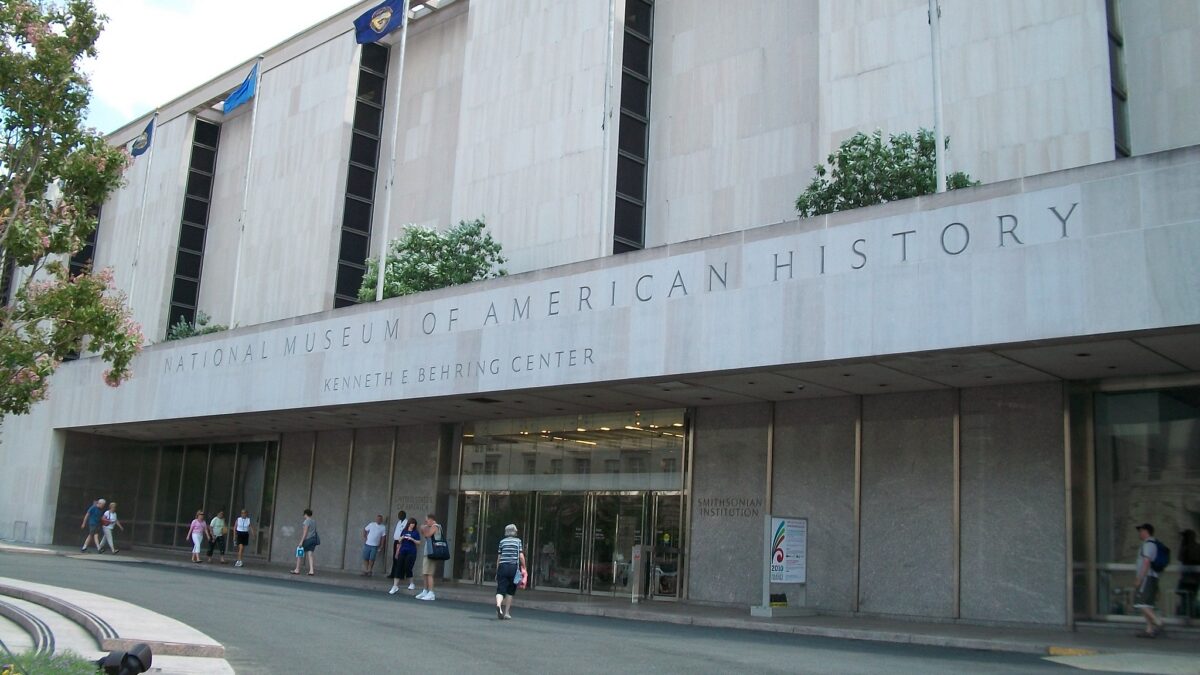

Warning! If you plan on visiting the nation’s capital this summer, skip the American History Museum. According to a new report by the Domestic Policy Council, the Smithsonian Institution’s National Museum of American History has failed in its fundamental mission — to instill in visitors a deeper respect for the American story.
Below are the five most disturbing things about the Smithsonian’s American History Museum, according to the report.
1. Villainizing Our Founding and Founding Fathers
If you’re going to the museum to learn about history, best go elsewhere. Sorely lacking are exhibits dedicated to the Pilgrims or Puritans, or to major events in the Revolutionary War, such as Washington’s crossing, the Continental Congress, or the Constitutional Convention. This follows the museum administration’s stated goal to “transform the national historical narrative” away from America’s Founding and Founders. In this, they succeeded. The museum is nearly devoid of … well, American history.
With 200,000 square feet of exhibition space, it is unforgivable that the museum dedicated to American history so fully neglects to give the American Founding the time and space it deserves. Instead, it vilifies America’s founding stories, calling the Pilgrims colonizers, reframing Thanksgiving as a “National Day of Mourning,” and embracing 1619 as our true founding instead of 1776.
The museum refuses to tell the patriotic narrative of American history. According to the report, there were no planned displays dedicated to George Washington or Thomas Jefferson for America’s 250th anniversary. Both Washington and Jefferson were given a cursory mention in one display, but it only noted that both were presidents and that they have been used to “instill patriotic values.” Washington’s pivotal role in the American Revolution, both Continental Congresses, the Constitutional Convention, or his presidency are absent. Additionally, it ignores Jefferson’s role in writing the Declaration of Independence, his contributions to religious freedom, his Founding of the University of Virginia, and his presidency.
While the museum focuses on how many of the founders owned slaves, it ignores all of the founders who worked to end slavery.
It is no surprise that the museum endorsed the American Association for State and Local History’s Reframing History project, which argues that teaching about the Founding Fathers perpetuates dominant groups’ power and reinforces white supremacist logic.
2. Bashing Christianity
According to the report, the museum portrays Christianity as an instrument of “conquest, exclusion, or cultural erasure” while ignoring the role Christianity played in shaping the Founders’ thinking on freedom and equality.
On top of this, the museum refuses to give Christianity any credit for the abolitionist and civil rights movements or for its contributions to classical liberal thought, which led to the widespread adoption of democracy as a form of government. Instead, the museum vilifies Christianity as a tool and motivator for oppression. For example, in the museum’s Aspects and Assumptions of Whiteness infographic, the museum claims that treating Christianity as the norm and celebrating Christian holidays are aspects of white culture that need to be dismantled.
3. Pushing Critical Race Theory and DEI
The museum prioritized race-based hiring and special programming for both non-residents and non-English speakers. Museum leadership also complained that centering history curriculum in K-12 schools around white people is dangerous and instead chose to use the Southern Poverty Law Center’s (SPLC) educational programming, an organization we now know sent funds to the KKK and other white supremacist groups. Among other things, the SPLC provided a toolkit entitled “Confronting White Nationalism in Schools.” The museum also openly supported the idea of transferring American land to indigenous peoples and claimed that even the museum itself is tied to systemic whiteness and is an imperial structure.
This statement makes it clear. The museum has shifted from its mission to tell the American story and is now forcing a national “reckoning” down the throats of its visitors. It is no longer dedicated to historical accuracy, but to pushing the message that America is and always has been racist. As Director Anthea Hartig stated publicly, history for her is a “prime tool of social justice.”
4. Undermining the Importance of Western Civilization
The museum consistently pushes anti-Western civilization propaganda, claiming Western culture is built on white supremacy. Western Civilization is built on the ideas of law and order, the rationality of humans, free inquiry, the scientific method, individual liberty, and the inherent dignity of human beings. Evolving out of the combined traditions of ancient Greek and Roman philosophy and Judeo-Christian writings and practices, Western Civilization has shaped 2,000 years of history. It led to the Renaissance, the Enlightenment, the Industrial Revolution, and the American Founding. Western Civilization also produced Homer, William Shakespeare, Jane Austen, Ludwig van Beethoven, Wolfgang Amadeus Mozart, Michelangelo, Vincent Van Gogh, Albert Einstein, Isaac Newton, Marie Curie, Thomas Edison, and Nikola Tesla, to name a few of its giants. Dismissing Western Civilization would also be to dismiss the accomplishments of these giants.
In an attempt to undermine Western Civilization, the museum teaches that there is no single American culture, language, or narrative. Dr. Orlando R. Serrano, Jr., the current “Head of PreK-12 Learning,” criticized the logic of Western Civilization because it prioritizes concepts such as “order, organization, and taxonomy.”
5. Refusing to Celebrate America’s 250th anniversary
Instead of celebrating what our Founding Fathers accomplished 250 years ago, the museum chose to have an exhibit titled Entertainment Nation, which argued that P.T. Barnum’s circus symbols reflect concerns about white supremacy, Mickey Mouse represents vestiges of blackface, and then went on to feature LGBTQ entertainers. This makes sense once you realize that under the current museum leadership, all exhibits must be tied back to identity politics, radical environmentalism, economic inequality, immigration, technological change, or nationalism and globalism, according to the museum’s interpretive plan.
When Director Hartig took over, she even had the museum’s mission statement rewritten, changing “we explore the infinite richness and complexity of American history” to “exploring, preserving, and sharing the complexity of our past.” Deleting the phrase “infinite richness” to describe American history and removing “American history” altogether demonstrate outright hostility towards our nation and its past.
The museum did have one exhibit dedicated to America’s 250th anniversary, but the objects focused on actual American history stayed in their normal locations, while a monarch butterfly representing migration and its immigration farm worker statue of liberty were given prominent places. The exhibit completely failed to address the true impact of the Declaration, the Revolutionary War, or the Founding of the country. Instead, it highlighted a framed photo of a drag queen.
Getting the Museum Back on Track
What this museum has become is a true tragedy for our country. Our country’s only national American history museum should serve as a source of patriotism and pride. It should be a place for Americans to go and learn to love their country and discover how we have grown and improved. Instead, the museum has a display questioning whether schools should teach patriotic values at all.
The first step in fixing a problem is to identify it, which this report has done. Unfortunately, getting this museum back on track with its original mission will require a complete overhaul of its leadership, staff, most exhibits, major programs, and mission statement. Once this is done, the museum can develop displays that once again provide an education in the duties and responsibilities of citizenship, inspire patriotism, and celebrate the American story. Then it will once again be worth visiting.