
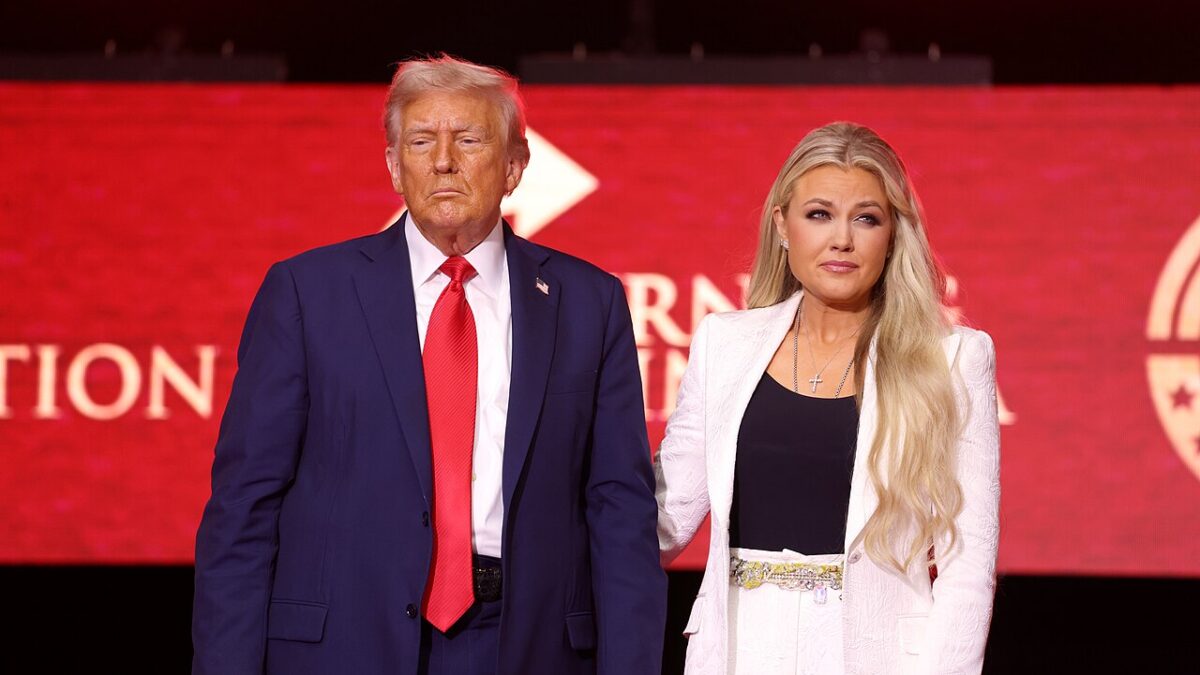
As the preliminary hearing in the case of Charlie Kirk’s alleged assassin continues this week, Judge Tony Graf has effectively blocked Erika Kirk’s request that the victim’s family be able to “meaningfully observe” evidence as it is presented before the court.
In a Supplemental Notice filed July 8, Kirk family attorney Jeffrey Neiman requested that all exhibits that have been admitted into evidence be made available to everyone in the courtroom, and that all evidence presented in the remainder of the hearing be “displayed openly and in real time.”
“At certain points throughout the preliminary hearing, the Kirk family sat in the room while evidence was admitted but not presented for their viewing,” Neiman wrote. “They were present in body, yet denied the very thing their presence was meant to secure: their ability to meaningfully observe the preliminary hearing.”
Neiman suggested that the victim’s legal right to be present at the hearing “is hollow if the victim or his representative is physically in the room but is prevented from seeing the evidence the Court is receiving.”
The judge denied this request from the Kirk legal team, saying that the publication of exhibits remains in the Court’s discretion.
“Transparency is an important principle, but it must be maintained in a manner consistent with the constitutional rights and protections afforded to all parties,” Graf said. “The court does not make a blanket ruling as it relates to any exhibit, and as previously stated, each exhibit will be afforded its own due in weighing whether it shall be published to the courtroom, or beyond, or not.”
One of the major pieces of evidence that the Kirk family would like to be made available is the recorded interview of defendant Tyler Robinson’s roommate and alleged trans-identifying partner Lance Twiggs. Twiggs’ testimony discusses messages between himself and Robinson in the aftermath of Charlie Kirk’s assassination. The FBI has also revealed in the hearing that Twiggs’ DNA was found on the towel wrapped around the rifle allegedly used by Robinson.
Neiman notes that Utah law gives victims and their legal representatives, the Kirk family in this case, the right to “be informed of, be present at, and to be heard at important criminal justice
hearings related to the victim,” and that the victim’s rights deserve to be protected at least as vigorously as the defendant’s.
Furthermore, the Kirk family argued that full transparency in this case is necessary to combat conspiracy theorists who continue to point fingers at anyone but the man who confessed to the murder.
“To receive evidence in a manner shielded from those seated in the courtroom — as
happened today — is not transparency,” the filing said. “And in the absence of transparency, speculation and conspiracy theories related to the tragic assassination of Mr. Kirk will continue to proliferate in the public domain, breeding doubt and distrust in the judicial system. This is not what anyone should want.”
The judge ruled that the Twiggs interview cannot be presented to the entire courtroom in its entirety because it contains other pieces of evidence that have not yet been accepted into the court records. However, it has officially been accepted into evidence with redactions, and there is still a possibility that the full video is presented publicly when the preliminary hearing is over, and the trial officially starts.






.jpg)