
The Young Washington movie could have been a cheap attempt to cater to patriotic conservatives who were excited to celebrate the 250th anniversary of America’s founding. It also could have pandered to the left’s version of history that often vilifies men like George Washington to spin negative narratives about the founding of the country. The movie did neither; instead, it captured the real spirit of America personified in one of its greatest men.
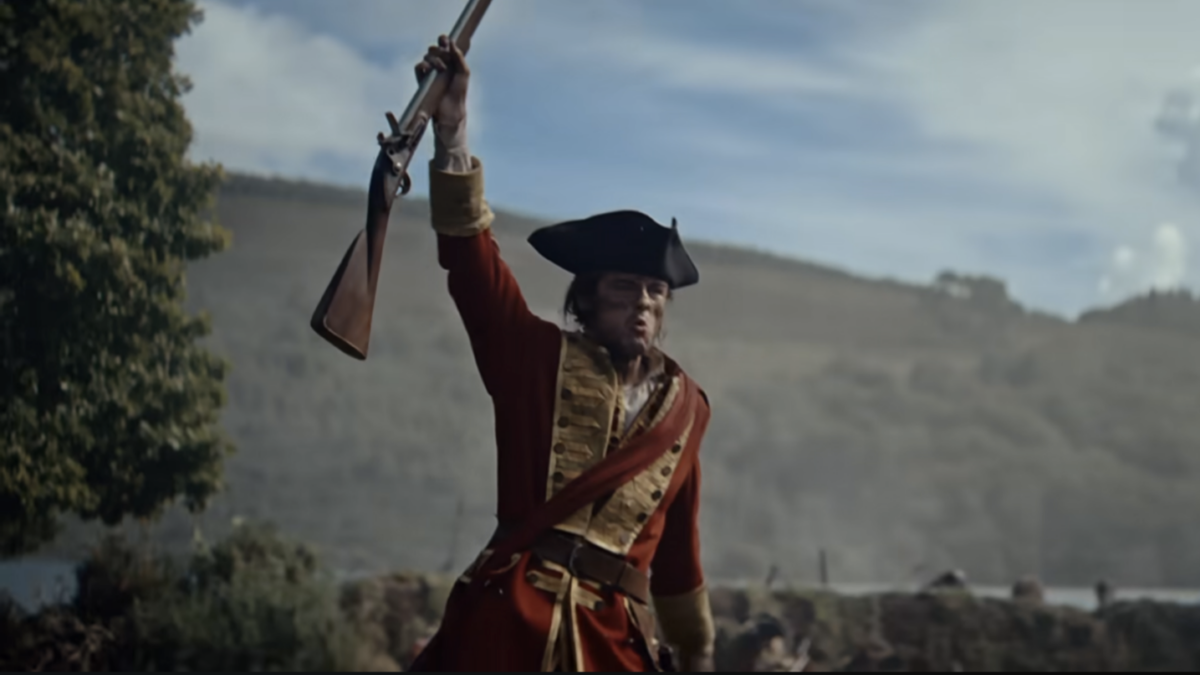
As the movie trailer shows, the film focuses on George Washington’s role in the French and Indian War, tracing his childhood ambition to become a British officer to his eventual appointment as colonel of the Virginia militia in 1756, when he was just 23 years old. Within that timeline, Young Washington shows the elements of the American character taking shape.
‘Even a Pawn Can Take the King’
George Washington’s character embodies the overconfident ambition that is a hallmark of the American spirit. From his early childhood, George has great ambitions to elevate his status from a common farmer to a high-class British officer. After his father’s death, he is mentored by his half-brother Lawrence Washington, who tells him, “If you want to be great, you need to learn from those who were.”
Lawrence teaches George from the works of Cicero, Cato, and Seneca, he helps him learn rules for civility in the company of gentlemen, and he teaches him wisdom and strategy from the game of chess.
“Even a pawn can take the King,” Lawrence tells a young George, and that sentiment drives George to a foolish confidence that he could defeat any odds in his path to greatness. This confidence would lead him astray at times, even leading to a horrible defeat and the death of one of his close friends after George arrogantly refuses to move from a vulnerable battle position. However, he gains wisdom from his mistakes and maintains the belief that he can overcome any obstacle to advance his position in life, save his men who had been abandoned for dead, and defend his homeland.
This perfectly exemplifies the American dream that no one’s lot in life is determined from birth, which separates America from most societies throughout human history. From the American Revolution to the airplane to the creation of the iPhone, Americans have always operated from an almost unjustifiable sense of confidence that “even a pawn can take the King.”
‘Wild, Beautiful, Dangerous, But Free’
The “frontier spirit” is usually associated with manifest destiny and westward expansion, but the movie shows that pioneers who loved and fought for the land were part of the American character even before the founding.
When courting a young Sally Fairfax, George described his ideal life as “wild, beautiful, dangerous, but free.” Young Washington depicts George Washington as an explorer who knew the land better than anyone. Before he was able to join the British army, he worked as a surveyor of the Ohio Territory, a job that required him to travel hundreds of miles to map the land.
“No man who lived a life of ease ever left a name worth remembering,” Washington says, and he showed he was willing to put himself in danger to protect the land. On his surveyor’s trip through the Ohio Territory, George travels through Indian land, and the Indian leader wants George’s help to force a French settlement off their land. This encounter allows George to obtain a position as an unpaid major serving the local British governor, and he takes a group of Virginian men to war to protect British land from the French settlers.
In a definitive split with his British superior, Colonel Thomas Gage, Washington was unwilling to surrender the land to the French, even if it meant probable death:
Col. Gage: “Whose land is this anyway?”
Washington: “This is our land.”
Col. Gage: “My land is an ocean away.”
Washington: “See, that’s the difference between us.”
Washington’s knowledge of the land and love for the “new world,” a term he uses several times throughout the movie, propels him into a position of power in the British army. It even gives him an advantage over a distinguished British general, who knows the battles of the “old world” fields but cannot lead as effectively as Washington in the new world forests and mountains.
Americans have always sought a new frontier to conquer, whether that be on the Oregon Trail, the mission to the moon, or the expedition into cyberspace, and Young Washington effectively traces that spirit back to before America’s founding.
‘The Creator Chose You; You’ve Been Shielded By The Spirit’
Young Washington actively emphasizes the spiritual element of the American character as a guiding force in George Washington’s path.
George’s mother tells him in his youth that “God raises what is well-grounded,” encouraging him not to turn away from his faith in trying times, like the death of his father.
After making a crucial mistake in his loss at Fort Necessity that cost him his rank and the lives of many of his men, Washington experiences failure and pain that push him to his breaking point. In that moment, his mother again points him toward his faith, saying, “Failure is the tutor sent by God. If you don’t learn from it, you fail twice; if you do learn from it, you’ve earned wisdom.”
He returns to the British army as an aide-de-camp, and by the providence of God, Washington is elevated to a position to take over command in a losing battle and save the lives of the Virginian men. After the battle, an Indian leader allied with France summons Washington to tell him that he ordered all his best men to shoot him, and they never miss.
“The Creator chose you; you’ve been shielded by the Spirit,” he tells Washington.
Washington reports back to the governor’s office with bullet holes in his jacket and hat, and the governor remarks, “How are you alive?”
The movie makes it clear that a providential hand guides and protects Washington, putting him in the right spot at the right time to save the lives of his fellow Virginians. The founders believed in that providential hand at play in the circumstances of the founding, and faith has been a core element of the American spirit throughout its history.
‘Love Letter to the Country’
The movie concludes with George Washington’s appointment as colonel of the Virginia militia. His only request is to be given blue uniforms, “the color of Virginia,” to differentiate himself and his men from the other British soldiers. Washington tells his soldiers that he is honored to serve them on behalf of Virginia, solidifying the core difference between the Americans and the British: In the British system, the soldiers serve their leader, and in the new world, the leader serves his soldiers.
“This is our love letter to the country itself and its first founder,” Director Jon Erwin said. The movie emphasizes how much those two entities are synonymous.
While there are moments in Young Washington when the actors’ accents blend or they deliver lines poorly, the message of the movie is clear and honest: One of America’s greatest men personifies a unique American character that has its flaws, but has led to incredible success.