
America turns 250 in just a few days. So when my younger brother came to visit me in Virginia before heading off to college this fall to study history, I figured there was only one fitting itinerary for two history geeks: a Founding Fathers tour.
Over the course of his trip, we visited George Washington’s Mount Vernon, Thomas Jefferson’s Monticello, and James Madison’s Montpelier. I expected to leave each one with a deeper appreciation for the men who built the country.
Instead, I left with the same sinking feeling after every stop: At 250 years old, America still struggles to talk about its founders as founders. At each estate, the story of Washington, Jefferson, and Madison was there, of course. But it was overshadowed by an almost compulsive need to frame each man first through the lens of slavery, as if the only acceptable way to discuss America’s founders in 2026 is with an apology attached.
The result is not a fuller history but a distorted one, leaving the impression that the most important thing about the men who gave us this country was not the country they gave us at all.
Before getting into the specifics of each site, let’s start with the obvious. George Washington, Thomas Jefferson, and James Madison all owned slaves. History cannot change that, nor should it. The point of preserving the past is not to lie about it. America’s founders were flawed men. That deserves acknowledgment, but it also deserves proportion.
Those same flawed men also risked their lives and livelihoods to create a new nation. They gave the world the Declaration of Independence, the Constitution, and a system of government strong enough to survive civil war, economic collapse, foreign threats, and, eventually, the destruction of slavery itself. That is what felt missing from so much of this trip: proportion.
To be fair, Mount Vernon was the least guilty of the three. If you are looking for a place that still feels primarily devoted to the life and legacy of George Washington, his estate comes the closest. You can still walk away thinking about Washington the general, Washington the president, and Washington the man who could have made himself king and instead went home.
But even there, the pattern was impossible to miss. My brother and I would move from one part of the estate to the next, only to find slavery once again brought to the foreground. There are exhibits on the lives of the enslaved at Mount Vernon, tours devoted specifically to enslaved life on the estate, and extensive discussion of Washington’s relationship with slavery.
None of that is inherently out of bounds. But even at the most Washington-centric of the three sites, it felt as though visitors were expected to process Washington first as a slaveholder and only then as the father of his country.
By the time we got to Montpelier, that pattern had become harder to ignore. Madison’s home does not simply acknowledge slavery as part of the estate’s history; it places it near the center of the visitor experience. There are exhibits devoted to the lives of the enslaved people who lived there, restored workspaces that highlight plantation life, and a broader effort to ensure that Madison is understood less as the Father of the Constitution than as a founder compromised by slavery.
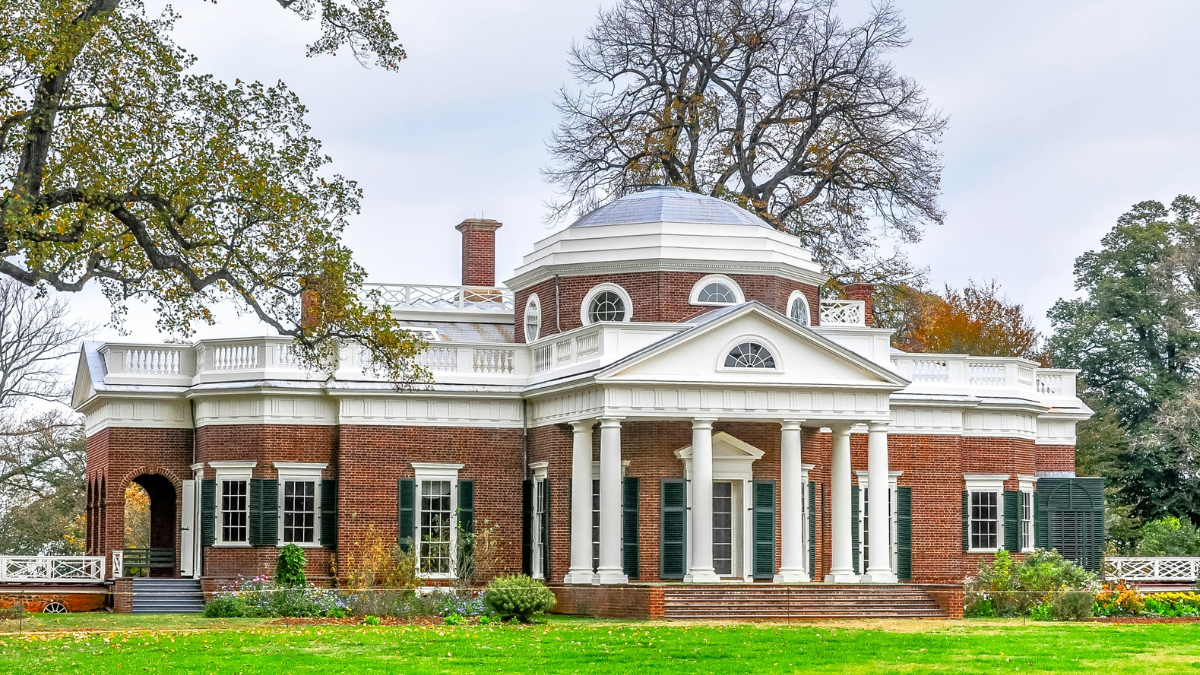
And then there was Monticello, by far the worst offender of the three. At Jefferson’s home, any semblance of balance disappears. Slavery is not treated as one important subject among many. It feels like the organizing principle of the entire estate. My brother and I had barely begun making our way through the property before it became clear that nearly every path led back to the same interpretive destination: Jefferson the slaveholder.
Visitors can tour exhibits devoted to the enslaved staff, walk through memorial spaces dedicated to those Jefferson enslaved, and take tours built specifically around the experience of slavery at Monticello. Sally Hemings is not merely part of the story there; she is one of its defining focal points.
By the end of the visit, it was hard to escape the impression that Jefferson’s authorship of the Declaration of Independence and his defense of religious liberty had been pushed to the side so the estate could foreground, above all else, his moral failures. That, ultimately, is the problem.
The decidedly anti-founder perspective embedded in Montpelier and Monticello is no surprise in light of the left-wing funding and activist leaders that have wielded influence over these historic sites. The National Trust for Historic Preservation, the owner of Montpelier, has received millions from George Soros’ Open Society Foundations and Democrat billionaire David Rubenstein, who has also given millions to the group that manages Monticello. In addition, leftist leaders with an anti-American perspective on history have wreaked havoc. Longtime Montpelier archaeology director Matthew Reeves once reportedly said of Madison that he would not participate in “honoring a ‘dead white president and a dead white president’s Constitution.’” This kind of hostility can’t help but bleed through into the displays and “education” offered at these venues.
I did not leave Mount Vernon, Montpelier, or Monticello angry that slavery had been discussed. I left frustrated that at all three sites, especially the latter two, the story of slavery seemed to crowd out nearly everything else. The men who helped build the United States were still there, but mostly in the background, introduced apologetically, as though their achievements could only be mentioned after the proper amount of moral throat-clearing.
America is about to turn 250. That should be an occasion not for historical whitewashing, but for historical balance. We do not honor the country by pretending Washington, Jefferson, and Madison were saints. But neither do we honor it by reducing them to slaveholders with good résumés.
A mature nation should be capable of doing both at once: acknowledging the sins of its founders without forgetting why those founders mattered in the first place.