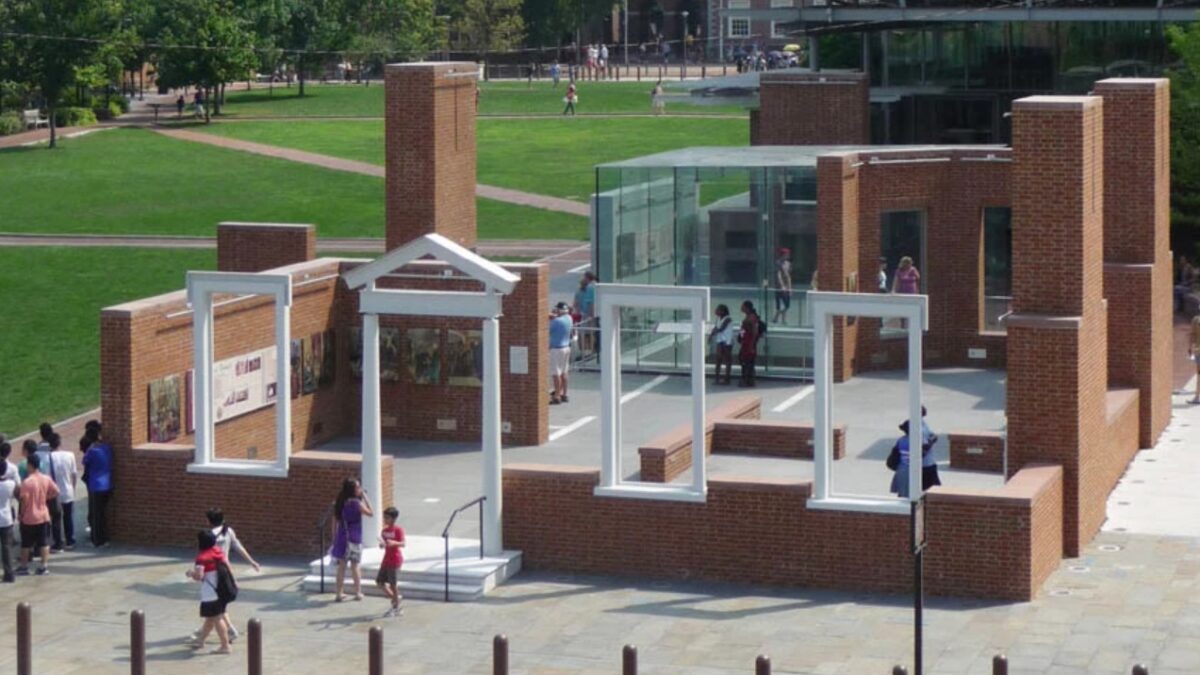

When George Washington lived in the President’s House in Philadelphia, at that time the nation’s capital, he consistently focused on setting rightful constitutional precedents. One thing our first president didn’t have to worry about was having lower federal court judges issue rulings that professed to bind the entire nation. Now, as the Trump administration seeks to replace a woke exhibit at the President’s House Site that made Washington the most heavily criticized individual at Independence Park, its efforts are being blocked by a lone federal judge who sits in New England, far from Philadelphia.
The President’s House exhibit, opened by the National Park Service under President Obama, was spearheaded by the Avenging the Ancestors Coalition and other leftist activists. ATAC (pronounced “attack”) has sponsored “Anti-July Fourth Day” events, and its founder, Michael Coard, speaks of “the 1776 birth of the racist American nation” and calls those who celebrate July 4 “traitors” who “embrace whiteness.”
The President’s House exhibit essentially ignored the watershed events that happened there during the first two presidencies, focusing almost exclusively on slavery. Because Washington had brought several slaves north with him to Philadelphia, 25 of the site’s 30 signs focused on slavery or race relations. These signs spoke of “Washington’s Deceit” and claimed he “mocked the nation’s pretense to be a beacon of liberty.”
After the Park Service removed the signs in January, Philadelphia sued, and a district court judge ruled they must be reinstalled. Some were rehung before the Third Circuit Court of Appeals issued a partial stay while it considered the case on an expedited basis. Last week, a three-judge panel for the Third Circuit — composed of Bush, Obama, and Trump appointees — unanimously ruled in the administration’s favor.
Writing for the court, Judge Thomas Hardiman observes that “the City does not own the President’s House or anything in it.” Rather, “NPS owns the President’s House” and is therefore free to change the exhibit as it sees fit. Hardiman’s opinion also notes that the Park Service’s replacement signs, which it seeks to hang by July 4, discuss the house, the people who lived there (including slaves), the executive branch, and the history of slavery in America. “These new panels are full of historical context,” he writes, and the ruling green-lights the Trump administration to hang them.
The administration can’t do so, however, because of a separate ruling by Judge Angel Kelley, whose district court is located in Boston. Kelley, a Biden appointee, issued a nationwide injunction saying the Park Service must rehang — by July 3 — all woke signs it has taken down during this administration. It might seem strange that a lower court judge in far-off Boston, who didn’t even address the specific arguments in the Philadelphia case, could effectively overrule three judges on a higher court that sits in Philadelphia and did address those arguments. But such is the reality under so-called “universal injunctions.”
Kelley’s opinion, which uses “diverse,” “equity,” or “inclusive” 23 times, effectively ignores the law, applying it only in its broadest strokes to reach her desired ends. She writes that the Park Service must “manage … sites in a manner that serves the public,” but its actions “failed to consider the interests of the public.” “For example,” she writes, the NGOs who brought the suit are harmed because this “shift” in “priorities” jeopardizes their ability “to participate in panels on topics including #MeToo and #BlackLivesMatter.” Also, a homeschooling member of one NGO “can no longer rely on the park sites for their pedagogical value.”
Her ruling ultimately objects to the opening line of Article II of the Constitution, which vests the “executive Power … in a President.” She concludes that “a unilateral, unreasoned, and lawless Executive Order of a president cannot be the sole justification” for changing exhibits, as we cannot let ourselves be ruled by “the whims of a single individual” — unless, of course, that individual is a district court judge in Boston.
Kelley’s ruling openly defies the Supreme Court’s opinion last year in Trump v. CASA. Therein, the Court writes that “under the Judiciary Act,” which President Washington signed into law, “federal courts lack authority to issue” universal injunctions. The Court notes that universal injunctions create the bizarre situation whereby a “plaintiff must win just one suit to secure sweeping relief,” while “the Government must win everywhere” — as the President’s House Site battle demonstrates.
The Trump administration promptly asked for a stay of Kelley’s rogue ruling. So, the race is on to hang the replacement signs at the President’s House Site by the 250th anniversary of American independence. If the administration succeeds — thereby honoring the man who did more to achieve our independence than any other — it will mark a great win for the separation of powers, for the telling of America’s story, and for the quarter-millennial celebration of the country.