
As part of its Russia collusion hoax lawfare attacks on President Donald Trump, the FBI opened a “subcomponent investigation” of Crossfire Hurricane, treating Trump as a criminal subject based on already-debunked information linking him to Russia, according to a Trump administration official.
The sub-investigation, known as “Oxferd Comma” was predicated on the idea that Trump, “the newly elected president, was acting as a Russian asset when he fired James Comey on May 9, 2017,” the administration official said. The case was marked as a “‘sensitive investigative matter,’ which was generally to keep it off the books from other agents to be able to see.”
The case was opened despite the fact that “almost everything in the FBI’s possession at that point had debunked or ruled out that Trump or his campaign was colluding with Russia at that time,” the official continued.
The FBI launched the investigation on May 16, 2017, one day before Robert Mueller was appointed special counsel to investigate the Russia collusion as though it were legitimate, despite the fact that the Clinton campaign-funded Steele dossier had already been debunked. Oxferd Comma was then absorbed into the Mueller investigation.
Well prior to May 2017, according to the admin official, FBI Special Agent William Barnett (who worked with Russia hoaxer and disgraced former Special Agent Peter Strzok on Crossfire Hurricane) gave a “lengthy interview” where he said the FBI concluded that there was no evidence of Russia collusion with Trump, or his former advisers Michael Flynn, Carter Page, and George Papadopoulos.
Oxferd Comma moved along, regardless.
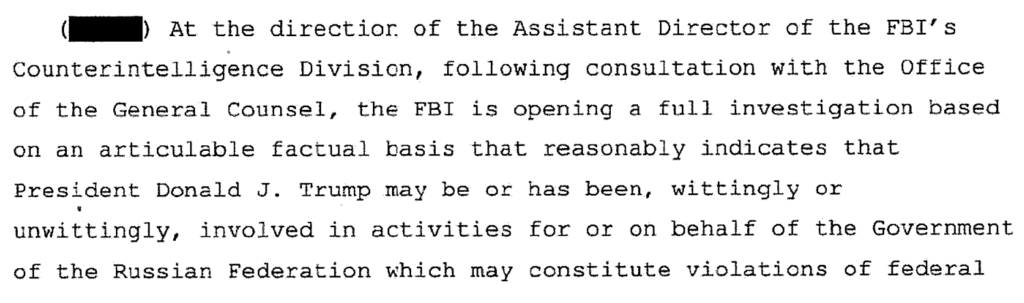
“The FBI is opening a full investigation based on the articulable factual basis that reasonably indicates that President Donald J. Trump may be or has been, wittingly or unwittingly, involved in activities for or on behalf of the Government of the Russian Federation which may constitute violations of federal criminal law or threats to the national security of the United States,” a May 16, 2017, document released by the White House on Wednesday shows. “The goal of the investigation is to determine if President Trump is or was directed, controlled by, and/or coordinated activities with, the Russian Federation in a manner constituting a threat to the national security of the United States and/or a violation of federal criminal statutes. In addition, this investigation will also seek to determine whether President Trump or others yet to be named obstructed and/or conspired to obstruct any associated FBI investigation.”
The administration official said that the White House will release a timeline of events and information known by the FBI that led to the decision to move forward with Oxferd Comma. The official also said that there was an FBI spreadsheet completed in February 2017 showing allegations in the Steele dossier had been “either disproven or internet rumor or could not be corroborated.” By February 2017 the FBI had also conducted interviews with a “Steele subsource” who “disowns the primary allegations that were attributed to him in the Steele dossier, saying it was bar talk, hearsay.”
The entire body of evidence that existed prior to the May opening of the Oxferd Comma investigation should have weighed against launching the investigation in the first place, but the FBI moved forward.
The May 16, 2017, document makes numerous claims and insinuations, such as the allegation that the Trump campaign intervened in a Republican Party platform “committee discussion” before the 2016 Republican National Convention to change platform language. The change altered the language on support for Ukraine from “[the provision of] lethal defensive weapons” to “a more anodyne call for ‘appropriate assistance.'”
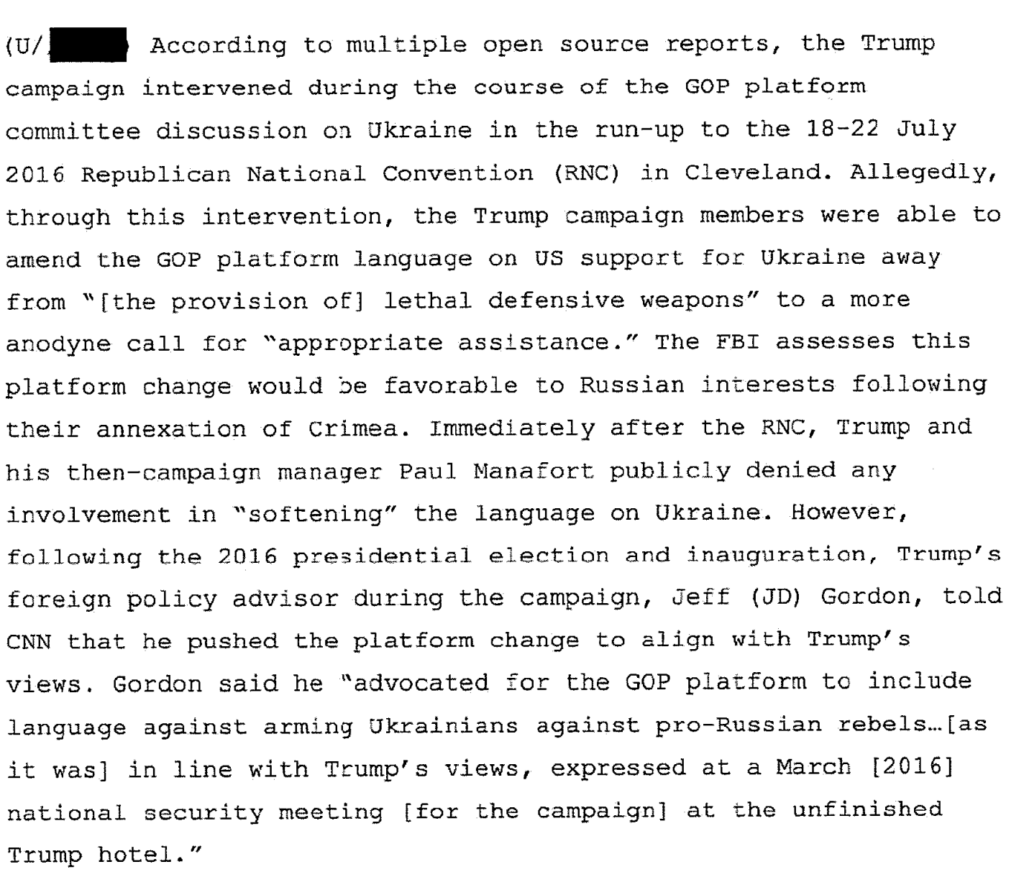
While the FBI stated this platform change would be “favorable” to Russia, it says nothing about the considerations of the American electorate who supported Trump, implying that the change must have been made as a service to Russian President Vladimir Putin.
The document also covers discussions Trump had with Comey from January to April 2017, claiming Trump had asked Comey to “resolve” the Russia investigations and implying that Trump pushed for a cover-up rather than the justified ending of a hoax that would strip the American people of a fully functioning presidency.
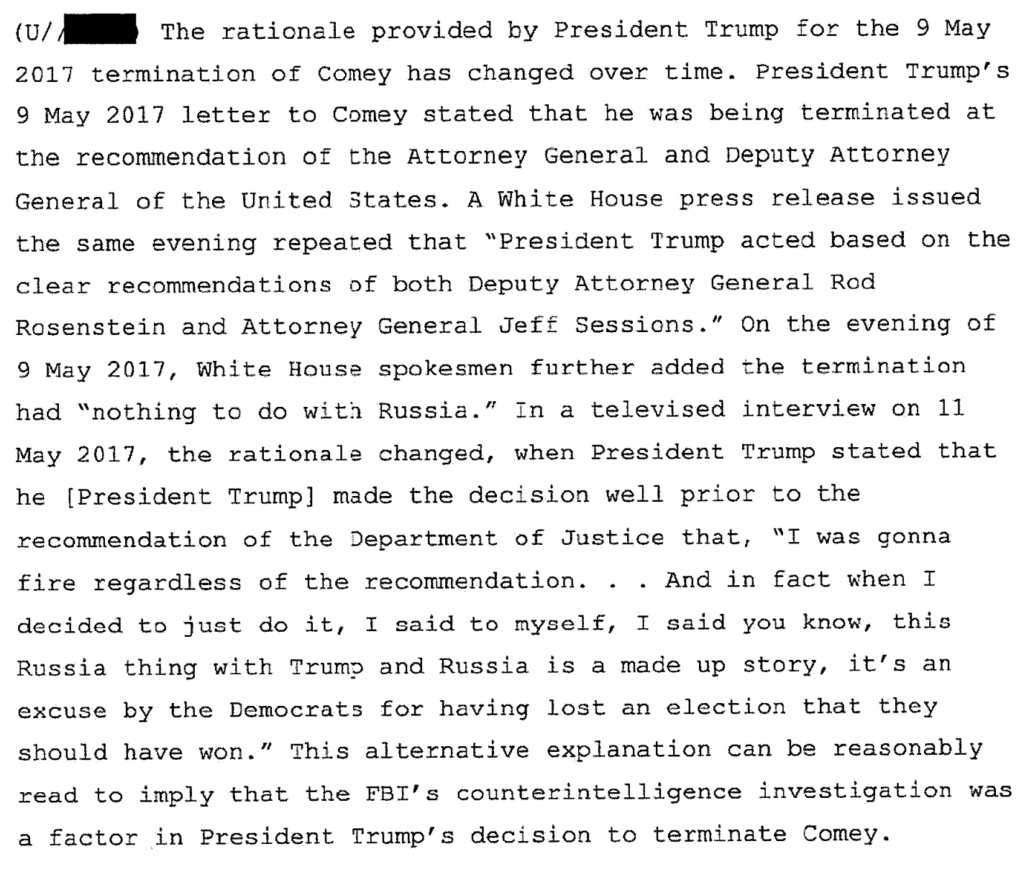
The FBI document also pointed to a media interview in which Trump talked about his deliberations for firing Comey and stated, “I was gonna fire regardless of the recommendation. … And in fact when I decided to just do it, I said to myself, I said you know, this Russia thing with Trump and Russia is a made up story, it’s an excuse by the Democrats for having lost an election that they should have won.”
The FBI deduced that “this alternative explanation can be reasonably read to imply that the FBI’s counterintelligence investigation was a factor in President Trump’s decision to terminate Comey.”
Instead, the breadth of evidence — known to the FBI at the time and now known to the public — shows that Trump was trying to stop a corrupt investigation from continuing and Comey was unwilling to comply.