
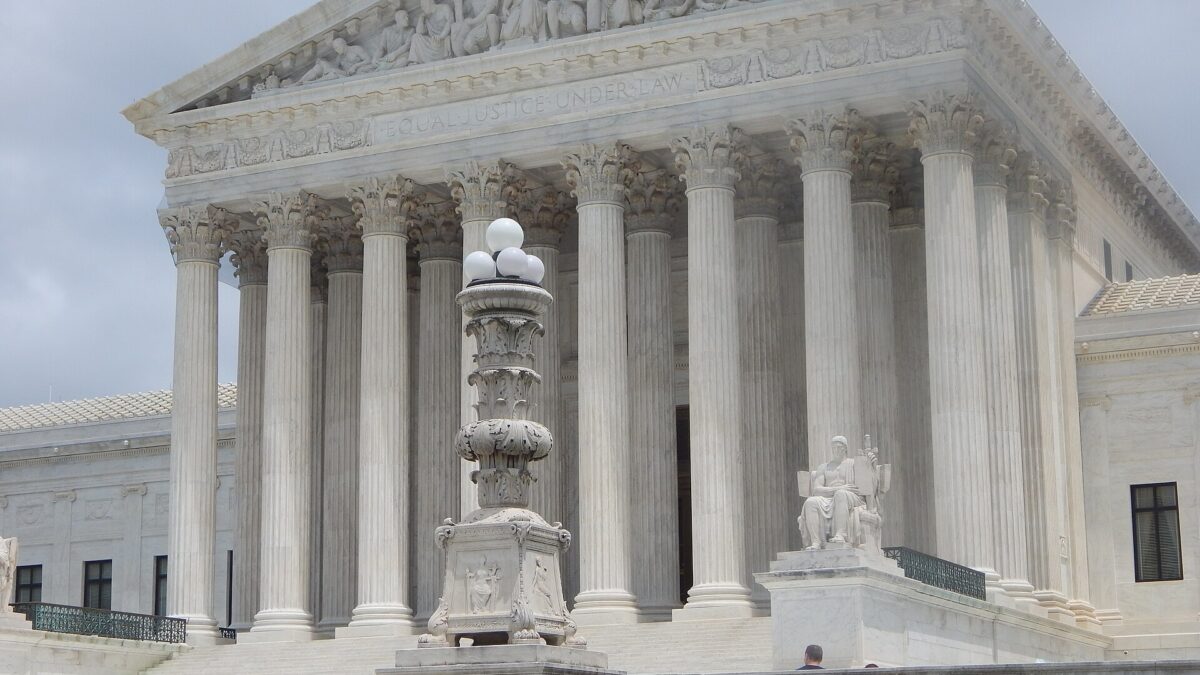
The U.S. Supreme Court dodged a notable case involving the consideration of race and potential Fourth Amendment seizures on Monday. And as has become routine with many significant cases before the bench, only Justices Samuel Alito and Clarence Thomas were willing to take it up.
The high court revealed in its latest order list that it has declined to hear arguments and issue a decision in United States v. Donte Carter. The case deals with the legal question of whether “perceptions of law enforcement that a court attributes to a particular racial group are a relevant factor in the Fourth Amendment analysis of whether a member of that group has been seized.”
According to Justia, the case came to fruition following an encounter between Washington, D.C. police officers and respondent Donte Carter. The officers approached a group of black men — one of which was Carter — as part of a “firearm interdiction operation.”
At one point, one officer asked Carter if he was carrying a gun, to which Carter denied and “twice lifted his shirt to show his waistband.” After hiking his pants at the request of the officer, a different officer “noticed a bulge in [Carter’s] groin area, believed it to be a firearm, and after a brief struggle, the officers recovered a gun from [Carter’s] pants.”
Carter was subsequently charged with several gun-related offenses thereafter. In seeking to “suppress” the gun and a following statement, he argued that the officer’s request that he hike his pants constituted an unlawful seizure and that the officer lacked reasonable suspicion at that time.
While the D.C. Superior Court rejected Carter’s challenge, the D.C. Court of Appeals (DCCA) ruled in his favor. The court held that it constituted an unreasonable seizure within the context of the Fourth Amendment, and that “considering the officers’ show of authority, the accusatory and repetitive questioning, and [Carter’s] status as a Black man in a highly policed area, a reasonable person in his position would not have felt free to leave.”
The U.S. government petitioned SCOTUS in January to take up the case and reverse the DCCA’s decision.
Supreme Court rules require that at least four justices must agree to hear a case before it can be considered by the full court. But Monday’s order list indicates that only Alito and Thomas were willing to do so.
Writing on behalf of himself and Thomas, Alito authored a blistering dissent chastising his colleagues for ducking a matter that “warrants this Court’s review.” In assessing the facts of the case, he noted that the DCCA’s decision “said that it ‘must look’ to a further fact: the ‘defendant’s race'” in such matters and effectively eviscerated a race-neutral approach to the Fourth Amendment.
“Under the [DCCA’s] test, officers will need to quickly assess a person’s race, and if officers and courts must craft special rules for black persons, what about dark-skinned Latinos, other Latinos, and members of other minority groups?” Alito wrote. “We have said that our ‘”Constitution is color-blind.”‘ … It ‘almost never’ allows government actors to treat persons differently based on their race.”
The Bush 43 appointee went on to detail how the high court’s past rejection of the “proposition that the Constitution permits an individual to be treated differently based on a ‘perception that members of the same racial group — regardless of their age, education, economic status, or the community in which they live — think alike.'” In doing so, he observed the dangers of permitting people “to be treated differently based on statistics, studies, or expert testimony that purports to show that members of the racial or ethnic group to which he belongs are more likely to act in a certain way than are members of other groups.”
“Here, the special treatment helped the individual; in other situations it will not,” Alito wrote. “Perhaps the DCCA’s test has legitimate justifications. In any event, it is important, and it warrants this Court’s review. I therefore respectfully dissent from the denial of certiorari.”
The lower court’s decision will remain in effect as a result of the Supreme Court’s unwillingness to hear the case.



.jpg)