

Pauline Newman was first appointed to the Federal Circuit Court of Appeals by President Reagan in 1984. At 98 years old, she is currently the oldest active federal judge in the United States — that is, unless her opponents get their way.
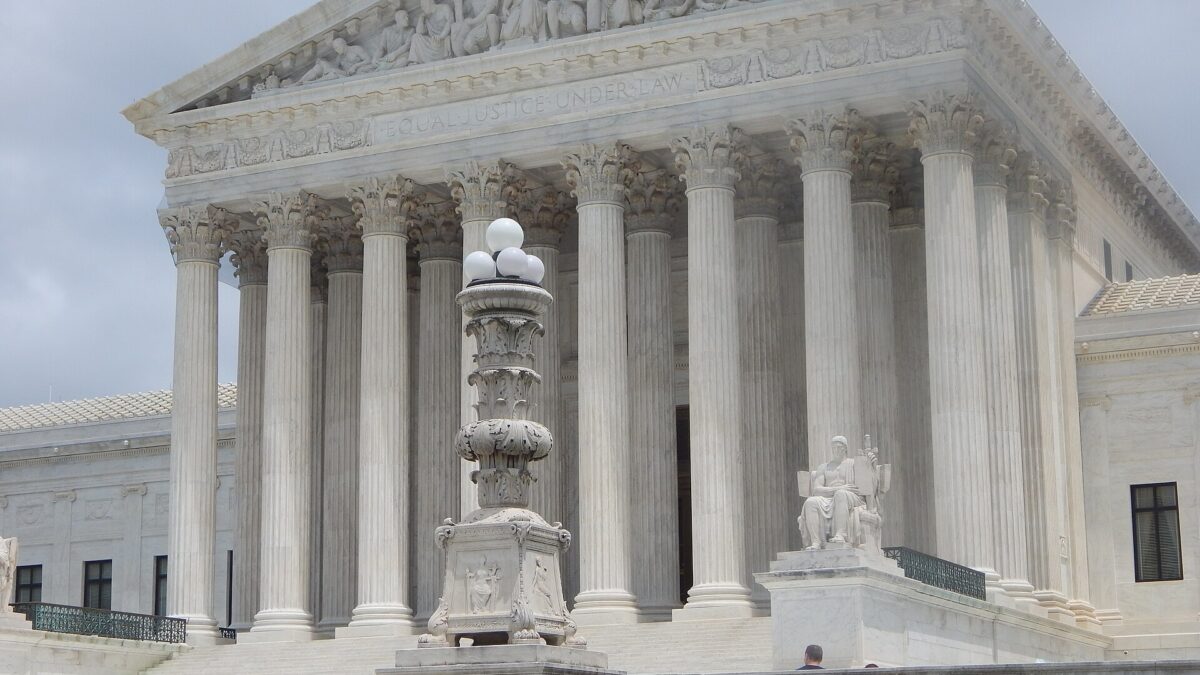
During its Thursday conference, the U.S. Supreme Court will decide whether to take up a case (Newman v. Moore) involving efforts by Newman’s judicial colleagues to effectively sideline the Constitution to kick her off the bench. Article III of America’s founding legal document grants federal judges lifetime appointments and states that they can only be removed by Congress via impeachment and conviction.
Newman’s decades of public service came under siege in early 2023 when her court — led by Chief Judge Kimberly Moore — launched an investigation into the Reagan appointee’s mental fitness over alleged concerns of cognitive and physical decline. According to Newman’s counsel, the New Civil Liberties Alliance (NCLA), Moore and the Federal Circuit’s Judicial Council “indefinitely removed Judge Newman from hearing new cases even before beginning a formal investigation into her fitness for office.”
Newman challenged her suspension on the grounds that the Judicial Council’s actions are unconstitutional and represent a violation of the 1980 Judicial Council Reform and Judicial Conduct and Disability Act (“the Disability Act“), which governs the process for filing misconduct and disability complaints against federal judges. As described by NCLA, she argued that the Disability Act “permits administrative suspensions, but only a time-limited suspension with a definite end-date,” and that “it explicitly forbids removing a judge from office.”
Newman’s legal bid for reinstatement was shot down in 2024 by U.S. District Judge Christopher Cooper, an Obama appointee known for his recent ruling against President Trump’s planned Kennedy Center renovations. Citing a past D.C. Circuit Court of Appeals decision, the D.C.-based judge held that Newman’s claims could only be heard by the U.S. Judicial Conference and not federal courts.
Cooper’s ruling was later upheld by the D.C. Circuit Court of Appeals in August 2025. The three-judge panel, comprised of one Biden and two Obama appointees, similarly claimed, “In the [Disability] Act’s legislative history, we discerned ‘clear and convincing’ evidence of Congress’s intent to channel review of as-applied challenges to the Judicial Conference alone and away from federal courts.”
With nowhere left to turn, Newman petitioned the Supreme Court in March to take up her case and decide whether the Disability Act bars claims like hers from undergoing judicial review. The Reagan appointee noted how her colleagues’ actions “undermine[] the judicial independence that is a vital foundation of our constitutional design” and argued that “every judge who gets crosswise with her chief judge or her colleagues must now worry whether similar tactics could be used to remove them.”
Newman’s counsel used the petition to take aim at the Federal Circuit Judicial Council’s allegations of cognitive and physical decline by noting that their client “has continued to speak and write before the legal community.” They further noted that “no finding of disability has been made concerning her in the years since the unlawful administrative orders began” and that she “voluntarily underwent and passed three expert evaluations of her mental fitness and was reported as having the mental ability of someone decades younger.”
“[Newman] now has been suspended longer than any federal judge in history. The length of the suspension, the apparent intention to keep her off the bench permanently, the same judges acting as complainant, witnesses and judges, and the refusal to transfer the matter to another circuit for neutral investigation are unprecedented,” the petition reads.
Under Supreme Court rules, at least four justices must agree to take up Newman v. Moore before it can be considered by the full court.