
Legacy media don’t describe. They exist to prevent description, corralling and deflecting. In the famous description from Iowahawk, “Journalism is about covering important stories. With a pillow, until they stop moving.”
Four states held primary elections on June 9, and on the morning of June 10, they were either ahead in their count or about as far along in their count of ballots as California, which held its primaries on June 2. These screenshots from live election results at the NBC News website are both from Wednesday morning at 9:30 PT:

California counts far more slowly than anyone else in the country, and California’s results have the most remarkable tendency to drift: What the outcome looks like on election night has nothing to do with the final outcome. Famous 2010 election outcome summarized in a single headline about the 2010 state’s attorney general race: “When Kamala Harris lost on election night, but won three weeks later.”
It just happened again.
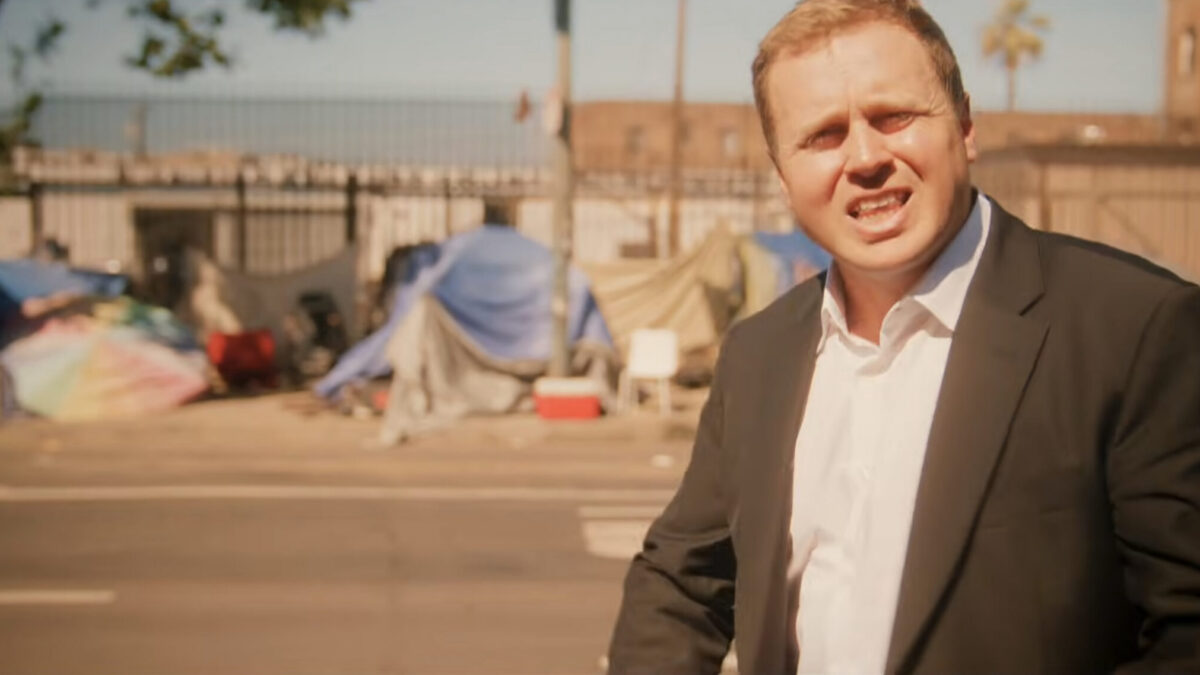
The Republican mayoral candidate Spencer Pratt made the extraordinary choice of accurately describing Los Angeles, talking clearly about the descent of the city into zones of Third World filth, failing public agencies, and a crisis of open drug addiction and fatal overdoses in the streets. Pratt’s candidacy was always a long shot, and Republican activists in Los Angeles kept using the term “math problem” to describe the likely ending in a place where Democrats outnumber Republicans by more than two to one.
But Pratt seemed to have at least partially solved the math problem: Initial returns showed him solidly in second place behind Mayor Karen Bass and her record of appalling failure, seemingly earning a spot on the November ballot. If that outcome probably didn’t give him a shot at being mayor, it very much did give him a high-profile platform to keep talking about the obvious decline of the city.
And then the count kept going.
As the week went on, initial third-place finisher Nithya Raman radically outperformed her election night results. Late-arriving mail-in ballots trended hard in her direction, as she grew her share of the vote with each new day of counting. An unappealing candidate who was polling at 18 to 19 percent in the bottom half of May suddenly started getting nearly 40 percent of the vote in late-arriving batches of mail-in ballots.
Well behind on election night, and for a few days after the election, Raman suddenly surged ahead and took second place, forcing Pratt out of the November election.
As everyone and their grandmothers haved noticed, California has insane voting regulations that define a valid mail-in ballot, including this one: “Vote-by-mail ballot identification envelope has no dated postmark, the postmark is illegible, and there is no date stamp for receipt from a bona fide private mail delivery service, but the voter has dated the vote-by-mail ballot identification envelope or the envelope otherwise indicates that the ballot was executed on or before Election Day and the ballot was received by the elections official in accordance with Elections Code section 3020.”
Mail-in ballots that have no postmark and that suddenly appear long after Election Day are to be counted if “the voter has dated the vote-by-mail ballot identification envelope.” Whenever the thing shows up, whatever date is hand-written on the envelope is good enough.
Allowing remotely cast ballots to slip in with handwritten dates in lieu of postmarks, California is also home to a giant population of drug addicts who live on the street, and every one of them is eligible to receive a mail-in ballot. As has been widely reported, people living in tents on Skid Row have been remarkably open about the two-dollar payments they got for delivering ballots for leftist mayoral candidates.
In an atmosphere of calculatedly loose ballot verification rules and easy ballot harvesting, California’s supposed “vote” keeps growing: “California’s going to have over 9.4 million primary votes cast for governor in 2026. That’s about 35% more than both 2018 and 2022. Those two midterm years were similar. This despite the fact that the state’s lost about 1.5 to 2 million citizens since 2018, mostly but not entirely replaced by immigrants and migrants.”
And finally, greasy California Gov. Gavin Newsom signed a bill into law on May 27, days ahead of the elections, making it illegal — in theory, and expect the new law to be challenged in court — for county voting officials to allow law enforcement officers to review ballots after an election.
Put all of those things together, and what do you get? If you believe the legacy news media, you get an election of undeniable integrity, and only bizarre far-right conspiracy theorists would ever dare to claim otherwise.
The New York Times, June 8: “Trump Previews Fall Strategy With Baseless Claims of California Vote Fraud.”
NPR, June 9: “California’s attorney general refutes Trump’s baseless claim of election fraud.”
The Guardian, June 9: “Trump ‘inventing fraud’ in California, experts warn as president ramps up baseless claims.”
The Wall Street Journal, June 8: “Trump Fuels Election-Fraud Claims in California.”
NBC News, June 9: “California’s slow vote count and Trump’s unfounded fraud claims offer preview of November’s midterms.”
By the most remarkable coincidence, every legacy news media organization adopts exactly the same frame: Donald Trump is pretending that there’s fraud in California’s election. The story isn’t about the state’s provably loose ballot-handling rules, the not-really-disputed significance of ballot harvesting from places like Skid Row, the late-breaking surge of ballots for unpopular far-left candidates, or the growing inevitability of California’s post-election new results that always favor Democrats. The story is about Donald Trump’s personality.
Are there reasons to doubt that California has fair and honest elections? No, because Orange Man Bad.
In an important essay that has now sadly been paywalled, the longtime journalist David Samuels described a transition in which Democrats stopped making arguments and started erecting “permission structures” with media complicity that were designed to signal which views are to be considered acceptable and which views are not to be discussed: high-status and low-status things to believe.
This is entirely what the “news” is currently doing. Rather than examining the possibility that the vote in California is manipulated and not a true representation of public sentiment, legacy media are uniting around the cultural signal that this is not a topic that is to be discussed.
Consider that lockstep messaging clear enough evidence that the opposite is probably true, and demands further examination.