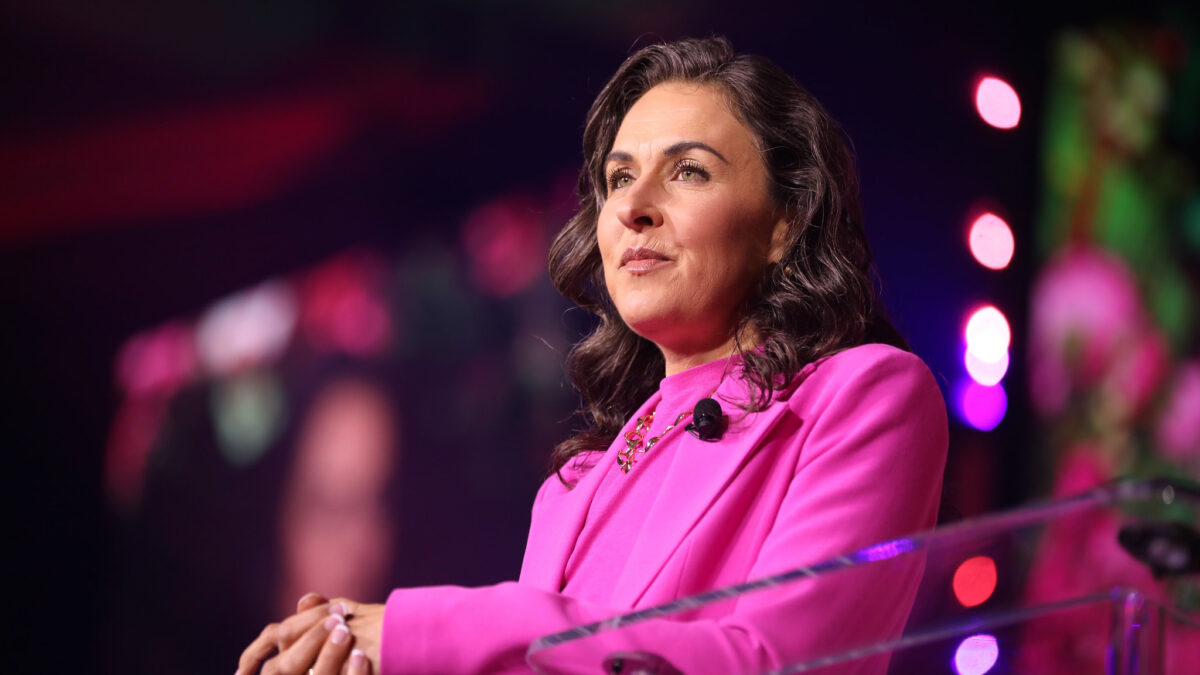

On Mother’s Day, The Seattle Times published a front-page article warning readers about me — a Seattle mother of four whose central heresy is believing children have a right to their mother and father and should not be bought and sold.
Reporter Jim Brunner identified my neighborhood, church, salary, family history, and upcoming speaking event. He contacted former employees, our board chair, and even my husband while he was deployed in the Pacific.
Had my husband replied to the inquiry, I wonder whether Brunner would have thanked him for defending the reporter’s First Amendment rights — rights Brunner would later exercise by doxxing the time and location of his wife’s upcoming speaking event in the pages of the state’s largest newspaper.
This was not journalism. It was a hit piece. The Seattle Times knew exactly what it was doing. Left-wing outlets routinely lecture conservatives about “dog whistles,” “stochastic violence,” and the dangers of politically charged rhetoric. Yet they seemed remarkably comfortable publishing granular personal details about an ideological dissenter to a readership where, according to a recent YouGov poll, 1 in 4 believes political violence can be justified to achieve political goals. Ask President Trump, Russ Vought, Brett Kavanaugh, and Erika Kirk whether leftist violence is a legitimate concern for those who reject left-wing orthodoxies.
Within 48 hours, online local forums were already swarming for additional identifying details about my family, community, church, and home.
Yet the most revealing aspect of the article was not what it included. It’s what it carefully avoided. Brunner spent thousands of words examining the dissenter while refusing to examine the dissent.
Brunner referenced selective fragments of my speeches and articles but never linked to my National Conservatism speech, the Greater Than website, the campaign trailer, nor the detailed critiques underlying our position. Why? Because once readers encounter the actual argument instead of the paper’s caricature of it, the caricature starts to collapse.
Instead, Seattleites were offered selective quotes like how I am “disabusing pastors of ‘the lie’ that their highest calling is to be ‘welcoming and affirming’” (true) and dangerous advice to women like, “If you can, get married early and have children” before making “partner in the law firm.” Did I blame the “black hole of marriage equality” for a “host of ills?” Yes, I did. Not because I’m some pearl-clutching religious Karen. But because we now have 11 years of receipts of how adult “equality” produced inequality for children.
And that’s the story Brunner didn’t bother to tell. The one he contorted himself to avoid like a Virginia congressional map. There has been a systematic deconstruction of children’s rights since gay marriage was nationally mandated 11 years ago. As predicted in the SCOTUS amicus brief I filed in Obergefell, making husbands and wives optional in marriage made mothers and fathers optional in parenthood. Brunner could easily fact-check that claim in his own state capital.
In 2018, Democrat darling state Sen. Jamie Pedersen — a gay “married” father of four surrogate-born boys — sponsored and helped pass Washington’s Uniform Parentage Act. It was a total rewrite of parentage law, which simultaneously legalized commercial surrogacy in the state.
His overhaul scrubbed the words “mother” and “father” from Washington parenthood statutes, created new pathways for unrelated adults to acquire children without background checks, and explicitly permitted payments from intended parents to birth or genetic parents. In any other context, the exchange of money for parental rights is regarded as trafficking.
By his own admission, Pedersen acknowledged that all of these changes flowed directly from the legalization of gay marriage. It’s as if the title of my “How Obergefell Commodified Children” speech was a dead ringer.
But Brunner could not be bothered by such detailed, relevant, local effects. Instead, his article simultaneously portrayed me as a looming extremist threat to a major civil-rights victory and as a fringe activist leading an unserious movement with a tiny budget and a coalition the paper undercounted by 25 percent.
Big threat, little threat — no need to choose. Because the actual goal was for the state’s largest newspaper to deploy the Eye of Sauron onto a military wife of a small (but mighty) nonprofit and an outdated (but stubbornly biologically factual) belief about children, marriage, and parenthood.
Props to Brunner. He did attempt to add a little bit of “The Science” to his reporting. He briefly cited a UCLA/RAND review claiming there is “no reliable evidence” that same-sex marriage harms children. But the review primarily measured legal and social outcomes for adults after same-sex marriage legalization, not whether children do best with their mother and father or whether restructuring parenthood carries costs for children. If you are curious about the actual data on children with same-sex parents, we have broken it down here.
The article also sent mixed signals about public support for gay marriage. Early in the piece, Brunner linked readers to Gallup polling showing Republican support for same-sex marriage had fallen to 41 percent — a remarkable collapse from prior highs and a sign that the issue is far less culturally “settled” than legacy media prefer to suggest. But later, when a more favorable number was rhetorically useful, the article pivoted to a different and far less established poll claiming Republican support remained at 56 percent.
Again, Brunner could not decide what story to tell. Gay marriage is supposedly so universally accepted that opposition is irrational and socially unacceptable. Yet readers were simultaneously warned, “There is no guarantee that Obergefell is going to stay.”
But clarity was not the point. Creating a political target was. The article was designed to frame dissent not as an argument to engage but as a threat to be stigmatized.
That framing explains why the piece devoted so much energy to insinuation, associations, and financial suspicion. For example, the article highlighted my $135,000 salary (not far from the Seattle salaried median) and our nonprofit’s supposedly threatening $1 million annual revenue.
But when quoting Lambda Legal as a credible opposing voice, the paper omitted that publicly available nonprofit filings list its CEO’s compensation at roughly $800,000, while Lambda Legal itself operates with more than $58 million in annual revenue and announced a $285 million capital campaign.
Some friends asked why I declined Brunner’s request for comment. Answer: because this isn’t 2015. Legacy outlets no longer get to publicly profile dissenters, caricature their arguments, and expect to control the narrative uncontested. Neither I nor any other conservative has to rely on or hope for fair representation on NPR or in the pages of The Seattle Times. The right has built its own platforms and channels, such as The Federalist, often with readership and downloads that far exceed MSNBC or CNN. Now, a “little-known” Seattle woman can easily ratio the state’s largest news platform from her couch.
Institutional intimidation only works when institutions still control access to the public. They don’t anymore.