
Wearing a provocative outfit isn’t the riskiest thing a pop star can do in 2026, nor is it singing cheeky songs about playing “naked Twister” or getting “wet at the thought of you.” The real danger is far less glamorous: saying something unscripted.
Just ask Sabrina Carpenter.
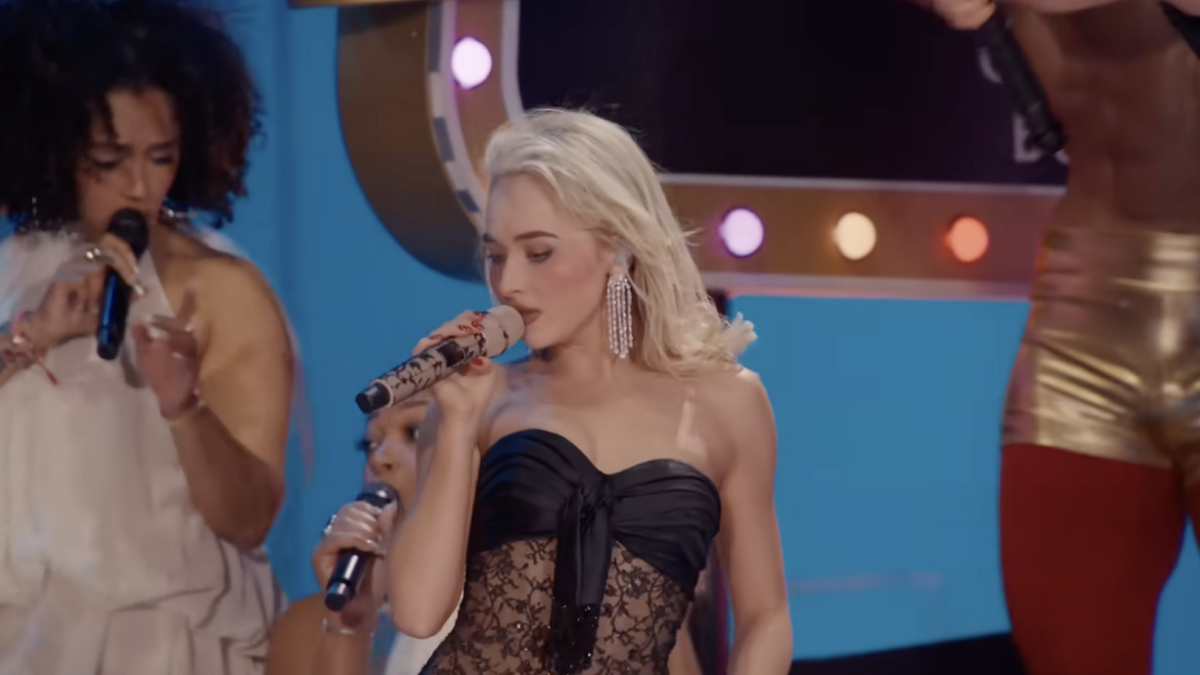
During her headlining set at Coachella, Carpenter delivered exactly the kind of polished, high-production performance modern pop demands. She first appeared with a vintage segment setting the scene with a police pullover and drive-in movie, soon to make her grand entrance by following a line of stars resembling the Hollywood Walk of Fame. Her setlist included choreographed numbers, celebrity cameos, and a carefully constructed aesthetic. None of that sparked controversy, even though her entire schtick is ironic promiscuity. What did instead was a brief, off-the-cuff exchange with a fan.
Mid-performance, seated at her piano, Carpenter heard a sound from the crowd she didn’t recognize. Reacting in real time, she said: “I think I heard someone yodel. Is that what you’re doing? I don’t like it.” A fan responded, “It’s my culture!” Carpenter asked, “That’s your culture, is yodeling?” The fan clarified, “It’s a call of celebration.” Carpenter then added, reacting like a normal human person, “Is this burning man? What’s going on? This is weird.”
The sound was later identified as “Zaghrouta.” According to Arab America, it is a “wavering, high-pitched vocal sound representing trills of joy.” The “lololololeeesh” sound, commonly used by Middle Eastern and North African women, “is produced by emitting a high pitched loud voice accompanied by a rapid back and forth movement of the tongue.”
In any normal setting, that would have been the end of it: a minor misunderstanding in a noisy, chaotic environment, quickly clarified and forgotten. But in 2026, America’s culture of digital hypersensitivity allows for no such moment to be contained. That part of Carpenter’s 90-minute show was clipped and spread online, stripped of context and tone. Quickly, it was reframed as something more serious. Accusations of insensitivity and racism followed across social media platforms.
Carpenter did what modern celebrities are trained to do. She apologized — promptly and publicly — explaining that she “couldn’t hear clearly,” that her reaction was “pure confusion, sarcasm and not ill intended.” She added that she had since learned what a Zaghrouta is. “I welcome all cheers and yodels from here on out,” Carpenter concluded in her social media post.
Her apology was casual and culturally conscious, considering how explosive the situation had become. But it also raises a more important question: Why apologize at all? Nothing about Carpenter’s reaction was malicious. It was confusion, expressed in real time, the exact kind of unscripted humanity audiences claim to want from live performers. By rushing to smooth it over, she reinforced the expectation that even harmless, fleeting misunderstandings require public atonement.
It says a lot about American culture that Sabrina Carpenter is comfortable telling the world how “f*cking horny” she is in her song “Juno,” yet rushes to repent as soon as the internet labels her as racially insensitive. The real consequence will not manifest in a hit to Carpenter’s career or Arab culture. Instead, we must watch how pop stars respond to the cultural lesson taught.
Live performances depend on spontaneity. The energy of the concert comes not just from the music, but from the unpredictable interplay between artists and the audience. Unscripted comments, improvised reactions, and moments that don’t go perfectly remind us of each other’s humanity. This makes live shows feel alive and worth the hundreds, if not thousands, of dollars spent on tickets.
Despite this, those are exactly the moments that now carry the greatest risk. When every offhand remark can be recorded, clipped, and judged by millions — many of whom were not there and are eager to interpret events through the least charitable lens — spontaneity stops looking like a strength. Suddenly, behaving like a normal person starts looking like a liability.
The rational response is obvious. Performers will start saying less. They will stick closer to the script, functioning more like musical robots instead of living, breathing people expressing a relatable sentiment through song. This will further exacerbate a lack of expressiveness in art and performance as artists will avoid engaging with anything they don’t immediately deem “brand safe.” The safest show is the one where nothing unexpected happens.
We’ve already seen this phenomenon play out beyond music. In Hollywood and even stand-up comedy, risk aversion has produced a wave of “safe” content — films that seem algorithmically assembled to avoid offense, and diversity quotas at award shows that ensure most competitive movies made ascribe to an accepted political ideology. As a result, the art becomes forgettable when it should, at times, provoke discomfort and critical thought. Live performance is now drifting toward that same sanitized middle ground.
The more hypersensitive the culture becomes, the less room there is for authentic interaction. To truly connect, we must embrace confusion, clarification, and, occasionally, getting it wrong.
There’s an irony here, especially at a place like Coachella, which prides itself on global diversity and cultural exchange. In that kind of environment, unfamiliar sounds like a Zaghrouta are inevitable. So are moments of misinterpretation. Human interaction requires discomfort.
If anything, Carpenter’s confusion accomplished something cultural gatekeeping rarely does: It introduced a wider audience to something they didn’t know before. Now it’s in the spotlight — but next time, performers may choose silence over the risk of getting it wrong.