
Editor’s note: This article contains references to graphic content.
Directly following a live event viewed by millions, the legacy media hurried to tell Americans what they actually saw, and even for a group of pundits known for tall tales, the historical revisionism they peddled in 24 hours is striking. Major outlets took Bad Bunny’s obviously political, sexualized, anti-conservative performance and made it out to be as “wholesome” as Richard Scarry’s Busy Town — literally — all in an effort to mislead and demoralize Americans hoping to see their country and their values given due deference on their favorite sport’s biggest platform.
‘Not Overtly Political’
In yet another episode of leftists’ “it didn’t happen, and it’s good that it does,” legacy media outlets explained that Bad Bunny’s show wasn’t really political. According to Rolling Stone, Bad Bunny (whose real name is Benito Antonio Martínez Ocasio) “was not overtly political, but he did send a message of unity as he paraded flags from all over Latin America.” People magazine asserted that he “steered clear of strong political statements.” The New York Times said that the messaging was “less political than some perhaps expected.” In fact, “For all the solemnity of the political moment, this performance is all about joy.” According to The Atlantic, those who anticipated a “divisive” show from Bad Bunny were “totally wrong.” In sum, don’t worry, politicization wasn’t really happening.
But for those who persisted in their belief that there was something political about the performance, the Times had an explanation: “Bad Bunny bringing the positivity feels political in this climate.” His “highroad political statement” was “unity,” nothing more and nothing less. The artist’s show simply “became a political flashpoint.” The man who made anti-ICE propaganda a focus of his Grammy awards speech and flippantly told 300 million Americans to go learn Spanish just stumbled into a political mess, like the 5-year-old who picks up a curse word at school.
It’s a shame really, according to the media, because Bad Bunny was really trying to send a “message of love and unity,” and everyone knows just how difficult messaging can be. After all, Bad Bunny had the words “THE ONLY THING MORE POWERFUL THAN HATE IS LOVE” displayed on a jumbotron, and the fact that this verbage was on a jumbotron should certainly have overcome the reality that, as Rolling Stone acknowledged, “it was some of the only English featured in the program.” The problem is the hearers, according to the media: “It’s a message the right has had trouble understanding.”
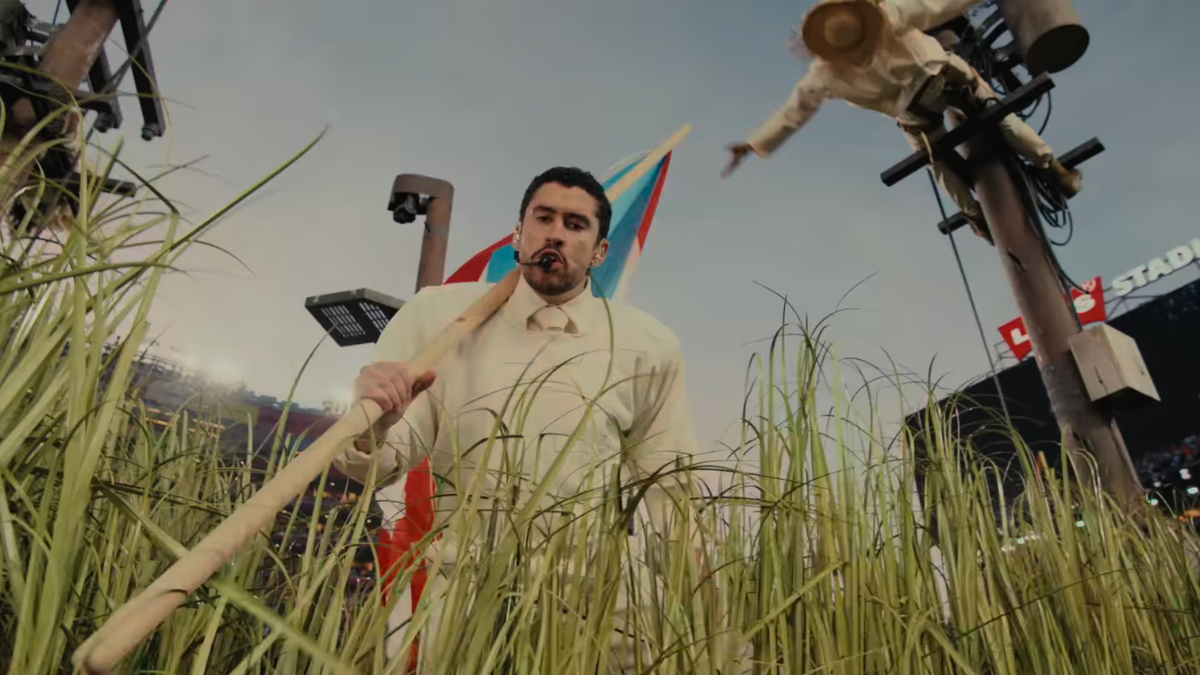
The above might seem like something of a flip-flop, but the whiplash fully sets in only when media outlets proceed to give fawning treatment of the political points Bad Bunny was in fact making. Rolling Stone schizophrenically provided a detailed analysis of the halftime show’s political messaging, exploring how individual songs served as a “direct rebuke to the U.S.” and it’s “oppression,” while others harped (ironically) on protecting Puerto Rico from “colonial exploitation,” racism, “gentrification,” overdevelopment, and the breakdown of its culture. In addition, the Puerto Rican banner Bad Bunny toted was tied to the territory’s independence movement, and, in one of his lyrics (not performed during the show), he says this flag — not the Starts and Stripes — is the one he wants draped over his coffin, the Times reminded readers.
On top of all that, the Rolling Stone noted that Bad Bunny delivered a “powerful rebuke” — yes, another — “to the exclusionary rhetoric coming from conservatives” and those worried about the destruction of American culture. The rebuke? Bad Bunny proclaimed that “America is much more than the United States” and Central and South American immigrants are absolutely essential. In other words, he “rebuked” the fuddy-duddies anxious to preserve American culture by telling them America would be entirely remade.
So it was actually political, but it was good that it was.
Just Like Sesame Street
Beyond the political angle, the media took great pains to report that Bad Bunny’s performance was completely “wholesome.” In fact, it was the pervasive “wholesome Latin culture” that “scandalize[d]” MAGA conservatives, according to the Daily Beast. (The pure insightfulness of this observation may throw some readers, so take a moment to let it sink in.) The Atlantic put it this way: “This performance’s wealth of gyration seemed subtly throw-backy and weirdly wholesome” (emphasis added). Why would that be the appropriate word? Well, The Atlantic has answer: “Maybe that was because the smiles on everyone’s faces conveyed sexiness without porniness.” If that seems unconvincing, recall that the journalistic class undergoes years of education and training to learn how to make these sorts of fine distinctions.
For those who are still unclear on how a show filled with sexualized dancing, perverse imagery, X-rated lyrics, and the promotion of promiscuity merits the description “wholesome,” perhaps The Washington Post can shine some light on the issue.
The Post notes that there was a real wedding during the performance, and another Super Bowl halftime show featured indecent exposure, so this one wasn’t really that bad. In fact, “It felt as if ‘Sesame Street’ had worked up a reggaeton remix of ‘People in Your Neighborhood’ or Richard Scarry’s ‘Busy Town’ had made room for dancers ready to get busy.” (Even Elmo was pushing the narrative, by the way.) Bad Bunny did exhibit “trademark grabs of his crotch … and inspired pelvic gyration,” and “dwerking” made it’s live-TV debut, but Ocasio’s TikTok shows are much worse. “And yes, the camera caught two men grinding from the waist up at one point, but Bad Bunny didn’t indulge his own penchant for gender play.” So take that, GOP prudes.
In fact, Kid Rock is the one everyone should pearl-clutching about, according to pundits like MS Now’s Joe Scarborough. Kid Rock has certainly written and sung lyrics that are profane and wicked (a category whose existence the left has a difficult time grappling with). But one of the lyrics Scarborough referenced is from a song (“Cowboy“) that Rock performed at Super Bowl XXXVIII — was Scarborough as incensed about it then? At that same halftime show, Rock sung “Bawitdaba,” the first number he performed at TPUSA’s All-American Halftime Show. Again, were media pundits as incensed about its vulgar references then as now?
Christians are right to take issue with the dissonance between “Bawitdaba” and the bold gospel message in Rock’s performance of “Til You Can’t” and ask how the former aligns with family friendliness, but the left’s media pundits don’t have a leg to stand on. The crude Kid Rock lyrics — including those about underaged girls — have been in the public square for years. Media’s “moral” criticisms, as usual, coincide with Rock’s alignment with the right, which exposes them as little more than a political attack — as is their stiff defense of Bad Bunny as “wholesome” and unifying and apolitical.
The political attacks are meant to confuse and demoralize conservative resistance to a political halftime show whose messaging targeted American culture and Christian values. As The Atlantic’s Spencer Kornhaber opined, the messaging was “conciliatory.” And by “conciliatory,” he presumably meant that it was “conciliatory” in the same way that an ultimatum is: Give up and give in, and we’ll get along quite nicely.