
It’s cannibalism.
The Southern Poverty Law Center is defending itself against criminal charges in federal court by admitting a bunch of things, but that’s not even the strangest development. Attacking the government’s case this week, the SPLC is attacking itself. They don’t appear to have noticed, but neither have the media.
The New York Times just covered this story straight, with no apparent ability to perceive irony, and see if you can guess where this is going from just the headline:
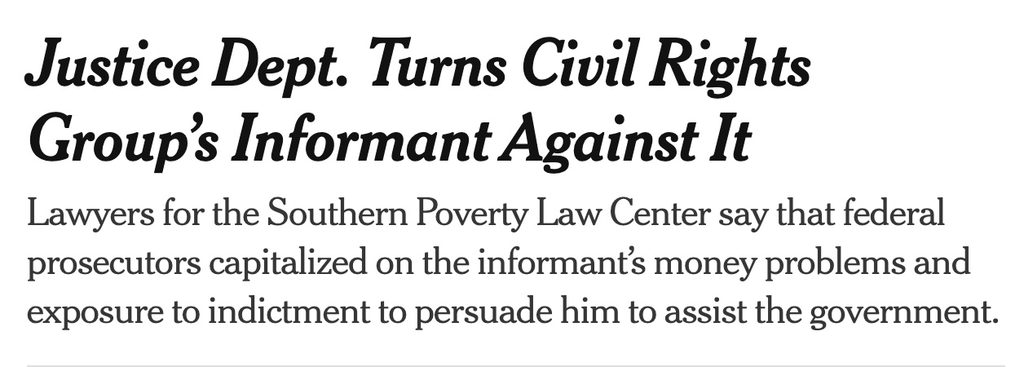
The SPLC’s lawyers, defending an organization that famously used paid informants for years to infiltrate targeted groups, are outraged that the government is using the SPLC’s informant as an informant, because informants are self-interested and deceitful, so using an informant is dirty. It’s like watching a snake eat its own tail. In a statement to the Times (that they repeated to CBS News), lawyers Abbe Lowell and Addy Schmitt said that the informant had “every incentive to tell the government what it wants to hear,” because he benefitted from his relationship with federal law enforcement. The use of informants is sleazy, say the lawyers defending the SPLC over its longtime use of informants.
Take a moment to really savor this: In a case that centers on the SPLC’s longtime use of paid informants, including the well-paid informant discussed in this defense brief, the SPLC’s lawyers just said that informants can’t be trusted. They specifically, explicitly, and repeatedly attack the credibility of a longtime SPLC informant, whose intelligence-gathering work inside a neo-Nazi organization sat at the center of the SPLC’s claims about American hate groups. If the government’s informant isn’t trustworthy, the SPLC itself can’t be trusted, because the government’s deceitful informant was the SPLC’s own major informant. You can’t attack one without hitting the other.
So lawyers hired to defend the SPLC are arguing in a public forum that SPLC informants are shifty and devious liars, and you shouldn’t believe a word they say. What an interesting moment.
The Federalist sent a series of questions to the SPLC’s defense team by email, and this is how that email message ended: “If his requests for payment discredit him, doesn’t that discredit the SPLC’s entire informant program? Did you mean to discredit your client?”
They haven’t responded, which has been the pattern as we’ve sent them questions throughout the life of the case.
But buckle in, because we’re just getting started. This is strange.
You can read the SPLC’s entire Oct. 28 brief here. As the writer and longtime SPLC observer Tyler O’Neil has noted about the defense filing, “The Southern Poverty Law Center just corroborated the basic claims in the fraud indictments against it,” starting with the fact that they’ve publicly corroborated that the government has the insider cooperation of a real SPLC informant. The very first paragraph of the defense brief tells you that the case against the SPLC is based on information from someone who had a long and deep relationship with the SPLC, and it tells you that his relationship with the organization also included a personal relationship that ran alongside the professional one and ended at the same time:
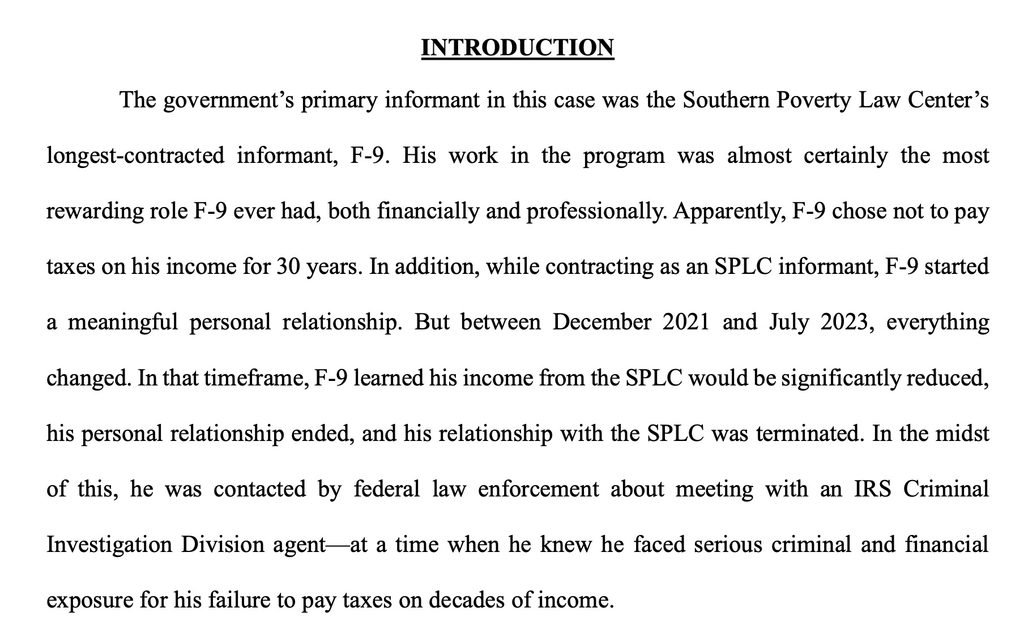
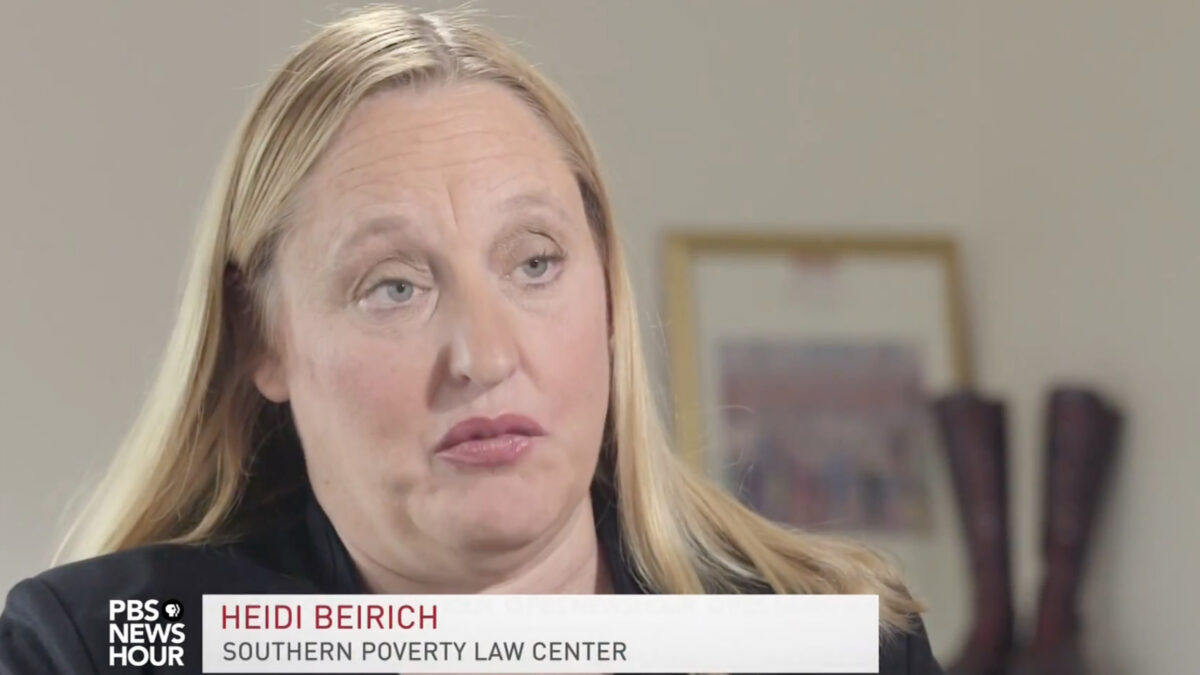
As the story in the New York Times notes, “his personal relationship” is an apparent reference to the informant’s “relationship he had maintained with the woman who ran the program, Heidi Beirich,” who is now a co-defendant in the criminal case. The government alleges that the SPLC paid an informant while the informant shared a bed and a bank account with the SPLC official who was paying him, and the defense argument appears to be … the same argument, phrased more vaguely.
The second paragraph gets even stranger.
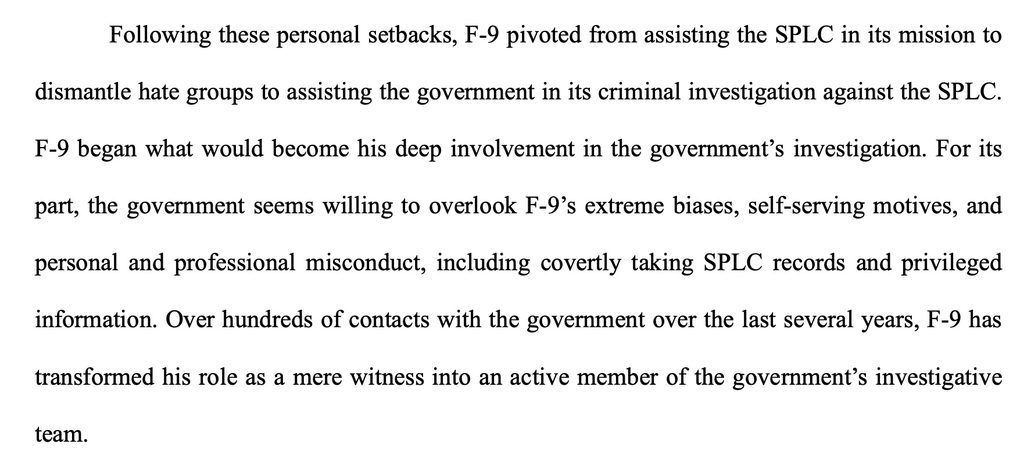
The claim is that the informant, identified in court as F-9, helpfully assisted the SPLC in its mission, which was very important and extremely virtuous. Also, the very same informant is described as someone whose work at providing information is colored by his “extreme biases, self-serving motives, and personal and professional misconduct,” including the fact that he took information and documents from inside the SPLC, which is wrong.
But this is exactly what he did for the SPLC. Here’s a sentence from the new CBS News report on this defense brief: “In the indictment, the government alleged that Beirich had a romantic relationship with F-9. Prosecutors described F-9 as an SPLC informant who infiltrated the Neo-Nazi group National Alliance and even once broke into its headquarters to steal documents.”
So the claim is that the informant’s behavior as an SPLC informant who stole documents on behalf of the SPLC is outrageously improper, because he took documents for the people who paid him to take documents. Do you have a headache yet? The guy who stole documents stole documents. The defense allegation is that the government’s witness from the SPLC’s informant program can’t be trusted because he’s engaged in the misconduct of providing information from inside an organization, and you can’t trust people who act like that.
It’s like the SPLC hired a team of lawyers to attack the SPLC: Our informant did wonderful work as an informant, but you can’t trust a word he says, because he’s an informant, and informants are very bad people who should never be believed. If F-9 exhibits “extreme biases, self-serving motives, and personal and professional misconduct,” then the SPLC uses liars and crooks as informants, and you can’t trust a word they’ve ever said. In soccer, this would be an own-goal.
Note also that the defense brief, saying explicitly that the government’s informant was “taking SPLC records and privileged information,” is again corroborating government claims. They just said in court that documents obtained by prosecutors through the informant are real, and that they actually came from the SPLC. This closes the door to challenging the authenticity of evidence that they’ve now described in a defense brief as “SPLC records.” That’s a confession dressed up as an attack.
Then we get to the first sentence of the third paragraph: “Starting in March 2022, F-9 began speaking to the team investigating the SPLC.” Led by the former Hunter Biden lawyer and Democrat fixer Abbe Lowell, the SPLC’s defense team has repeatedly framed the prosecution as a dirty Trump vendetta and a political hit. Then their own brief says that the investigation started during the Biden administration.
Finally, the SPLC’s defense team alleges that the informant appears to have an enormous cache of records about the organization that he hasn’t turned over to the government yet, so they demand he be subpoenaed for all of his records on their client.

They argue that the informant might be withholding exculpatory evidence, and that’s a fair argument. But if the informant has an enormous cache of insider material on the SPLC that he hasn’t disclosed yet, the other possibility is that the wholesale disclosure of those materials includes information that’s damaging to the SPLC, both in court and in the public sphere.
Think about being a lawyer for an organization that’s in legal trouble, and then learning that a longtime insider who has turned against the organization is privately hoarding a bunch of insider material, and then demanding that he stop holding it back.
The defense of the SPLC in court is becoming a threat to the reputation of the SPLC.
This story will be updated if we ever get a response from the SPLC’s defense team. Federal prosecutors have not yet responded in court to the SPLC’s new claims, and they have declined in the past to comment on an ongoing prosecution.