
A dangerous theory is taking hold that religious freedom applies only to the right to worship.
Illinois’ assisted suicide law took effect in September. Cardinal Blase Cupich and Bishop Thomas Paprocki have both sued to keep the state from compelling Catholic hospitals and doctors to take part. A group of Muslim doctors similarly have sought protection from the state mandate. The state has yielded temporarily. In July, a federal judge shielded the Little Sisters of the Poor from New York’s version. The message from the state in each case is the same: you may care for the dying, but you must also be ready to help kill them.
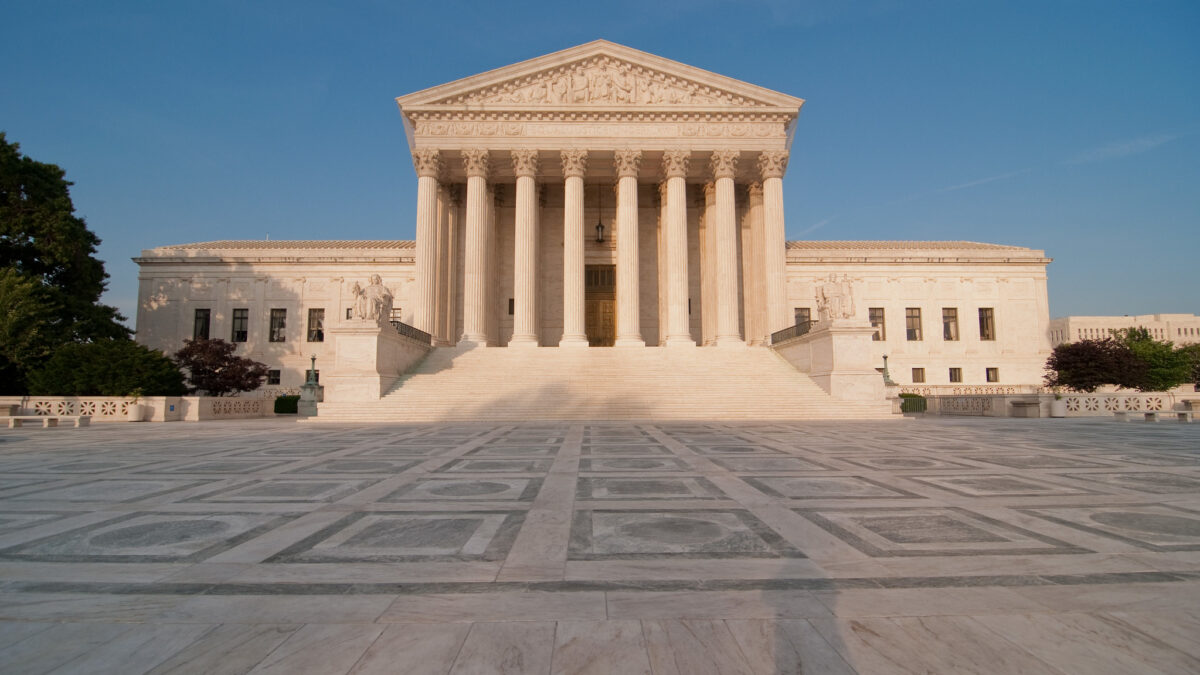
The Supreme Court will hear oral argument on Nov. 3 in St. Mary Catholic Parish v. Roy. Colorado’s universal preschool program requires participating schools to agree to operate at odds with Catholic teaching on marriage and sexuality. Parishes in the archdiocese of Denver could not agree to state requirements, so the state shut them out of the preschool program paying $6,000 per eligible child, along with the families who wanted their children taught there. Colorado says it has no problem with the preschools being Catholic, it just doesn’t want them to operate as if they are.
Catholicism is just one example of a religion whose exercise does not end at the sanctuary door. Catholics pray at Mass and live that prayer in the works of mercy: feeding the hungry, sheltering the homeless, visiting the sick, burying the dead, and instructing the ignorant. Faith asks to be lived coherently, in belief and in service to one another. Jews, Muslims, and Protestants would recognize the pattern in their own traditions. No one is free if he must split himself into a Sunday self and a Monday self, and no community is free that must do the same.
The trouble is the left’s drive to secularize everything, and it does not stop at who gets access to the public square. It demands secularization of religion itself, and of religious people. The nuns may care for the elderly and infirm, but they should also be willing to assist in their suicide. The Catholic preschool may teach four-year-olds, but it must “get with the times” on sex and gender. Charity is welcome so long as religion is nowhere near it. That is not neutrality. It is hostility.
Scalia’s Views
New work from Donald Drakeman of Notre Dame may inadvertently offer an additional false argument from the secular left. While he hasn’t mentioned these current controversies in commentary previewing a new book, his theory would decide them. He argues that new archives show the founding-era understanding of “free exercise of religion” was limited to public worship services. With that theory, the Constitution protects the nun kneeling in a chapel during Mass but says nothing about the same nun at a dying patient’s bedside. Faith is a Sunday event. The rest of the week belongs to the state. That is a dangerous theory, and religious Americans and faith-based institutions should recognize it for what it is: an easy path toward muzzling them.
Justice Antonin Scalia, whom Drakeman invokes, did not read the clause so narrowly. Dissenting in Locke v. Davey, he would have held that Washington state could not deny a scholarship to a student because he chose to study theology, which is to say he treated the study of theology as religious exercise. He also joined the unanimous Hosanna-Tabor opinion interpreting the religion clauses as protecting a church’s choice of ministers. Neither case involved a worship service. In Employment Division v. Smith, Scalia wrote that the exercise of religion often involves not just belief but physical acts, and he listed assembling for worship, proselytizing, and abstaining from certain foods. He never confined the clause to the sanctuary. His argument was about accommodations, not whether religious exercise reaches beyond worship.
Worship is the easiest thing to shut down, which is why government hostility often shows up there first.
The History of Free Exercise
Stanford’s Michael McConnell, the preeminent originalist voice for robust religious exemptions, has yet to weigh in publicly on these new archival findings. Nevertheless, his vast body of work stands as the natural intellectual fortress against any attempt to shrink the free exercise clause to the sanctuary door.
His 1998 article on the history of free exercise, for example, supports the view that the founding generation understood the right to reach conduct, not just worship. New York’s 1777 constitution, like others of the era, protected religious liberty, but carved out acts of “licentiousness” and “practices inconsistent with the peace or safety” of the state, a caveat that would have been pointless if the right ended at the church door. James Madison’s “Memorial and Remonstrance Against Religious Assessments” goes further, calling each person’s duty to the Creator “precedent, both in order of time and in degree of obligation, to the claims of Civil Society.”
A faith that may be freely exercised only within the church is a faith the state has already succeeded in controlling. The nun at the bedside and the families hoping to send their children to their parish preschool are not asking for special favors. They are asking the courts for the constitutional protection to exercise their faith fully and freely.