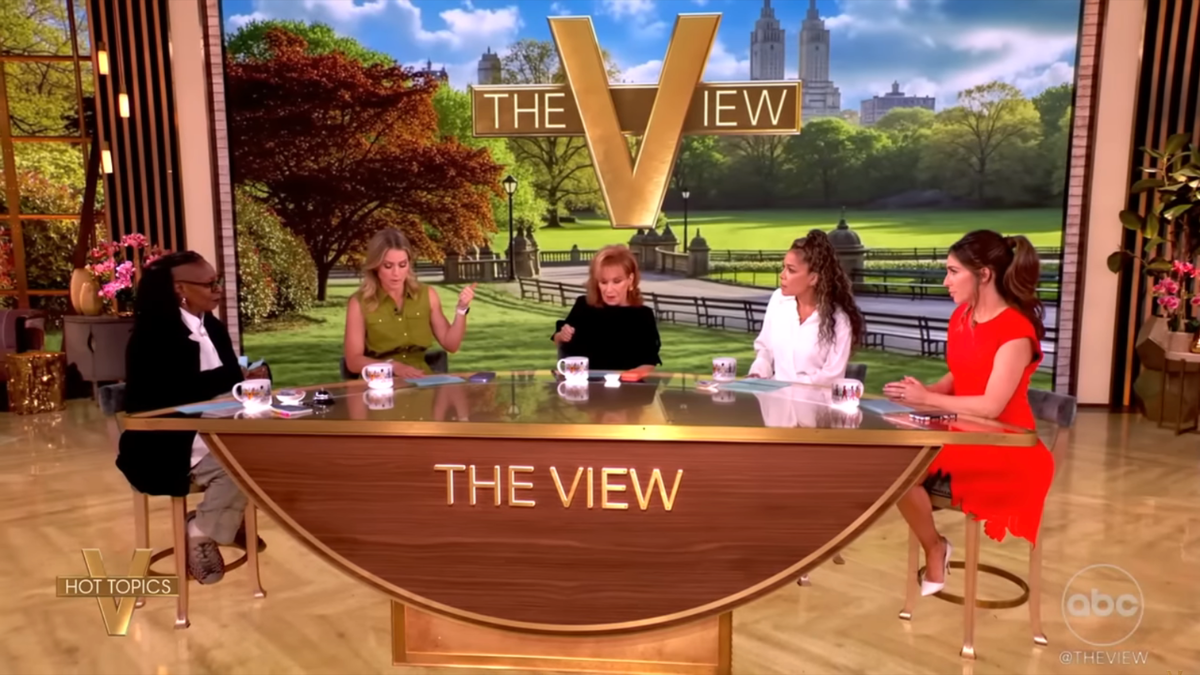

Disney and ABC walked into a federal courthouse in Washington on Tuesday and asked a judge to save them from the Trump administration. The network’s 45-page complaint accuses the FCC of running a “retaliatory campaign” against ABC for broadcasting content the White House dislikes.
In a separate FCC docket, Disney lawyers have spent months arguing that a panel show anchored by Joy Behar and Whoopi Goldberg is functionally indistinguishable from Meet the Press. Both arguments cannot be entirely true at once, and after a decade testifying on fiduciary duty and evidentiary standards, I have developed an ear for a witness who wants the jury to believe two contradictory stories depending on which room they are standing in.
That is the real story buried under Tuesday’s headlines. The View, for anyone who has never watched it, is an ABC daytime opinion and entertainment program, a politically left-wing panel where celebrity guests, cultural chatter, and news headlines all run through the co-hosts’ strongly held personal views. There is nothing illegal about that.
Yes, government leaning on a broadcaster’s license because it dislikes the coverage should worry every American who still owns a copy of the Constitution. But ABC’s own legal position, that this program is simultaneously a target of unconstitutional persecution and a neutral bona fide news program, does not survive first contact with its own guest list.
Start with what actually happened. In April, FCC Chairman Brendan Carr ordered early license renewal reviews for Disney’s eight “owned-and-operated” ABC stations, in markets from Los Angeles to New York, years ahead of their normal 2028 through 2031 schedule, the first time in more than 50 years the agency had done that.
The timing followed a dust-up over Jimmy Kimmel saying Melania Trump “had a glow like an expectant widow,” and it landed on top of an existing FCC probe into Disney’s diversity, equity, and inclusion practices. ABC’s lawsuit, filed before U.S. District Judge Loren AliKhan, asks for a temporary restraining order and argues the administration waged a retaliatory campaign against ABC for disapproving what it broadcasts. Commissioner Anna Gomez, the lone Democrat on the FCC, publicly cheered the lawsuit, calling the renewal process a “campaign of censorship and control.”
Separately, and this is the part most coverage buries, the FCC has spent months examining whether the show is still eligible for the “bona fide news interview” exemption to the equal time rule, a Section 315 provision that forces a station to give rival candidates equal airtime once it lets one candidate on the air. The Media Bureau put broadcasters on notice in January that segments “motivated by partisan purposes” do not get the exemption. ABC insists the show operates just like network Sunday shows, resting on a 2002 FCC letter that has remained untouched for close to a quarter century.
Congress built the “bona fide news” exemption in 1959 so no station hosting one candidate would owe every rival equal minutes, which would have turned local news into a scheduling nightmare and discouraged campaign coverage altogether. Lawmakers carved out four categories — newscasts, news interviews, documentaries where a candidate’s appearance is incidental, and live coverage of events like debates, trusting a broadcaster’s good-faith editorial judgment over government second-guessing. That theory holds only if the programming is doing journalism rather than advocacy with a rotating cast of interviewers, and the guest ledger below makes that call easy.
Here is where the expert witness in me leans forward. If you are going to ask a federal judge to treat you as a martyr for independent journalism, you should probably not also ask a federal agency to treat your panel show as a hard news broadcast while it tells viewers to “vote Democrat” in the next election, which is exactly what co-host Ana Navarro told her audience on air this year.
A NewsBusters count of the show’s full 29th season, running from last September through July, found 87 guests expressing a liberal opinion against 5 conservative ones, a split of roughly 95 percent to 5 percent. The prior full calendar year was worse at 128 to 2, better than 98 percent one-sided, and one of the two conservative bookings only occurred because Marjorie Taylor Greene was feuding with her own party’s leadership that week.
That is not a rounding error. It is a programming decision, repeated for years, by a staff that knows exactly what it is doing. Meet the Press does not have that problem, because it functions as a news interview program rather than a daytime rally with commercial breaks.
None of that makes the FCC’s conduct defensible. I am a card-carrying skeptic of government power, and a president musing publicly about pulling a license because its comedians are mean to him is exactly the content-based leverage that should make conservatives nervous, not gleeful. Justice Antonin Scalia spent a career reminding us the First Amendment protects speech we hate as fiercely as speech we love, and a broadcast license is not a leash the White House gets to yank whenever a punchline stings.
If the FCC can find a viewpoint-neutral basis for accelerated review, tied to the DEI investigation rather than the jokes, let it make that case on the merits. If it cannot separate the two, it should lose.
But conservatives do not have to pick a side between “the FCC is right” and “ABC is the victim here.” Both institutions can be behaving badly at once. Government should not weaponize licensing against disfavored speech, and a network dressing up a partisan talk show as neutral journalism to dodge a fairness rule is also misleading the public, just with better lawyers and worse math.
Justice Louis Brandeis had the right prescription more than a century ago: sunlight is the best disinfectant. Publish the guest logs. Publish the FCC’s actual legal theory for a renewal that was not due for two more years. Let both records speak, because each side is betting the public will only read the press release its own side wrote.
The View was created to showcase women of “different generations, backgrounds, and views,” according to its own founding premise. Somewhere between Barbara Walters and Ana Navarro, the “different views” part fell off entirely, which is the network’s prerogative under the First Amendment and also the reason its equal time petition deserves the skepticism it is demanding for its own claim.
A program booking political guests at a 95-5 ratio is not a discussion; it is a caucus meeting with better lighting. Free speech protects ABC’s right to run an all-left-wing panel every weekday morning. It does not entitle ABC to call that panel a news program when convenient and a protected editorial product when it is not. Pick a lane. The rest of us are trying to drive.